Further info and resources from my website

Showing posts with label politics. Show all posts

Saturday, April 13, 2019

Fighting political corruption - Brazil vs France

PARIS

I recently came back from one of my regular stays in my home away from home in Brazil. On the very day that I arrived in Rio de Janeiro there was only one headline news topic: Former president Michel Temer had been arrested on corruption charges. (During my last stay in December my Copacabana neighborhood only gossiped about another fallen leader, former Renault-Nissan head Carlos Ghosn, whose swanky Nissan-owned penthouses, just a couple of blocks away from mine, was being searched and confiscated.)

I couldn't help compare the situation in Brazil with the one I left behind me in France.
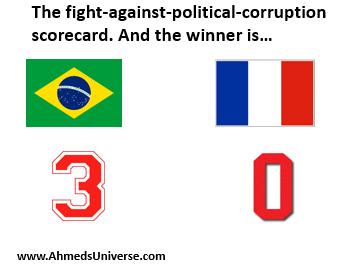
As the below diagram shows, Brazil isn't shy about firing its leaders or putting them behind bars when caught rend-handed. There is little doubt that there is more corruption in Brazil than in France but then why is there more tolerance in France? Back in 2011 I wrote a blog post denouncing France's Real crimes, Fake justice when former President Chirac was condemned to 2 years in jail but...never set foot in one!

Like Lagarde, Juppé was rewarded for committing crimes: President Macron just nominated him
to the highest court in the land, the Constitutional Court. Yes, your eyes aren't playing tricks on you:
he who is going to ensure people uphold the country's top law is himself a convicted felon. 


Could it be that this old, wealthy "democracy"'s political system is so rotten at the core and despises its citizens to such an extent that it doesn't even pretend to have a clean justice system? I am more and more inclined to think along those lines based on facts such as those summarized below. Actually, if you wonder why I put "democracy" between quotation marks it is because i stopped  a long time ago to believe in representative democracy and, 7 years before the Yellow Vests movement took France by storm calling, among other things, for direct democracy I advocated the exact same thing in my blog post on DirDem vs RepDem as I called the old and new political system.

The lesson one can draw from this situation is that, contrary to appearances, a young, chaotic, developing country such as Brazil can teach those most established so-called democracies a lot. It always makes me laugh to hear "First" World leaders pontificate and give advice to their "Third" World counterparts, oblivious to the Biblical injunction that before seeing the mote in others' eyes, they should remove the beam in their own eyes.


(Other blog posts exposing the shortcomings of the French political system include, in addition to the ones mentioned above, the following:
- October, 2018: The Increasingly Undemocratic French Constitution
- May 2017: Thoughts on the French presidential election
-May 2012: Good riddance, Sarkozy!)

Sunday, October 7, 2018

The French Constitution at age 60: Sadly, increasingly undemocratic

PARIS 
The scary situation where 30% of the people's
will has been cancelled by politicians
French presidents have only three objectives they relentless pursue from the moment they are sworn in, to the moment they leave office :

- Leave at least an imposing monument for generations to come to remind them by;
- Have a celebrity be (re)buried in the Pantheon (even if against their wishes);
- Change the Constitution.

Current President Macron wasted no time to have a Pantheon burial (Simone Veil) and is busy leaving his mark on the Constitution (I cringe at the thought of what architectural eyesore he will bequeath us when he lives office in 2022 - I hereby  predict that like his two direct predecessors he will fail to be reelected.)*

Of course, the preferred way for politicians to change the Constitution is to do it themselves - and among themselves -  feeling that the nation's basic law is too important to be left to citizens to make a decision. And yet it was those same citizens (or at least their parents and grandparents) who approved it when the 5th Republic was introduced exactly 60 years ago. A basic democratic principle is that what the people have decided can only be changed by the people. Not in undemocratic France (and other mock democracies, by the way) where politicians confiscate the people's right to decide on the law of laws.

One thing I learned when I went to law school is referred to as the hierarchy of norms whereby a decision at a lower level must comply with a decision from a higher rung in the legal hierarchy. The rationale being that the farther away a decision-maker is from the sovereign people the lower in the legal hierarchy the decision is. Thus, from the lowest rungs to the highest we'll have the following:

- a cabinet minister's decision (usually known as a decree) has to comply with the law, because a minister is appointed whereas a law is made by Parliament which is elected (in other words, lawmakers are just one degree removed from the people whereas government ministers are two degrees away from the people.)

- Members of Parliament can only pass laws that comply with the Constitution, because lawmakers (known as deputies in France) are only the representatives of the people (of course most politicians believe and behave as if they were the people's masters, not their servants.) 

- The Constitution is therefore the highest law in the land since it has been voted on directly by the people themselves. Sadly, the basic democratic tenet that what the people have decided can only be changed by them directly in a referendum has been slowly but steadily eroded in the last 60 years with politicians deciding on BOTH laws and the Constitution.

It is therefore a travesty of democracy that those who pass laws are supposed to comply with the Constitution when they can change the latter at will. What's the point in having a Constitution then? Just say that politicians are all powerful and can decide on what they want when they want. Not markedly different from the Ancien Régime.


The shrinking democratic credentials of the French Constitution


In the 1960s there were only two changes to the Constitution: one was made in a referendum (it dealt with the way the president should be elected), but for the other one, Parliament decided they would handle it. The 1970s and 1990s saw more than 10% of the Constitution articles amended: not a single one with the people's vote. The 2000s saw this democratic deficit reach new heights: 9 changes, only 1 referendum. Particularly scandalous was the EU-inspired Lisbon Treaty which was rejected by French citizens in a  referendum. What was the President's reaction? Sarkozy ignored the people's will and had the shamefully supine French Parliament rubber-stamp his decision in a 2008 Constitutional amendment. **

If Macron has his way, another 10% of the Constitution will be changed and considering his low approval ratings he is not going to risk a referendum. We will then reach the worrying situation where  30% of the people's vote has been cancelled by politicians.

Let us hope that either opposition politicians (in the case of a Parliamentary vote) or the people (in the case of a referendum) defeat Macron and stop this undemocratic spiral. A Constitution is the paramount social contract, it is the basic pact that binds society together. As such it cannot be amended on a regular basis (the way laws are) and can only be done by the people themselves.

French presidents should heed other countries with similar political systems, such as Spain and the US. The former celebrates this year the 40th anniversary of its Constitution which has been left largely unchanged since 1978. As for the US, it has amended its 250-year-old Constitution fewer times than France has in only 60 years. That tells you that there is something deeply wrong with the French political system.

LEAVE LADY CONSTITUTION ALONE! She is a respectable lady who doesn't need to have more scars inflicted on her by shameless, self-serving politicians


*It is noteworthy that the last two presidents left in disgrace failing to get a second term. The last but one, Nicolas Sarkozy, failed to get reelected, and the last one, François Hollande, having to live the  unprecedented ignominy of not even being able to run due to his abysmal approval ratings, themselves due to his disastrous record.

**I have more respect for British politicians who, although they were against Brexit, once British voters made their decision in a non-binding referendum, they decided to abide by what the people have decided. In France, politicians despise voters and don't even hide it.

The blogger has written several posts on the French political system: 

-April 2017: "The French presidential election: Going  blank"
-May 2012: "Good riddance, Sarkozy!"
-Dec. 2011: "Real crime, fake justice: Chirac gets 2-year suspended jail sentence"
-June 2010: "Sarkozy, la France c'est moi!"
-March 2010: " Obama and Sarkozy: A Tale of Two Presidencies"

Thursday, May 4, 2017

The French presidential election: Going blank

PARIS
Facing off for the top prize
So, here we are, just a few days' away from the runoff election that will decide who will be the most powerful man in the Western world. Yes, I mean it: the French president has more powers than his American counterpart who has to deal with Congress, a more often-than-not independent judiciary and a highly decentralized country where most decisions affecting people's lives are made by mayors or governors rather than by the Federal government. And other European leaders tend to be heads of government, sharing power with a head of state (elected or hereditary, depending on the case). As one of the major candidates reminded the nation in his campaign (see below), we live under a presidential monarchic who, apart from being elected, maintains most of the power and trappings of the "kings who built France," as the phrase goes (Les rois qui ont fait la France).

And, for once, the finalists are as different as can be, with two radically different views of what ails France and how the country should be run. After many decades of pretending otherwise, voters have finally realized that there is no difference between the mainstream parties and gave the Socialists and their partner-in-crime the Gaullists what Churchill called "the order of the boot". Something I have been calling for in as far back as 2011, when I wrote in a post subtitled "Democracy 2.0" that throughout the Western world whether you pick Party A or Party B makes no difference. They are just the two faces of the same coin, the establishment party. Or, to quote my beloved Gore Vidal, they are just the two wings of the single party.

Let me give you my two cents on the four candidates who made this campaign by being within a whisker of each other in both polls and actual election results, before I share with you my vote - and why.

François Fillon, a.k.a The Crook, had what was  undoubtedly the best program, and it certainly wasn't the most popular one as it offered the French some belt-tightening ahead. The only issue with it, were actually two, both related to how credible its plan is: First, when Fillon was in charge for five years, why didn't he implement  it? What guarantees do we have that once in charge he will deliver on his promises? Remember that when a private business makes false claims on its products, it can be penalized and fined; not so with politicians, who can promise you the moon and the stars and, once elected, do the opposite and still keep their seat. Second, the little credibility Fillon had disappeared with the financial scandal he got engulfed in. French voters can tell a liar and crook when they see one, and rewarded his campaign with the dubious distinction of  being the one which, in a 60-year period of time, managed to get a Conservative candidate disqualified for the runoff. If there is a dustbin of history for politicians, Fillon is heading straight for it.

The Gang of Four that made history


Marine Le Pen, a.k.a. The Loony or The Fruitcake (have your pick), has the silliest of all manifestos, basically based on hatred: of Arabs, Muslims, immigrants, Europe, the euro. Anything that can be offered to the people's anger as the source of their miseries, you'll find it in Ms Le Pen's bag. French politicians have been doing this for centuries: It used to be the Jews (in the Middle Ages) and Huguenots (in the 16th and 17th centuries). Nihil novi sub sole, as ancient Romans used to say (in their times, Christians were the scapegoats - food for thought.) Her success resides only on two facts: Her denunciation of the elite's abject failure in running the country (which hardly anybody can dispute) and that, having never been elected to office, she can claim the benefit of the doubt. Apart from that, her program of Fortress France does not make any sense at all.

Jean-Luc Mélenchon, a.k.a. The Commie (or Bolshie.) His sharp tongue, quick wit, consistent philosophy, grasp of details, brilliant, inventive campaign (those videos, holograms and the cruise on the Ile-de-France canals!) made him my favorite. He is the only one of all candidates, who realized that the corrupt leaders we got and their ineffective policies couldn't be separated from the sick political system we have. I fully agree with his calls for revamped political institutions, which he calls the 6th Republic, and many of its tenets such as the ability to recall all politicians. Is it normal that we  have to put up with a deeply unpopular and incompetent president as Hollande for so long? Is it normal that neither you and  I can decide on our compensation or rules governing most of our career, but politicians can? Is it normal that when we commit a felony or crime we go to court (and jail if found guilty) like everybody else, but not politicians who have their own court (Cour de justice de la  République) who rarely finds politicians guilty: and small wonder - its membership is largely made up of...fellow politicians! And even when they do find them guilty, they make the bizarre ruling that no punishment should be meted as we saw with the recent Christine Lagarde trial. Mélenchon is right to say that the system is rotten at the core and propose to do something about it, beyond the mere superficial slaps on the wrist for wayward politicians. I also fully support his call to move to real environmentally friendly policies, not the vague lip service most other politicians adopt.

However, on the economic front, I deeply disagree with Mélenchon. We already have the highest tax burden of the developed group of nations. If that could have translated in higher growth and more employment, we would have seen it. And I feel very uncomfortable with his anti-"rich" rhetoric. What is wrong with being rich, if you've earned it through your hard work - or inherited it? Unless the rich have gotten there through fraud and murder, confiscating their wealth strikes me as deeply unfair and demotivating for society at large.

Emmanuel Macron, a.k.a The Dapper (or the Charmer). Let's give credit where credit is due: His is the most amazing political career France has ever seen, and few countries can boast a novice with no experience of running a campaign, no party, no funds, coming from nowhere and about to win the ultimate prize. For sheer audacity, vision, and management skill, one has to acknowledge his amazing talents and wonder what he could do for the country if he continued to evince the same skills once in office. For a while, he was my favorite. Even when I couldn't completely shake off a feeling that he may just be a manipulator, who saw an opportunity and seized it. (Even then, still a brilliant one.) However, as  I shared several times with my old friend, C.T.H., a member of his campaign team, as soon as Macron put meat on the bone of his program, that's when he lost me. Freeing 80% of French households of the Taxe d'habitation (a kind of property tax) is typical of the worst of the French political-administrative establishment. First of all, that's a local tax, so what is he doing, apart from being generous with other people's money? And then, the lucky ones aren't exactly exempt from this tax, it's the central government that pays it to cities and towns on  their behalf, but should the rate go up, then you will still be liable for it. Again, what's the point  of putting in place such a complicated scheme when the objective, increasing people's purchasing power, could be done via levers the central government controls such as VAT, income rebates or credits. A bad idea, to be jettisoned immediately, as the idea to increase the CSG-based social security taxes, another tax created in the 1990s: then with a 1.1% rate, it currently stands at 15;5% and he wants to increase it? Wasn't he supposed to be a liberal (in the European sense?) As for his non-reform of the net-worth tax (ISF), it is absurd to remove most assets from it, except the one that affects most people who don't make money out of it: homeowners.

Worse, unlike Mélenchon, he seems to be very happy to keep the political system as it  is. Maybe just tinker a little bit here and there ("moralisation de la vie publique"), but over all, let's not rock the boat. Which rekindles my suspicion that Macron may just be all PR and marketing, all fluff, with some Conservative economic policies, some left-wing social policies,  all repackaged by a nice smile and endearing family life. But still a politician bent on grabbing power. And his will to rule by decree is alarming - this is the "presidential monarch" Mélenchon is right to denounce.

Le protest vote
Based on this, I just can't bring myself to vote for Macron. And I won't cast a negative vote: voting for him, to block the Loony. Since neither of the two has managed to convince me, then I'm voting blank. I do hope that Macron will prove my concerns wrong, and manage to fix some of the country's most serious issues. If  he does, then in five years' time, I will be more than glad to vote for him. As for Blondie, I do hope that they commit her either to an institution or behind bars: either way we'll be free of that nightmare. Until 2022 when, should Macron fail, then the National Front could finally grab the elusive prize it has been after for several decades. After all, that's a French political tradition: Fight long enough, and you end up in the Elysée Palace.


Sunday, November 15, 2015

Terror strikes my hometown and neighborhood - AGAIN

PARIS
My second city's tribute to my
hometown
To paraphrase Oscar Wilde, for a global city to be hit by a terror attack once a year can be considered a misfortune; to be hit twice smacks of gross negligence. Add to that that my neighborhood is the only one with the dubious honor of having been targeted twice makes me wonder if time hasn't come for me to move permanently to my second home, Rio de Janeiro. Now, that would be the mother of all ironies: seeking refuge from terror in a city well-known for random violence.

But we live in troubled times where what made sense for so long suddenly doesn't. Here is a short summary of the last 48 hours.

As (bad) luck would have it, as in the dreadful events last January (which I recounted in this post ) I was at home on Friday evening, relaxing from a long week of SAP-to-Workday workshops at French pharma giant Sanofi, when I heard the ear-splitting sound of sirens. At the beginning I didn't pay much attention, but after a while it suddenly hit me that the blaring sirens had been going at it for a good fifteen minutes. A quick look at the city skyline didn't reveal any Neronian fire. An accident, maybe? Then the ominous alternative crept into my mind: another attack?

I grabbed the TV remote control and tuned into one of the 24-hour French channels. My hunch was confirmed: another series of terror attacks have hit my hometown with my neighborhood once again targeted.(Dear Mr. Terrorist, I don't mind your being bloodthirsty. But do you also have to be unfair? Would you mind spreading the victim share among all Paris districts? Next time, could you try Montorgueuil?  Or the 16th arrondissement? Why not cross the Seine and have fun in the Left Bank?)

Since the action was taking place just a few blocks away from my place, I grabbed my coat and ran out. It was around 11 pm. By then I had already received some text/Whatsapp messages from friends and family who, when apprised of my intention to go to the Bataclan concert hall, tried to dissuade me. But there was no way I was going to experience the events vicariously on a small screen when I could witness them live.

The next few hours will probably never be erased from my memory. In the cold fall night I stood and watched as the elite security squads forced their way in using their guns in deafening noise, soon to be followed by explosions as the terrorists blew themselves up. Then the sad sight of bodies being retrieved. My phone battery died but I managed to shoot (no pun intended) a couple of videos and take some pictures. I'll never forget the distraught young man whose two brothers were inside the Bataclan (where I had been many times for some popular parties) and who tried to go in but was restrained by the cops (I later heard they had both died).


Few people managed to sleep that night in the neighborhood, or in the city. The next morning I woke up early and went back to see the remains of the carnage: the sad pair of shoes of a concert goer who never suspected that his Friday fun would put an end to his life. Still-fresh blood on the pavement was a reminder of the horror that took place just a few hours ago.
Apologies for the gory details but sometimes you need to
face reality head-on

People were too shocked to engage in meaningful and rational discourse. But some questions were being asked and the government's official version challenged:

- Some claimed that many who died didn't die at the hands of the attackers but as side effect of the police action - collateral damage, they'd call it in the US (but the supine press won't tell you about it.)
- Also, how come that for the second time in a year, and even more spectacularly, terrorists were allowed to operate freely in France?
-Was this timed for the the looming key regional election where the incompetent government headed by the Clown-in-Chief; François Hollande, is expected to suffer a big defeat? (I watched him on TV and his incompetence was eerily reminiscent of Gerge W. Bush as captured in Fahrenheit 9/11: both "leaders" showing they were not up to the task)
- Should France continue to target IS (Islamic State - not Information Systems) in Syria, if IS can retaliate so easily and spectacularly in France?

A victim's scattered sad belongings:
A testimony to the horror  that took place a couple of hours ago


The media vultures were all over the place and I was flabbergasted to see their reporters interviewing basically anybody who walked up to them and served them any cock-and-bull story. A Spanish anchorwoman basically bought lock, stock and barrel what was clearly the rants of an old woman who kept on referring to the Second World War. Other reporters fed their audience the asinine comments that all of us will later lap up while watching TV. A wise neighbor told me, "The only group who knows less than reporters is the government: and the little they know, they are not telling us." Couldn't disagree with him, since the entire French political class has lost the last shreds of respect from the citizenry. They can't fix the environment, but spend billions organizing a useless COP21 jamboree whose only function is to serve as a political marketing ploy for the government (regional elections were undemocratically pushed back to help the moron masquerading as French president win a few votes with the event's reflected glory). They can't fix the economy, nor unemployment now at record levels, and even less immigration. At least we thought they could keep us safe but, as this year's events are proving, the political class is also proving to be an abject failure at security. So, why are we putting up with them much longer? Shouldn't such low performers have been discarded long ago? Beats me.

In moments like these, scared people give the impression of rallying behind the "leader" who has no idea in what direction to lead us. But deep down inside of them, most know it is hopeless.


Last night, I took the metro around 10 pm and was deeply shocked to find it empty. I was born here and have never seen an empty metro on a Saturday night. The streets were equally empty, reminding me of that Friday in the early 90s when I was living in New York City and we were told at noon to go home because of the fear the Rodney King riots from Los Angeles would spill over in Manhattan. Last night in Paris I was eerily reminded of that distant Friday when I walked from the UN building towards Grand Central Station and the greatest city on earth was deserted in anticipation of possible mayhem. But in ghost-town Paris disaster had already struck. And will strike again. No solution is in sight.

Poor Paris.

Poor France.

(Except for the Christ the Redeemer picture, all photos and videos by the blogger)

UPDATE: Nov. 26, 2015. A week ago, while browsing through press accounts I stumbled on the name of a victim ("Djamila Houd") and her place of origin (Dreux, South west of Paris). I immediately emailed Tassadit Houd, one of my oldest friends, who is from Dreux, asking her whether she was a relative. I was getting worried when I couldn't get through to Tassadit and today I finally heard from her: Djamila was indeed a relative. Her own sister! She and her family are devastated. It took them 10 days before they got to bury her. Djamila was having a quiet dinner at the sidewalk restaurant La Belle Equipe (belonging to her husband, Gregory) when she was shot twice in the back. Here's the account by the local paper. In the family picture at the funeral my friend Claire Tassadit is the second from the right. Another press report quotes my dear friend Tassadit's tribute to her sister.


IN MEMORIAM
Djamila Houd, a Muslim victim of Islamist terrorists.

She leaves behind a husband and an 8-year-old girl who
will become a "Ward of the Nation"

Sunday, June 15, 2014

Curse of Spanish Monarchs: Never to die on the throne

BARCELONA  

It was from this rebellious and republican city that, two weeks ago, I heard the momentous news. I had just landed at Barcelona's splendid airport (the only one I know that boasts an outdoor section in the transit area, thus allowing you to breathe fresh air and bask in the  sun) and hailed a taxi to take me to my hotel. I had barely sat in the back seat when the taxi driver asked me, "¿Qué le parece?" (What do you think?)


"¿Qué me parece qué?" (What do I think about what?) I asked.
"La abdicación." (The abdication) was the curt answer.
"La abdicación, ¿de quién?" (Whose abdication?)
"Pues, ¡del Rey!" (Well, the King’s) the taxi driver replied before turning on the radio.

I was stunned. As I explained in my blog post "My 20-year affair with Spain" I have known only one Spanish monarch, Juan Carlos, and have always been a great admirer of what he had achieved for his country (Note: I am NOT a royalist, read my April 2011 blog post "Abolish the monarchy or reinvent it"). Sure, the last few years have been quite difficult, in no small part due to the economic crisis which had triggered a popularity loss for all political institutions in the Western world (never high in the first place, anyway) and it wasn't so inconceivable that the great man would bow out. But still, once it happened, it was quite a shock, even in independence-minded Catalonia.

As fate would have it, I find myself back in the same city just a few days before the coronation of Felipe VI. A lot has been written in the press and commented on TV and in the blog sphere, in Spanish and English, about the meaning and consequences of the abdication, but I haven't seen any historical perspective on the topic, namely that unlike British or even former French monarchs, Spanish ones have a long tradition of losing their crowns.

The first Bourbon king, Philip V*, who came to the throne in the early 18th century, abdicated in favor of his son only to climb back to the throne a month later when the new king died unexpectedly. If you want to go back even further, the first king of a united Spain, the legendary Emperor Charles V, the most powerful monarch in his time, ruling over most of the Americas and a good third of Europe, voluntarily renounced his throne in the mid 1500s and finished his days in a remote monastery in western Spain.

But let's just go back two centuries. The early 18th century saw Charles IV** deposed by Napoleon who, ever the family man, put his brother Joseph on the Spanish throne. With Napoleon himself deposed in 1815, brother Joe (known to Spaniards as Pepe Botella*** for being too partial to alcohol) was removed and the Bourbon dynasty was restored with Charles's son, Ferdinand VII, on the throne. Ferdinand lost his job twice but managed to die with his crown on. His daughter and successor, Isabella II, didn't fare any better. After 30 years on the throne she was overthrown; and so disgusted was the country with the Bourbon dynasty that they plucked an Italian prince to come over and become their new sovereign. 

Barely three years into his reign, Amadeo was forced to abdicate and pave the way for the First Spanish Republic which didn't last more than a couple of a years (interestingly, the first  two presidents were both Catalan) and in 1875 the monarchy was restored not with Isabella, who remained in exile, but with her son, Alfonso XII. Young Alfonso was to be the only Spanish king in both the 19th and 20th centuries not to abdicate or be deposed. However, his succession was far from assured since it was one of those rare cases where, upon his death, it was impossible to announce, "The King is Dead! Long Live the King!" The reason? Alfonso had no children; but his wife, Maria Cristina, was pregnant. So Spain had to wait until she was delivered of a baby to know whether they had a posthumous king or queen; it was a son, who became on his birth King Alfonso XIII. 

Alfonso 's reign was an utter disaster: it started with the American-Spanish War of 1898 when Spain lost all its remaining colonial possessions. In 1931, Alfonso XIII (current King Juan Carlos' grandfather) lost the rest of his kingdom when he fled the country and  the Second Spanish Republic was established . Worse was to come with an early version of the Syrian conflict, the Spanish Civil War (another similarity with the Syrian situation was that many foreign fighters rushed to Spain to fight for the Republic). 

Alfonso died in exile, just like his grandmother Isabella, and his son Juan (who carried the title of Count of this city where  a major avenue bears his name) never ruled because dictator Franco wouldn't relinquish power in his favor. For reasons only known to the Generalisimo (or Caudillo as he was also called), he decided that upon his death Juan Carlos, Juan's son,  would succeed him, thus restoring the monarchy in 1975.

With King Juan Carlos following in the family tradition of regnum interruptum, if I may coin the phrase, it is a fair question to wonder whether his son's won't be an even shorter reign, maybe the last one of a long line of monarchs. He is already off to bad start, through no fault of his, though: with Spain, the ruling world soccer champions, having lost humiliatingly their first World Cup game to Holland 5-1 two days ago, many Spaniards are equating Felipe VI= V-I and wondering if worse disasters are yet to come. But Spanish kings have an uncanny knack for survival: after all the  civil wars, rebellions, foreign invasions, forced abdications and other  upheavals, they have managed to transfer the crown from grandparent/parent to child/grandchild for 1,000 years within one single family line. **** 


*Apart from the current monarchs, I am using for the historical ones the English names under which they are know, thus "Charles" for "Carlos" and "Philip" for "Felipe". 

**No mistake in the numbering. Although belonging to the same dynasty, the Hapsburgs (known in Spain as the "Austrias"), Charles IV did come after Charles V. The reason? Charles V was also Holy Roman (that is, German) Emperor and the number  "V" was his number as Emperor. As Spanish king, he was Charles I; but even in Spain he is widely referred to as Charles V, as evidenced by the roundabout in Madrid known as Glorieta del Emperador Carlos V.

***Pepe is Spanish for Joe and botella for bottle. No relation to Madrid's current mayor, Ana Botella.

****Even when the dynasty name changes, because of a female marrying outside the dynasty, it is still the same family. Thus, the first Bourbon king (Philip V)was also the grandson of the last Hapsburg king (Charles II) through his daughter Maria Teresa who had married the famous French King Louis XIV. The three houses of Trastamara, Aragon and Hapsburg, who ruled in succession in the late Middle Ages/early Renaissance, were actually a grandmother (Isabella the Catholic), daughter (Joanna the Mad) and grandson (the aforementioned Emperor Charles V.)


Sunday, April 13, 2014

Work-life balance, French-style: No after-hours work email

PARIS
If you liked the 35-hour workweek, then you'll love the ban on after-office-hours email which has become law in France this week (actually it is an agreement between business and union which as such as the force of law.) Since there is little doubt that many employees are overworked and stressed out  anything that could restore a healthier work-life balance can only be applauded. Few people realize that France, supposedly a worker's heaven, is also home to frequent corporate suicides.

There is clearly a cultural bias here. Whereas in Europe in general, and in France, the country of la joie de vivre, in particular, work-life balance is seen as enhancing workers' rights, in the United States, the country of 24 x 7 business, it is considered  a cost on business.

First, let us clarify what this new policy is all about. It does not apply to all French employees, only to those working in consulting and technology companies, therefore at most one million employees. Actually, when you take into account executives (cadres) who do not have a strict work schedule, probably just a few hundred thousand employees will be impacted by this law. Of course, nothing can prevent the current administration from extending the law to all French employees, say, before the next election, when it is desperate to emerge from the abysmal approval ratings it has sunk into.

Second, enforcing this law is not going to be easy. Actually almost impossible. There are so many ways to circumvent it that one wonders why they even bothered to adopt it. For example, even if you are one of those employees prevented from sending email after 6 pm, nothing can prevent you from copying  on a thumb drive any documents you need, go home, work from there and then shoot an email from your private email address. People have been doing this for years, and will now be encouraged to do it even more.

Then, there is the case of those road warriors, especially when traveling across time zones. It may be 6 pm in Moscow, but because France is a couple of hours behind it means you still have a few more hours to shoot that criminal message before your email server goes dead.

And, of course, nothing can stop you from writing zillions of messages offline, and the next morning, as the email server wakes up, it'll find itself busy dispatching tens of thousands of messages which  will create even more anxiety, pressure and workload on the recipient workers.

So, why is the government (in France no labor agreement happens without the state's blessing) bothering about a law which for all practical purposes will not protect burnt-out employees, but can work as a disincentive for foreign investors in France? The problem is the disconnect between politics and business/technology. No matter how fast you adopt a law, it always lags behind technological advances which are so much faster.

Controversial or pioneering? France goes where others fear to tread


If government bodies had any idea of what the business world REALLY looks like and how disruptive technology can be, they would not stop at email. What about social media? Government should also stop corporate employees sending business-related tweets, or updating information on LinkedIn. And yet, none of this is contemplated.

And what about business software? A lot of the work that people do now is done through ERP-type systems many of which can be accessed via the cloud anywhere, anytime. As a manager, you can still finalize a performance appraisal after having served dinner to your children. You could check on the recruitment status of some job vacancies in your team after having watched your favorite TV show. Again, the law does not  even seem to realize that such technology use is even more prevalent than email and can impact a worker's work-life balance even more significantly.

Worse, as I mentioned earlier, this new policy could have an adverse impact on workers by reducing the number of jobs available to them. Just as I have never known in my adult life France with a balanced budget, I have rarely seen an unemployment rate lower than 8% or 9%, it usually hovers around 10%. This new law is not going to encourage companies to hire more workers in France; and, honestly, what kind of work-life balance are we talking about here when we know that without work you don't have much of a life?

In summary, this new law won't change much. It will just add more compliance costs to companies, deter foreign ones from hiring in France and put even more pressure on employees to do more within the 9-to-5 work  schedule, thus achieving the exact opposite of what it set out to do.

Oh, mon Dieu! I am posting this business column on a Sunday. I am in full violation of French labor laws that forbid work on  the Lord's Day. If you don't hear from me in the next couple of weeks, that will mean that the Labor Inspector has knocked on my door and I am languishing in jail for contempt of the laws of the Republic.


Sunday, February 9, 2014

Bereft of actresses and heroines, a sadder, poorer world awaits us

RIO DE JANEIRO
An article in this week's edition of The Economist made me hit the roof. The famous British weekly referred to Scarlett Johansson (pictured here) as a "Hollywood actor." I don't know this person intimately but I have seen her in enough movies to state with quite some confidence that she is a woman. In that case she should be referred to as a "Hollywood actress", right?

21st-century, post-modern Anglo-Saxon society, especially the American variety, is driving politically correctness (PC) to absurd levels. For the sake of sexual equality we are asked now to erase all signs of sexual differences, even in language. This is crazy. As there are boys and girls, cows and oxen, roosters and hens, so are there actors and actresses. What is wrong with that?

Gender-equality advocates, the looniest of PC freaks, make the case that here we are referring to positions or roles, and a position can be held by either a man or woman, therefore there should be just a single word for it. Otherwise we would be perpetuating the notion that some roles are still confined to a sex.

This approach is simply wrong for various reasons.

First, English is already largely a gender-neutral language. Player, director, dancer, executive etc. are used equally to refer to a man or woman in that role. This is the result of the language's natural evolution and gender-equality proponents should therefore be happy enough and shut up.

Second, why don't English speakers come out of their self-centeredness and check what is happening in other cultures and languages? Whether Arabic, German or Latin languages, over one billion people have a masculine and a feminine for all these roles. Actually, Latin languages such as French, Spanish and Portuguese have gone the other way to further equality between the sexes: they are insisting that a word which traditionally only existed in the masculine form (French "Président" and Spanish/Portuguese "Presidente") now have a feminine as well since a woman can also hold the position of "President". We now have "Présidente" and "Presidenta", although there are still organizations that refuse to use the term (the French Academy, a refuge of old farts disconnected from everyday life, still insist that a woman elected to the highest office in the land  be called, absurdly "Madame LE Président") and Brazil's most read daily O Globo refers to Dilma Roussef as "Presidente" - check  my blog post on this topic). Sure, there are some languages such as Turkish which don't distinguish between the masculine and feminine genders, but English is not one of them, so why force-engineer a linguistic change which, let's face it, is not going to change facts on  the ground per se? It can't have escaped you that several Latin and Muslim countries have already had female presidents while the US is still waiting for one.

Third, PC freaks are so obsessed with their nutty crusade that they don't realize that their proposal for gender equality perpetuates the old male-dominated system when they insist that the masculine term should be the neutral one. If we wanted true equality, then we should say, "OK, from now on only one word for both. For words X, Y & Z it will be the masculine one; for words A, B & C it will be the feminine one." But no, they want everybody to become actors and heroes. If a woman can be referred to as an "actor" then why can't a man be referred to as a "heroine"?

Fourth, common sense has been completely lost in this fight. If  "ambassadress" has all but disappeared and "Jewess" is no longer used (which it was as some terms naturally become obsolete), "director" has always been the only form  for both male and female holders of that titles: are we going to rewrite history and refer to Russia's Catherine the Great as "The Emperor Catherine"? Should Elizabeth II, a monarch in her own right, insist that, for equality's sake, she now be known as King Elizabeth ? Most people would agreed that is absurd, and yet if gender-equality advocates value consistency they should propose this.

By the way, I have nothing against feminists. On the contrary. I believe that women (among other groups) have been historically discriminated against and that should stop. Yes, I believe in women's rights but also in the right of language to evolve naturally and not become deformed based on any lunatic group's ideals .

Can we come back to our senses? There are many more serious issues in this world (global warming, wars, drought, hunger, Aids etc.) Can we focus our energy on these and not waste our time on preposterous fights? We would do everybody, including good-prose lovers, a great favor.


Friday, December 6, 2013

Mourning the passing away of a unique political leader: Nelson Mandela, 1918-2013

PARIS
I was 26 years old when Nelson Mandela was freed . I will never forget that day. I was living in the United States then and, watching the news on TV, I was shocked when I realized that he had entered jail before I was born, meaning that he had spent an entire life, a generation, behind bars. And why? Just because of his principles, mainly that all human beings are equal.

In a world ruled by corrupt, incompetent, rotten and often illegitimate rulers, Mandela stood apart: a political leader motivated only by his people's interests, with zero ambition for himself. This was made  even more obvious when, at the height of his popularity, basking in his people's and the world's adoration, he refused to seek a second term and retired.

For his funeral world leaders will congregate to praise the great man. How hypocritical that neither Obama, Putin, Hollande, Cameron, and certainly not Mugabe, will follow his example but will continue to serve only themselves and their corporate and banking friends with total disregard for their citizens.

Goodbye, Madiba. The world was made a better place by your presence. It is made worse by your absence.

It will take generations, if not centuries, for a man of your caliber to appear amongst us.