Further info and resources from my website

Showing posts with label France. Show all posts

Friday, December 31, 2021

Covid: What I learned and how it will affect my outlook for 2022

BARCELONA

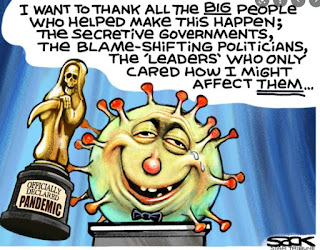
As we reach the end of Year 2 of the pandemic, I can't help but wonder what good, obedient citizens most of us have been and a fat lot of good it did us.

First, government told us that face masks were useless, so we discarded them. 

Then, we were told we actually had to use them. So, we complied (the Health minister in France responsible for this rigmarole, Olivier Véran, is inexplicably still in place. Scoop for my readers: President Macron likes to be surrounded by handsome men, gay or straight.)

Third, our dear political leaders put in place a flurry of restrictions including lockdown and curfews. Some governments got carried away and we were regaled with the height of absurd measures as seen in France with "self authorizations" where we sign a document allowing ourselves to go outside. 

Fourth, we were told salvation will come from getting vaccinated. We complied.

Fifth and sixth, we were told additional jabs will kiss the nasty virus goodbye. We complied with a second and third booster jabs.

And today, the last day of 2021 (actually 2020 redux) we are exactly back to square one with restrictions in place, Covid cases breaking all records. Sure, vaccination has meant fewer deaths, but we are now facing the very real prospect of society falling apart as many companies won't be able to operate correctly (we will probably look fondly on the supply chain issues we had in the past year.)

This is failure from our ruling class on an epic scale. Boris "Do as I say, not as I do" Johnson, Emmanuel "I love to listen to the sound of my voice" Macron, Joe "The Zombie" Biden, Angela "I'm out of here, anyway" Merkel, Pedro "How much longer can I stay in the Moncloa Palace?" Sanchez, Mario "Shall I be president or remain prime minister" Draghi, all have shown themselves to be clueless when dealing with the other great threat facing the human race collectively

I never believed much in the political class - and when it comes to France I stopped believing in it altogether in 2005 when they violated our fundamental democratic rights by canceling the results of a referendum: We the people decided we didn't want the European Constitution, and the French government (actually one man, President Sarkozy, and rubber-stamping Parliament) decided they didn't care how we felt and imposed their will on us. 

With two pandemic years under my belt, you will come to the same conclusion as I did: We don't care anymore what government says or does. So many rules are absurd and ineffectual, the results are so paltry that moving into 2022 here are my New Year's Resolutions:

- I will stop listening/caring about what our presidents/prime ministers/ministers and the lot say or do. 

-I will use common sense: face masks outdoors are meaningless, so I will NOT wear them - unless a cop forces me to. I will wear it indoors, I will be cautious, I will enforce social distancing. If I get a cold or some temperature, I can get a rapid test and no need to rush to full-capacity hospitals: a little fever and headache can be taken care of at home. 

- I will continue living my professional and personal life to the full. That terror that many governments want to instill in us to justify their existence is NOT going to work with me. I know what you're up to, you can't fool me.

-Make use of coming presidential elections (France, Brazil etc.) to throw the rascals out. Of course, there's no guarantee that whoever comes next is going to be any better but I'd rather give the benefit of the doubt to a new ruler than to one whose failed results are plain to all to see.

-I will hope for the best but plan for the worst - a principle that has guided me though most of my life - I see no reason to change that now. 

 Best wishes for 2022 - that may turn out to be 2020 - part 3. Or not. Nobody knows. We'll find out as we   get there. If we do. And if we don't, well, what a great ride it has been!


Saturday, April 13, 2019

Fighting political corruption - Brazil vs France

PARIS

I recently came back from one of my regular stays in my home away from home in Brazil. On the very day that I arrived in Rio de Janeiro there was only one headline news topic: Former president Michel Temer had been arrested on corruption charges. (During my last stay in December my Copacabana neighborhood only gossiped about another fallen leader, former Renault-Nissan head Carlos Ghosn, whose swanky Nissan-owned penthouses, just a couple of blocks away from mine, was being searched and confiscated.)

I couldn't help compare the situation in Brazil with the one I left behind me in France.
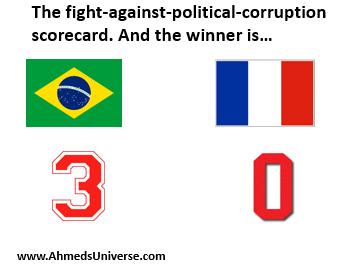
As the below diagram shows, Brazil isn't shy about firing its leaders or putting them behind bars when caught rend-handed. There is little doubt that there is more corruption in Brazil than in France but then why is there more tolerance in France? Back in 2011 I wrote a blog post denouncing France's Real crimes, Fake justice when former President Chirac was condemned to 2 years in jail but...never set foot in one!

Like Lagarde, Juppé was rewarded for committing crimes: President Macron just nominated him
to the highest court in the land, the Constitutional Court. Yes, your eyes aren't playing tricks on you:
he who is going to ensure people uphold the country's top law is himself a convicted felon. 


Could it be that this old, wealthy "democracy"'s political system is so rotten at the core and despises its citizens to such an extent that it doesn't even pretend to have a clean justice system? I am more and more inclined to think along those lines based on facts such as those summarized below. Actually, if you wonder why I put "democracy" between quotation marks it is because i stopped  a long time ago to believe in representative democracy and, 7 years before the Yellow Vests movement took France by storm calling, among other things, for direct democracy I advocated the exact same thing in my blog post on DirDem vs RepDem as I called the old and new political system.

The lesson one can draw from this situation is that, contrary to appearances, a young, chaotic, developing country such as Brazil can teach those most established so-called democracies a lot. It always makes me laugh to hear "First" World leaders pontificate and give advice to their "Third" World counterparts, oblivious to the Biblical injunction that before seeing the mote in others' eyes, they should remove the beam in their own eyes.


(Other blog posts exposing the shortcomings of the French political system include, in addition to the ones mentioned above, the following:
- October, 2018: The Increasingly Undemocratic French Constitution
- May 2017: Thoughts on the French presidential election
-May 2012: Good riddance, Sarkozy!)


Sunday, October 7, 2018

The French Constitution at age 60: Sadly, increasingly undemocratic

PARIS 
The scary situation where 30% of the people's
will has been cancelled by politicians
French presidents have only three objectives they relentless pursue from the moment they are sworn in, to the moment they leave office :

- Leave at least an imposing monument for generations to come to remind them by;
- Have a celebrity be (re)buried in the Pantheon (even if against their wishes);
- Change the Constitution.

Current President Macron wasted no time to have a Pantheon burial (Simone Veil) and is busy leaving his mark on the Constitution (I cringe at the thought of what architectural eyesore he will bequeath us when he lives office in 2022 - I hereby  predict that like his two direct predecessors he will fail to be reelected.)*

Of course, the preferred way for politicians to change the Constitution is to do it themselves - and among themselves -  feeling that the nation's basic law is too important to be left to citizens to make a decision. And yet it was those same citizens (or at least their parents and grandparents) who approved it when the 5th Republic was introduced exactly 60 years ago. A basic democratic principle is that what the people have decided can only be changed by the people. Not in undemocratic France (and other mock democracies, by the way) where politicians confiscate the people's right to decide on the law of laws.

One thing I learned when I went to law school is referred to as the hierarchy of norms whereby a decision at a lower level must comply with a decision from a higher rung in the legal hierarchy. The rationale being that the farther away a decision-maker is from the sovereign people the lower in the legal hierarchy the decision is. Thus, from the lowest rungs to the highest we'll have the following:

- a cabinet minister's decision (usually known as a decree) has to comply with the law, because a minister is appointed whereas a law is made by Parliament which is elected (in other words, lawmakers are just one degree removed from the people whereas government ministers are two degrees away from the people.)

- Members of Parliament can only pass laws that comply with the Constitution, because lawmakers (known as deputies in France) are only the representatives of the people (of course most politicians believe and behave as if they were the people's masters, not their servants.) 

- The Constitution is therefore the highest law in the land since it has been voted on directly by the people themselves. Sadly, the basic democratic tenet that what the people have decided can only be changed by them directly in a referendum has been slowly but steadily eroded in the last 60 years with politicians deciding on BOTH laws and the Constitution.

It is therefore a travesty of democracy that those who pass laws are supposed to comply with the Constitution when they can change the latter at will. What's the point in having a Constitution then? Just say that politicians are all powerful and can decide on what they want when they want. Not markedly different from the Ancien Régime.


The shrinking democratic credentials of the French Constitution


In the 1960s there were only two changes to the Constitution: one was made in a referendum (it dealt with the way the president should be elected), but for the other one, Parliament decided they would handle it. The 1970s and 1990s saw more than 10% of the Constitution articles amended: not a single one with the people's vote. The 2000s saw this democratic deficit reach new heights: 9 changes, only 1 referendum. Particularly scandalous was the EU-inspired Lisbon Treaty which was rejected by French citizens in a  referendum. What was the President's reaction? Sarkozy ignored the people's will and had the shamefully supine French Parliament rubber-stamp his decision in a 2008 Constitutional amendment. **

If Macron has his way, another 10% of the Constitution will be changed and considering his low approval ratings he is not going to risk a referendum. We will then reach the worrying situation where  30% of the people's vote has been cancelled by politicians.

Let us hope that either opposition politicians (in the case of a Parliamentary vote) or the people (in the case of a referendum) defeat Macron and stop this undemocratic spiral. A Constitution is the paramount social contract, it is the basic pact that binds society together. As such it cannot be amended on a regular basis (the way laws are) and can only be done by the people themselves.

French presidents should heed other countries with similar political systems, such as Spain and the US. The former celebrates this year the 40th anniversary of its Constitution which has been left largely unchanged since 1978. As for the US, it has amended its 250-year-old Constitution fewer times than France has in only 60 years. That tells you that there is something deeply wrong with the French political system.

LEAVE LADY CONSTITUTION ALONE! She is a respectable lady who doesn't need to have more scars inflicted on her by shameless, self-serving politicians


*It is noteworthy that the last two presidents left in disgrace failing to get a second term. The last but one, Nicolas Sarkozy, failed to get reelected, and the last one, François Hollande, having to live the  unprecedented ignominy of not even being able to run due to his abysmal approval ratings, themselves due to his disastrous record.

**I have more respect for British politicians who, although they were against Brexit, once British voters made their decision in a non-binding referendum, they decided to abide by what the people have decided. In France, politicians despise voters and don't even hide it.

The blogger has written several posts on the French political system: 

-April 2017: "The French presidential election: Going  blank"
-May 2012: "Good riddance, Sarkozy!"
-Dec. 2011: "Real crime, fake justice: Chirac gets 2-year suspended jail sentence"
-June 2010: "Sarkozy, la France c'est moi!"
-March 2010: " Obama and Sarkozy: A Tale of Two Presidencies"

Thursday, May 4, 2017

The French presidential election: Going blank

PARIS
Facing off for the top prize
So, here we are, just a few days' away from the runoff election that will decide who will be the most powerful man in the Western world. Yes, I mean it: the French president has more powers than his American counterpart who has to deal with Congress, a more often-than-not independent judiciary and a highly decentralized country where most decisions affecting people's lives are made by mayors or governors rather than by the Federal government. And other European leaders tend to be heads of government, sharing power with a head of state (elected or hereditary, depending on the case). As one of the major candidates reminded the nation in his campaign (see below), we live under a presidential monarchic who, apart from being elected, maintains most of the power and trappings of the "kings who built France," as the phrase goes (Les rois qui ont fait la France).

And, for once, the finalists are as different as can be, with two radically different views of what ails France and how the country should be run. After many decades of pretending otherwise, voters have finally realized that there is no difference between the mainstream parties and gave the Socialists and their partner-in-crime the Gaullists what Churchill called "the order of the boot". Something I have been calling for in as far back as 2011, when I wrote in a post subtitled "Democracy 2.0" that throughout the Western world whether you pick Party A or Party B makes no difference. They are just the two faces of the same coin, the establishment party. Or, to quote my beloved Gore Vidal, they are just the two wings of the single party.

Let me give you my two cents on the four candidates who made this campaign by being within a whisker of each other in both polls and actual election results, before I share with you my vote - and why.

François Fillon, a.k.a The Crook, had what was  undoubtedly the best program, and it certainly wasn't the most popular one as it offered the French some belt-tightening ahead. The only issue with it, were actually two, both related to how credible its plan is: First, when Fillon was in charge for five years, why didn't he implement  it? What guarantees do we have that once in charge he will deliver on his promises? Remember that when a private business makes false claims on its products, it can be penalized and fined; not so with politicians, who can promise you the moon and the stars and, once elected, do the opposite and still keep their seat. Second, the little credibility Fillon had disappeared with the financial scandal he got engulfed in. French voters can tell a liar and crook when they see one, and rewarded his campaign with the dubious distinction of  being the one which, in a 60-year period of time, managed to get a Conservative candidate disqualified for the runoff. If there is a dustbin of history for politicians, Fillon is heading straight for it.

The Gang of Four that made history


Marine Le Pen, a.k.a. The Loony or The Fruitcake (have your pick), has the silliest of all manifestos, basically based on hatred: of Arabs, Muslims, immigrants, Europe, the euro. Anything that can be offered to the people's anger as the source of their miseries, you'll find it in Ms Le Pen's bag. French politicians have been doing this for centuries: It used to be the Jews (in the Middle Ages) and Huguenots (in the 16th and 17th centuries). Nihil novi sub sole, as ancient Romans used to say (in their times, Christians were the scapegoats - food for thought.) Her success resides only on two facts: Her denunciation of the elite's abject failure in running the country (which hardly anybody can dispute) and that, having never been elected to office, she can claim the benefit of the doubt. Apart from that, her program of Fortress France does not make any sense at all.

Jean-Luc Mélenchon, a.k.a. The Commie (or Bolshie.) His sharp tongue, quick wit, consistent philosophy, grasp of details, brilliant, inventive campaign (those videos, holograms and the cruise on the Ile-de-France canals!) made him my favorite. He is the only one of all candidates, who realized that the corrupt leaders we got and their ineffective policies couldn't be separated from the sick political system we have. I fully agree with his calls for revamped political institutions, which he calls the 6th Republic, and many of its tenets such as the ability to recall all politicians. Is it normal that we  have to put up with a deeply unpopular and incompetent president as Hollande for so long? Is it normal that neither you and  I can decide on our compensation or rules governing most of our career, but politicians can? Is it normal that when we commit a felony or crime we go to court (and jail if found guilty) like everybody else, but not politicians who have their own court (Cour de justice de la  République) who rarely finds politicians guilty: and small wonder - its membership is largely made up of...fellow politicians! And even when they do find them guilty, they make the bizarre ruling that no punishment should be meted as we saw with the recent Christine Lagarde trial. Mélenchon is right to say that the system is rotten at the core and propose to do something about it, beyond the mere superficial slaps on the wrist for wayward politicians. I also fully support his call to move to real environmentally friendly policies, not the vague lip service most other politicians adopt.

However, on the economic front, I deeply disagree with Mélenchon. We already have the highest tax burden of the developed group of nations. If that could have translated in higher growth and more employment, we would have seen it. And I feel very uncomfortable with his anti-"rich" rhetoric. What is wrong with being rich, if you've earned it through your hard work - or inherited it? Unless the rich have gotten there through fraud and murder, confiscating their wealth strikes me as deeply unfair and demotivating for society at large.

Emmanuel Macron, a.k.a The Dapper (or the Charmer). Let's give credit where credit is due: His is the most amazing political career France has ever seen, and few countries can boast a novice with no experience of running a campaign, no party, no funds, coming from nowhere and about to win the ultimate prize. For sheer audacity, vision, and management skill, one has to acknowledge his amazing talents and wonder what he could do for the country if he continued to evince the same skills once in office. For a while, he was my favorite. Even when I couldn't completely shake off a feeling that he may just be a manipulator, who saw an opportunity and seized it. (Even then, still a brilliant one.) However, as  I shared several times with my old friend, C.T.H., a member of his campaign team, as soon as Macron put meat on the bone of his program, that's when he lost me. Freeing 80% of French households of the Taxe d'habitation (a kind of property tax) is typical of the worst of the French political-administrative establishment. First of all, that's a local tax, so what is he doing, apart from being generous with other people's money? And then, the lucky ones aren't exactly exempt from this tax, it's the central government that pays it to cities and towns on  their behalf, but should the rate go up, then you will still be liable for it. Again, what's the point  of putting in place such a complicated scheme when the objective, increasing people's purchasing power, could be done via levers the central government controls such as VAT, income rebates or credits. A bad idea, to be jettisoned immediately, as the idea to increase the CSG-based social security taxes, another tax created in the 1990s: then with a 1.1% rate, it currently stands at 15;5% and he wants to increase it? Wasn't he supposed to be a liberal (in the European sense?) As for his non-reform of the net-worth tax (ISF), it is absurd to remove most assets from it, except the one that affects most people who don't make money out of it: homeowners.

Worse, unlike Mélenchon, he seems to be very happy to keep the political system as it  is. Maybe just tinker a little bit here and there ("moralisation de la vie publique"), but over all, let's not rock the boat. Which rekindles my suspicion that Macron may just be all PR and marketing, all fluff, with some Conservative economic policies, some left-wing social policies,  all repackaged by a nice smile and endearing family life. But still a politician bent on grabbing power. And his will to rule by decree is alarming - this is the "presidential monarch" Mélenchon is right to denounce.

Le protest vote
Based on this, I just can't bring myself to vote for Macron. And I won't cast a negative vote: voting for him, to block the Loony. Since neither of the two has managed to convince me, then I'm voting blank. I do hope that Macron will prove my concerns wrong, and manage to fix some of the country's most serious issues. If  he does, then in five years' time, I will be more than glad to vote for him. As for Blondie, I do hope that they commit her either to an institution or behind bars: either way we'll be free of that nightmare. Until 2022 when, should Macron fail, then the National Front could finally grab the elusive prize it has been after for several decades. After all, that's a French political tradition: Fight long enough, and you end up in the Elysée Palace.


Sunday, November 15, 2015

Terror strikes my hometown and neighborhood - AGAIN

PARIS
My second city's tribute to my
hometown
To paraphrase Oscar Wilde, for a global city to be hit by a terror attack once a year can be considered a misfortune; to be hit twice smacks of gross negligence. Add to that that my neighborhood is the only one with the dubious honor of having been targeted twice makes me wonder if time hasn't come for me to move permanently to my second home, Rio de Janeiro. Now, that would be the mother of all ironies: seeking refuge from terror in a city well-known for random violence.

But we live in troubled times where what made sense for so long suddenly doesn't. Here is a short summary of the last 48 hours.

As (bad) luck would have it, as in the dreadful events last January (which I recounted in this post ) I was at home on Friday evening, relaxing from a long week of SAP-to-Workday workshops at French pharma giant Sanofi, when I heard the ear-splitting sound of sirens. At the beginning I didn't pay much attention, but after a while it suddenly hit me that the blaring sirens had been going at it for a good fifteen minutes. A quick look at the city skyline didn't reveal any Neronian fire. An accident, maybe? Then the ominous alternative crept into my mind: another attack?

I grabbed the TV remote control and tuned into one of the 24-hour French channels. My hunch was confirmed: another series of terror attacks have hit my hometown with my neighborhood once again targeted.(Dear Mr. Terrorist, I don't mind your being bloodthirsty. But do you also have to be unfair? Would you mind spreading the victim share among all Paris districts? Next time, could you try Montorgueuil?  Or the 16th arrondissement? Why not cross the Seine and have fun in the Left Bank?)

Since the action was taking place just a few blocks away from my place, I grabbed my coat and ran out. It was around 11 pm. By then I had already received some text/Whatsapp messages from friends and family who, when apprised of my intention to go to the Bataclan concert hall, tried to dissuade me. But there was no way I was going to experience the events vicariously on a small screen when I could witness them live.

The next few hours will probably never be erased from my memory. In the cold fall night I stood and watched as the elite security squads forced their way in using their guns in deafening noise, soon to be followed by explosions as the terrorists blew themselves up. Then the sad sight of bodies being retrieved. My phone battery died but I managed to shoot (no pun intended) a couple of videos and take some pictures. I'll never forget the distraught young man whose two brothers were inside the Bataclan (where I had been many times for some popular parties) and who tried to go in but was restrained by the cops (I later heard they had both died).


Few people managed to sleep that night in the neighborhood, or in the city. The next morning I woke up early and went back to see the remains of the carnage: the sad pair of shoes of a concert goer who never suspected that his Friday fun would put an end to his life. Still-fresh blood on the pavement was a reminder of the horror that took place just a few hours ago.
Apologies for the gory details but sometimes you need to
face reality head-on

People were too shocked to engage in meaningful and rational discourse. But some questions were being asked and the government's official version challenged:

- Some claimed that many who died didn't die at the hands of the attackers but as side effect of the police action - collateral damage, they'd call it in the US (but the supine press won't tell you about it.)
- Also, how come that for the second time in a year, and even more spectacularly, terrorists were allowed to operate freely in France?
-Was this timed for the the looming key regional election where the incompetent government headed by the Clown-in-Chief; François Hollande, is expected to suffer a big defeat? (I watched him on TV and his incompetence was eerily reminiscent of Gerge W. Bush as captured in Fahrenheit 9/11: both "leaders" showing they were not up to the task)
- Should France continue to target IS (Islamic State - not Information Systems) in Syria, if IS can retaliate so easily and spectacularly in France?

A victim's scattered sad belongings:
A testimony to the horror  that took place a couple of hours ago


The media vultures were all over the place and I was flabbergasted to see their reporters interviewing basically anybody who walked up to them and served them any cock-and-bull story. A Spanish anchorwoman basically bought lock, stock and barrel what was clearly the rants of an old woman who kept on referring to the Second World War. Other reporters fed their audience the asinine comments that all of us will later lap up while watching TV. A wise neighbor told me, "The only group who knows less than reporters is the government: and the little they know, they are not telling us." Couldn't disagree with him, since the entire French political class has lost the last shreds of respect from the citizenry. They can't fix the environment, but spend billions organizing a useless COP21 jamboree whose only function is to serve as a political marketing ploy for the government (regional elections were undemocratically pushed back to help the moron masquerading as French president win a few votes with the event's reflected glory). They can't fix the economy, nor unemployment now at record levels, and even less immigration. At least we thought they could keep us safe but, as this year's events are proving, the political class is also proving to be an abject failure at security. So, why are we putting up with them much longer? Shouldn't such low performers have been discarded long ago? Beats me.

In moments like these, scared people give the impression of rallying behind the "leader" who has no idea in what direction to lead us. But deep down inside of them, most know it is hopeless.


Last night, I took the metro around 10 pm and was deeply shocked to find it empty. I was born here and have never seen an empty metro on a Saturday night. The streets were equally empty, reminding me of that Friday in the early 90s when I was living in New York City and we were told at noon to go home because of the fear the Rodney King riots from Los Angeles would spill over in Manhattan. Last night in Paris I was eerily reminded of that distant Friday when I walked from the UN building towards Grand Central Station and the greatest city on earth was deserted in anticipation of possible mayhem. But in ghost-town Paris disaster had already struck. And will strike again. No solution is in sight.

Poor Paris.

Poor France.

(Except for the Christ the Redeemer picture, all photos and videos by the blogger)

UPDATE: Nov. 26, 2015. A week ago, while browsing through press accounts I stumbled on the name of a victim ("Djamila Houd") and her place of origin (Dreux, South west of Paris). I immediately emailed Tassadit Houd, one of my oldest friends, who is from Dreux, asking her whether she was a relative. I was getting worried when I couldn't get through to Tassadit and today I finally heard from her: Djamila was indeed a relative. Her own sister! She and her family are devastated. It took them 10 days before they got to bury her. Djamila was having a quiet dinner at the sidewalk restaurant La Belle Equipe (belonging to her husband, Gregory) when she was shot twice in the back. Here's the account by the local paper. In the family picture at the funeral my friend Claire Tassadit is the second from the right. Another press report quotes my dear friend Tassadit's tribute to her sister.


IN MEMORIAM
Djamila Houd, a Muslim victim of Islamist terrorists.

She leaves behind a husband and an 8-year-old girl who
will become a "Ward of the Nation"

Tuesday, February 10, 2015

An open letter to Workday's Bhusri and Duffield: Time to fix Europe

RIO DE JANEIRO

Dear Dave and Aneel,
Drip-feeding country extensions
is NOT the right strategy

A great admirer of Workday's since its beginnings, for various reasons you will find summarized in several of my blog posts, the global and European person I am was more than gratified to see that you have decided to open an office in Germany. However, this cannot hide the fact that  before you open a new market, you should make sure the previous ones are up and running.

The Frenchman in me cannot therefore understand why you are expanding in Germany when you have yet to make France work. It was exactly three years ago  that you opened the French office and in that period of time you have only signed up two French customers: Lafarge and Sanofi. Even Oracle has managed to sign up more Fusion customers in France, which is the ultimate insult. With France being PeopleSoft's most successful market outside the United States, it should have been a piece of cake to convert many of these customers to Workday. Adding insult to injury, Danone, of all customers switched from PeopleSoft to... SuccessFactors when it should have been yours. A crime!

What has gone wrong?

The most serious mistake you have made is one typical of American multinaltionals: starting a presence in the UK and thinking that with that "Europe is solved." The UK, as many British people may have told you, is not in Europe, but off Europe. In a couple of years, they may no longer even be in the European Union. Opening an office in London is no more meaningful than opening one in Chicago. With most EMEA executives being UK-based (and British) you have made your EMEA organization EMEA in name only. As is natural they would focus on what they know best: the UK market, which explains your success in the UK, and then the "low-hanging fruit" of the Netherlands and Scandinavia. But the rest is as far away from them as planet Mars. The appointment of Chano Fernandez, a Spanish national, was a step in the right direction, but I have a feeling you didn't hire him because he hails from Spain, a country close to my heart (read my blog post "My 20-Year Affair with Spain") but because he was at SAP. And, anyway, since he was appointed, a year ago, I have yet to see a single Spanish company select Workday. Or an Italian company. Or a German one.

You have clearly made some casting mistakes, hiring the wrong people for the wrong roles in the wrong geography. Worse, many of the people you have hired in key positions have no prior experience in HR systems, your flagship product. Don't get me wrong: it may make sense sometimes to hire people from a  wider field, but when your product is first and foremost about HR, it boggles the mind to see so many people in key Workday EMEA roles who have no experience of talking to HR leaders, have no sense of the local HR ecosystem or a deep understanding of the competition.

As you know, every HR market is quite parochial. Sending to France a high-flying VP from HQ who speaks no French, cannot spell the name of some of the competitors, is not on a first-name basis with many opinion leaders and system integrators is a waste of your resources. And are you surprised at the results? Are you surprised that some of your better people,especially from sales, have left and are joining your competition?

Another key dimension of the local nature of HR is localization or what I  call "glocalization". I am
Marketing 101 mistake: English-language product screens
on  Workday's French website (As of  09-02-15 )
flabbergasted that it is taking you so long to develop the various country payroll localizations needed to be successful in the European market. You have waited for your 11th year in business to finally come up with your first European localization: the UK (well, not yet available, just announced for this year.) And France won't be available before next year. Wouldn't it make sense, from a product strategy perspective, to have swapped the countries and delivered France first?  That UK-centricity I mentioned earlier is again at work. Do you remember the number of European localizations (including Payroll) we released in PeopleSoft 8 between 2000 and 2001? EIGHT! Why this suspenseful drip-feeding of localizations at Workday? (And don't get me started on other regions of the world such as Asia or Brazil where I spend part of the year, and which are unlikely to get anything from you before eons - unless there is a clear change in product direction.)
Used to be one of the blogger's favorite 
Workday features. 
Now gone

You got so many things right from the beginning, and are still performing so brilliantly in many areas, that it pains me to see how you lost sight of the ball in Europe, and are making mistakes which, based on your previous PeopleSoft experience, you shouldn't have made. I guess you wouldn't be human if you didn't repeat some of your past mistakes.

Another thing. Please tone down the paranoid streak in your Partner and Alliance organization. So many positive things are already being written/said about you, you don't need to overdo it by becoming a marketing control freak who tries to prevent any constructive criticism to be published. All of your admirers, whose numbers include me, do not want you to turn into another evil company of which there are far too many in our industry.

I hope that my advice will help Workday grow into a better, more focused and successful SaaS company.

Oh, one last thing: Please bring back the Wheel. I miss it a lot.

Sincerely,
Ahmed Limam

Wednesday, January 7, 2015

Terror in Paris, on my doorstep - literally

PARIS

            Mayhem right on the blogger's doorstep.
The ambulance pictured on the left blocks the
way to the blogger's home. On the right-hand side is the
street where took place the worst massacre France
has  know in over 50 years,
The day started quite oddly with so much mist and haze that Notre-Dame Cathedral was hidden behind an unusual wall of pea soup. Little did I suspect that the day would end with the famous cathedral tolling its bell.

Alone the whole day and working from home (one of the perks of being a freelancer  -except when you're on the road), I was so busy dealing with several things that I when I heard the loud bangs around 11:30 am I didn't pay much attention to them. After all central Paris, like all large metropolises, is so full of different types of noises that they barely register with you. I just thought, "Oh, I'm late, I should have gone out quickly to get some lunch."

It was over lunch (which I had at home, too busy to go out) that I heard the dreadful news. A terror attack had resulted in 12 deaths at a well-known French satirical magazine, Charlie Hebdo, famous for the caricatures that drew the ire of radical Islamists. I knew vaguely that the magazine had its offices 10 minutes' walk from my place, although subconsciously, I also remembered that after being threatened they had moved somewhere else.
The entrance to the blogger's building. On the right you can see
where one of the shots fired by the killers went

The blogger taking a picture of the bullet
that went into a window right by the entrance
to his building a few minutes before he was due out.
Behind the blogger, heavy police presence guarding
Charlie Hebdo's offices
After an early afternoon conference call with a client, I went out to run some errands quickly before coming back for another meeting when, upon coming out of my building, I felt as if I had just stumbled upon a film set. Ambulances, TV crews, cops: pandemonium everywhere.  A neighbor mumbled something about "suspects" and I thought, "Oh, one of the killers must have tried to hide in the vicinity." I felt the cops were being a bit paranoid, though, since I had to show my ID to leave the cordoned off area and come back.  I asked one of the cops what the matter was, and his reply was a curt, "Just watch BFM" (a popular French TV station).

As soon as I came back home I turned the TV on to get more info and see what was the link between the massacre and my street. I flipped through several channels, and suddenly I felt something was not right. There was something weird about some of the pictures. They looked eerily familiar. I immediately hit the internet where I checked some pictures. And, then, my neurons connected. And I was shocked by the realization that...

...the murders had taken place on my doorstep! Literally.  I then remembered that about a year ago the street right across the entrance to my building had started getting the presence of a police car. I had asked around why, whether some VIP had moved in, but nobody I talked to knew. And every time I walk by, which is basically every day I'm in Paris, I see the police car and always make a mental note to find out who they are protecting.

Now I know. This is where Charlie Hebdo had moved. And without any publicity since there was no sign indicating their presence. That didn't prevent the killers from not only finding the location of the new office, but also picking the one day in the month  where all the main reporters gather around the editor.

The killers shot their assault rifles inside and outside the Charlie
Hebdo
office. On the streets they hit the blogger's building


Another thought hit me. 11:30 was the time when I had planned to go out but I was busy on a call that I had decided to go out later. I can only imagine what could have happened if I had crossed paths with the murderers. So easy to die of a stray bullet; I survived one in Rio de Janeiro, a couple of years ago (it flew two inches from my face), so I am probably down to only five lives now.

I immediately headed back downstairs just on time to see the French president with several of his Cabinet members walk by to pay their respects to the victims. To enter my building I had to walk around the large ambulance parked right in front of the entrance door: it had been used to ferry the dead and the injured.
Car parked right by the entrance door to my building which was
hit by the killers' car as they escaped - or came in. Some details
are still unclear. But the police forensics spent several hours
analyzing it in detail and scooping up all the evidence around


That's when I heard that among the dead were Wolinski and Cabu. Wolinski has been famous since my teen years for his comic strips, and Cabu was a talented cartoonist whom we hired at PeopleSoft in 2000 for the launch of Release 8.0. He entertained us through his quick-witted drawings during Craig Conway's presentation. The then CEO of PeopleSoft couldn't understand why throughout his presentation there were moments of undiluted audience hilarity until he'd turn around and look at the screen and catch, between his slides, a funny Cabu cartoon making a spot-on comment on the wonderful world of business software.


The day after at noon: one minute silence in front of the
Charlie Hebdo office. The blogger's building stands
behind the mourners
The rest of the day was of course lost to work as the neighborhood, family and friends, and the whole nation gathered to mourn the massacre France has thought will never happen.
Notre Dame Cathedral, here seen from the blogger's home,
 at midnight, as it begins to toll its bell for the day's victims.


A day to remember. And wonder if worse is to come. And some serious thinking about the implications of the event will have to made by political leaders.

(All pictures taken by the blogger. Free use allowed)


Monday, July 21, 2014

No SaaS please, we're bankers!

PARIS
As traditional, on-premise corporate computing moves relentlessly to the cloud, especially its more sophisticated version, SaaS (software as a service)*, one business sector seems impervious to the march of History: the banking industry. Since banks spend more on IT than any other business, it is worth discussing what is holding up bankers (no pun intended) and wondering whether it is a question of time before the industry moves with the times, or will it remain as a quaint on-premise island in a sea of SaaS-based systems. In this post I'll focus on HR systems, since that is the corporate IT sector I have more experience in.

The changing landscape of international banking and how it will affect HR
Following the financial meltdown that started in 2007, banks are facing some unique challenges:

- More stringent regulations in all developed countries, though so far the bark has been worse than the bite. European banks have been faster at adopting so-called Basel 3 rules, thus giving them, counter-intuitively, an edge on US banks because, once the latter are hit, they will find their European counterparts better prepared. 

- Some of the new rules, especially in Europe,  have to do with bankers' compensation. Senior managers will have to learn to focus on profits (see below comment). One of the challenges of HR leaders will be how to enforce a new culture where greed is no longer good, and where other aspects of performance are taken into account, rather than the obsessive focus on revenue.

- One such regulation has to do with block leave (or garden leave) which mandates that during a certain period of time employees have no access to email/systems/phone in order to restraint heir ability to engage in fraudulent activities. (Of course, I still receive email messages from some senior executives who are on such block leave - and I'm talking here about their their bank email!)

-  Increased use of technology, such as complex trading algorithms, which means that many jobs formerly done by humans  are now done by machines which do not threaten to leave you for the competition nor demand exorbitant compensation.

- The days of unlimited profits are gone, and that will have an impact on IT budgets. This would be a driver to move to the cloud since costs can be reduced substantially when your HR system of record is migrated from on-premise to SaaS.

- Most of the global investment banks are retreating from their global operations and closing businesses. This deglobalization will affect all players, with global powerhouses shrinking their global operations, and the size of their workforce, and a larger number of regional/domestic banks will become even more local in nature. The challenge for all banks will be to trim fat without cutting muscle.

- In emerging markets, such as Brazil, Turkey, China and South Africa, local banks will matter even more than the global one, a trend not really new as I witnessed myself when I started spending part of the year in Brazil and was shocked to see that  the local HSBC subsidiary had little in common with the European parent company. It was quite surprising, and humbling, to see that Premier status, despite HSBC's marketing slogans, meant nothing there. In that market, as in India (think ICICI) local talent prevails and is giving the global banks a run for their money, if that is the phrase. If global banks want to survive, they will have to learn to fly the right talent on the right opportunity, say from London or New York, to São Paulo or Singapore, close the deal and then back home. The type of skills necessary will be markedly different from what we currently see.

Better be safe than sorry
There are various reasons why bankers are reluctant to move to a SaaS HR system of record (note that for other HR functions, such as recruiting or learning, the move to SaaS started a while ago.)

First, HR systems of record, along with  core banking tools, tend to be particularly sticky here. This most conservative of industries tends to favor status quo systems, stressing their advantages ("We've been using them for so long") while drawing attention to some problems associated with  the cloud. The financial crisis, which revealed banks' boldness, has put the brakes on many innovative ideas. The cloud suddenly became particularly risky, and it is a brave HRIS leader that will push for it. Rarely does a banking head of HR even bother about it, feeling s/he has more urgent battles to fight.

The banking industry also has a long history of home-made systems, in use next to packaged software, the latter often customized beyond recognition, thus adding another strong incentive to stick to legacy systems longer than other industries. And yet the complexity of their  legacy systems will eventually force the banks to move forward and start considering SaaS more seriously.

Security, for obvious reasons a predominant concern with banks, has them look at SaaS with particularly watchful eyes. And NSA snooping has not helped the SaaS movement, especially in Europe, where banks are not particularly keen on having the integrity of their core HR data  compromised along with privacy concerns. It is safe to say that SaaS vendors are losing 10% of their potential revenue in Europe because of this issue.

As everywhere else, moving to SaaS entails cultural change that banks are not finding easy to make. A bank 's IT department with an army of PeopleTools or ABAP consultants will be reluctant to consider that it has a problem, and that it may not need these skills anymore. Often, HR does not have enough clout to stand its ground and insist on having its own technology.

Leading by example...where there is no clear example
HR departments in the banking industry tend to display pack mentality. There is a lot of hand-wringing, indecision and wait-and-see among HR/IT leaders, with everybody watching their counterparts in other banks to see who will take the plunge first. (Interestingly, their brethren in the insurance industry didn't have such qualms and have moved to the cloud much faster.) As the following graph shows, there have already been a couple of banks that have made the move to SaaS HR (adopting mainly Workday) but they tend to be tier-2 banks. None of the global behemoths have pulled the plug on their legacy HR (usually PeopleSoft), although several are looking at the SaaS model seriously.


Whatever the geography, on-premise HR rules the roost

Action items for a successful transition
Any successful move from legacy HR to cloud HR in the banking industry will need the following:

  • Display bold HR vision from determined HR leaders. When considering the challenges facing the banking industry, this is a golden opportunity for HR leaders to lead change and transformation and try to show their value. The move to SaaS is a once-in-a-decade opportunity to do so.
  • Ensure that new rules are adhered to. The example I gave above of block leave is a good one. So far none of the heavyweight software vendors can cover that functionality satisfactorily which explains why many banks are not in compliance.  (Even Workday covers this requirement only partially)
  • Identify what needs to be available for a successful cloud implementation: Is the SaaS model good for us? Can the vendors' service level agreements meet our needs? Will they understand our way of doing business? If we, a European bank, select Workday, how confident are we that they will protect our data? I heard Workday's Aneel Bhusri the other day reiterate that HR data is safe because the customer can decide to have it stored in any of the regional data centers outside the US. That is simply not true. Even outside the US,Workday is still an American company, subject to US law and jurisdiction. If a US court orders it to provide the data stored in its data center in Ireland, will Workday refuse to comply? And if it complies,  what guarantees will a European bank (or any customer, for that matter) have that the data will not be subject to NSA abuse? No American vendor can provide any such guarantee.
  • Find the budget for the new investment. Considering the vast amounts banks have traditionally spent on IT, you might think that that should not be a problem. But with profit growth going south HR leaders need to beef up their ROI and make a more compelling case than in the past, something which, as mentioned earlier, they should be able to articulate cogently...if they know how to do it!
  • Realize that the move to a SaaS model requires a mental recalibration of people and organizations, along with revisited processes. That spaghetti environment that HR systems in banks have become over the decades should be disentangled and streamlined. What better opportunity than a move to a new next-generation system?


Banks should remember the unique characteristic of an HR system: it is the only IT system in a company where every employee is a user. Provide them with a rich interface and a modern user experience, and you are suddenly increasing your current and future employee engagement. Just as an earlier generation moved en masse from mainframe computing to a cloud-server environment, what are you waiting for, bankers, to move to SaaS?

No SaaS? You must be bonkers!


*For those who are confused about the terms "SaaS" and  "cloud", mainly because some  less-than-wholesome vendors use the two interchangeably, let me clarify some key differences. When a company's IT system no longer runs on its own data centers but is hosted by a third-party vendor, it is said to be "in the cloud" whether that IT system refers only to the hardware (network, for instance), the technology (database, OS) or the application (say, HR system.) When your application runs in the cloud, and the hardware and infrastructure are also managed by the same vendor, then we are talking about SaaS, the most advanced cloud offering. For software purists, as your humble servant is, you then have true SaaS (such as Salesforce, Workday, SAP's SuccessFactors) or faux-SaaS, a term I coined to refer to those products (such as Oracle's Fusion and the numerous legacy systems masquerading as SaaS) that were developed as an on-premise offering and then ported to the cloud, often in a single-tenant environment. True SaaS, on the other hand, is always multi-tenant, with a single line of code, is not available in an on-premise deployment, and only requires a browser to access the application.  In other words, a true SaaS product is always in the cloud; the reverse, however, is not true.

(Although the blogger, in his capacity as advisor-cum-consultant, has been involved with two banks on their legacy-HR-to-SaaS projects, the ideas defended in this post are his only, and do not reflect neither the banks' opinions nor their particular situation)


Tuesday, March 11, 2014

America and France: Two countries united by failed military payroll

NEW YORK
“Dulce et decorum est pro patria mori,” ancient Romans
used to say. It is not only good to die for one's country,
but payroll software requires you do it for free
Last month saw France's president pay a state visit to the United States. Among the various topics on offer for Presidents Obama and Hollande  one could mention the drop in foreign investment in France (due to the French government's idiotic policies), the impact of the NSA spying scandal (due to the US government's idiotic policies), both leaders' marital woes (alleged in Obama's case, true in the case of Hollande who regaled the nation with two First Ladies, one official, one hidden), the various crises around the world (Syria, Ukraine etc.) However, there is one topic which the two leaders probably didn't get to discuss: how their respective military failed spectacularly in implementing a payroll system for their armed forces.

The U.S. tries first... and fails first
As in so many other cases, the U.S. was a pioneer in the use of package software to run its HR and payroll operations. In the late 1990s it adopted the HR software leader of the time, PeopleSoft (which had developed a specific Federal product) to integrate over 90 different systems into a state-of-the-art HR/payroll system. Several hundreds Department of Defense (DoD) contractors  and employees worked on the project which was supposed to go live in 2006. I will spare you the the details of this soap opera which comes with epic cost overruns and deadlines missed, but suffice it to say that in 2010, that is TWELVE years after project kickoff, DIMHRS (Defense Integrated Military HR Systems as the acronym goes) was announced dead on arrival (the system integrator  was Northrop Grumman.) Oh, and it only cost $1 billion, by the way. Quite a lot for a payroll system that was never used.

The solution was...to go back to the 40-year old system (written in Cobol) and it did not fare markedly better as it results in countless payroll errors for many of the 2.7 million active-duty personnel: many soldiers get shortchanged on their pay, others get overpaid and then have to do with abrupt paycuts as DoD recoups the monies, which is hardly the best way to motivate troops who put their life on the line all over the world. In some cases deserters continue to be paid for years. Retirees who are rehired to find themselves in a bizarre situation: a glitch in the system often results in retiree records being updated to "dead" with condolence letters sent to the  family of an otherwise quite healthy soldier. This happened to none other than the U.S. Army Chief of Staff.

It is quite mind boggling that an organization like the Pentagon which uses the most sophisticated technologies in the world can be defeated by something quite humdrum as payroll software.

Where the US leads, its oldest ally, France, follows
The French military is smaller in size than its U.S. counterpart (300,000 troops half of which in the Army) but it is proportionately as maddeningly complex, if not more. As in the US every branch of the military uses a different HR/payroll system, each originally custom-built and with pleasant names such as Concerto, Rh@psodie, Symphonie. Starting around 2005 each branch decided to move to a package software based on SAP. As the below diagram shows each branch had its own version of SAP HR which was interfaced to Louvois, a new custom-made payroll system, to be replaced in 2016 by ONP, an HR Access-based payroll system for all French government employees. Unfortunately for French servicemen and taxpayers Louvois, like its US counterpart, was an unmitigated disaster. Costing north of half a billion euros, with several hundred million more in overpayments, compensation paid to tens of thousands of military families who got shortchanged and additional implementation/maintenance costs to fix the issues, the French military will probably end up paying even more than the Pentagon for the same result: a failed payroll system. At least we French have one consolation: in one area, failed military payroll projects, we outdid the Americans.  The French Minister of Defense had to recognize the failure since it was on such an epic scale and promise to build a new payroll system by the end of next year before it was to be replaced by ONP. Even the CEO of Steria, the IT company which built the system, appeared on TV for a prime-time attempt at damage control. And now the bombshell: I have it from confidential sources that even the ONP project  will be scrappped: another half a billion dollars are thus being simply thrown out the window with this second  project failure by the same government. Two spectacular HR IT  failures two years in a row. Who can say that we in France don't do things better than in the United States?


What went wrong? 
- Too many obsolete payroll and accounting systems which do not communicate with one another and HR systems. This issue has more than academic results: for instance, a soldier who is the beneficiary of payroll errors is wounded in Afghanistan and sent back to a hospital back home. According to the rules he should be forgiven all debts related to payroll errors. Except that since HR systems take for ever to be updated and when they are they are badly interfaced to payroll, our soldier finds himself without a "wounded warrior" status and he and his family have to go through unjustified financial hardships. Hardly the best way to reward someone who almost lost their life for the country.

- Absurd number of manual workaround and paper-based processes: staff data has to be written on a form, then physically sent to another location where it is manually entered into another system, by yet another employee.  In 2014, when organizations are moving their HR operations to the cloud such an antiquated way of doing business is unbelievable

- The complexity of rules, pay levels and status types in both countries is mind-boggling. In the US the multiple basic pay/entitlements/housing allowance/re-enlistment bonus often results in a soldier's pay changing several times per day. The creativity of French legislators and bureaucrats is no less astounding: for instance, the Navy pays a €300 allowance to every single mother whose child has  been recognized by one of the Republic's sailors whatever port city in the world she can be found in. Many Navy personnel have recognized up to 10 children. A senior naval officer even told me that he knows of one case where a sailor owned up to ...20 children! The French government, ever understanding (and generous with taxpayers' money) when it comes to such shenanigans, coughs up. And every payment has to comply with the tax rules of every country the child was born in. Only a particularly robust HR and payroll system  can handle such complexity. It is obvious that some rules have to change, and Congress and Parliament will have to make the necessary changes. But many processes are not mandated by law: they are just the result of a decades-long practice of using paper and manual processes. These can be streamlined much more easily, and should have been done so. Why weren't they? Incompetence is one answer, and the vested interest that system integrators have in maintaining the staus quo: after all, the more complex the requirements are, the more need there will be for customization. Here, as we have seen in other industries, what is good for an SI is not good for the customer and, ultimately the taxpayer.

- The various HR systems used do not provide for an efficient way to track personnel and allocate them swiftly. The U.S. Marines are in an altogether different one. France, as shown in the previous diagram, replicates the madness: does it really make sense to have each branch with their own SAP implementation? Wouldn't have it been much more efficient to streamline HR processes first, arrive at a common set of requirements and then implement just one instance of SAP HR for all military personnel, something they will eventually have to do. And why spend years and hundreds of millions developing Louvois if it is to be replaced, upon implementation, by yet another payroll system? The strategy does not make sense at all.

- Change resistance by  a reluctant bureaucracy and competing priorities are not helping, either. Change management was rarely given the importance it deserves, and the decision-making process was at best byzantine with defense committees and appropriations sub-committees fighting for control: this is hardly the hallmarks of success.

What to do about it? 
Although some of the issues seem to spring from the unique circumstances of government organizations, most can be encountered in any industry, regardless of size or geography. Before some start  hysterical attacks on the wastefulness of government, they should be reminded that failed IT project (whether HR or ERP) are prevalent in all industries: I know several well-known brand names whose HR systems are a shame, so let the company that has never known a failed IT project cast the first stone. However, in the case of government's failed projects one difference stands out: we taxpayers are paying for it. If a private business mismanages its HR budget, well, it's only the shareholders who are losing money; when government does, it's all of us.

- Reduce the complexity of rules. Sure, government is unique, but do you think that multinational companies that track and pay hundreds of thousands of employees (for some) across several time zones/dozens of currencies/scores of different legislations are easier to manage? If they can, whey can't Defense? When reengineering your processes, trace every requirement to a law or a policy; everything else should not be in the system. Ensure that there is a single point of contact to facilitate decision-making. When too many cooks fight in the kitchen, the result is rarely a great broth.

-Beware of requirements creep: a tendency seen in all industries, but particularly prevalent in the public sector is, in the absence of an agreement as to requirements, to revert to As-Is which undermines the whole business process reengineering exercize. Using a requirement-tracking tool is another great advantage in enhancing the quality of the requirements, something that few defense organizations do comprehensively.

- Realize that unlike wine, Cobol lines of code don't improve with age. Documentation, when available is long gone, as are those who created both. It is high time to move to the 21st century.

- Go vanilla! Eschew customization, one of the greatest ills to have been inflicted on corporate IT. The decision to go with off-the-shelf software was the right decision, however the military organizations decided to atone for it by customizing the software out of recognition (especially in France) and in the case of payroll, and some other HR functions, even use home-made software. In both the US and France, going back in time and re-adopting the old custom-made system is another grievous mistake.

- Build up your resources: government organizations tend not to be the leanest organizations with the availability of high-tech skills lagging other industries. They should set up Centers of Excellence (CoEs) and transfer knowledge from HR/IT vendors as soon as possible so that by the time the system integrator is gone, everything does not go down the drain or deplete state coffers by resorting to expensive contractors.

- Improve planning and be fast: I know it is a challenge to circumvent government bureaucracies, but decision-making should be sped up as much as possible. Because technology changes much faster than government bureaucrats can countenance, try and break down these huge projects into smaller ones based on relatively easy to define HR processes and sub-processes.

- Develop KPIs about progress, success factors, user satisfaction and ensure these are measured adequately: all deviations should be explained and accounted for. It is nothing short of scandalous that when French Defense Minister Le Drian was asked who should be blamed for the fiasco, he replied, "it is a collective responsibility," meaning that since everybody was guilty, then nobody was. And so far, not a single head has rolled reinforcing the culture of impunity so prevalent in the public sector. Are key product features missing from the HR and payroll products? Then how come that we didn't ask the vendors to include them in their roadmap? And if we did, how come that SAP/Oracle/HR Access didn't deliver them? And if they didn't when they were supposed to, then how come they are not held accountable and being asked to pay the hefty penalties that should have been part of the contract? If the issue is one of configuration and customization, then all eyes should turn to Northrop Grumman, Steria, HR Access: did they implement the system according to specifications? If not, then they should be held accountable. Were specifications provided in a clear, thorough and timely fashion to the system integrator? If not, then government employees and contractors should be held accountable. And who took the decision to unplug the older systems which worked and replace them by the newer ones which ended up not working? As we all know, a new payroll goes live only after several parallel processes are run and all issues are fixed. Somebody must have taken that decision. Who? Why?

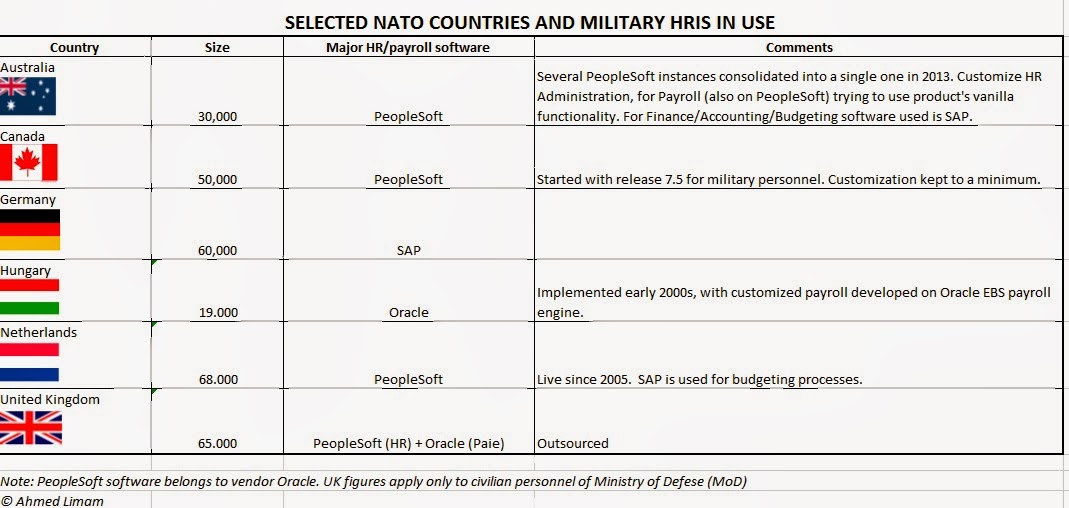
- Learn from others: Defense may be unique within every country, but since its roles and activities are replicated throughout the world, learning from others can yield great benefits, especially when comparing oneself with similar armies such as members of the NATO alliance.


- Start looking at the cloud: one advantage of being a laggard is that you can learn from others without paying the price of being a guinea pig. Some HR functions can be safely moved to the cloud with cost reductions and quality gains, others will require strategic product decisions by SAP, Oracle and Workday. So far none has seem ready to move their public-sector products to the cloud. A nudge from the customer would go a long way.


In summary, taxpayers, that is you and I, are right to wonder why in the private sector (well, the better managed businesses at least) to produce a payslip costs a couple of hundred dollars per year , whereas in the military the figure is closer to $1,000...when it works! How can our troops win the wars of the future (especially knowing that they will increasingly be IT-related) when they are defeated by a mere software? These are hard questions for which so far very few cogent answers have been provided.


Note # 1: As in all posts in this blog,  text, charts and diagrams are Ahmed Limam's intellectual property. They cannot be used without his written authorization.

Note # 2: The blogger's advisory and consulting experience covers all industries, including government, both national (such as defense)  and international (such as EU institutions and UN agencies- he worked five years for the latter in New York and Madrid.)