
PARIS
As we move from traditional on-premise ERP projects to cloud-based environments the role of system integrators is changing radically. Gone are the days when Accenture or IBM could command hefty fees for unlimited mandays and run projects unchallenged by awestruck (and often ignorant) customers.
First, customers are now savvier about technology and no longer accept any proposal that comes their way lock, stock and barrel. Second, the SaaS model has put an end to the unfortunate tendency of integrators (henceforward referred to as SIs) to customize the business software out of recognition, indulging every customer's whim some of which were even encouraged by unscrupulous SIs. Now that customization as we've known it is dead, traditional SIs have had to reinvent a good part of their business - or risk becoming irrelevant in the long term. We all remember how, when SaaS first erupted on our radars, all the large SIs ignored it, refusing to countenance the possibility that an HR project which required (so they had us believe) 18 months then could now be done in less than 12 months. But reality has this ugly habit of sticking around and the SI landscape has been affected irreversibly.
One evolution has been the birth of cloud-specific SIs. Workday, to mention the leading SaaS HR system, has spawned a growing ecosystem of boutique integrators such as DayNine in the United States or Kainos and Kloud in the UK to which one can add the smaller everBe partner in France or Appirio. These small outfits have several strengths: nimbler, more focused, less expensive. However, you also have to be aware that their smaller size means they may have limited bandwidth (for instance, if you need an expert on Absence Mangement they may have them but for Compensation you'll have to reach out to another company) and they tend to be rather thin on the change management/ transformation/process reengineering side of things (without which your new HR project is unlikely to become a smashing success).
This is when, with a deep sigh, you may consider one of the bigger SIs of which there are two categories: the Indian powerhouses and the US majors.
The Indian SIs such as Wipro (my employer in 2013), Infosys and TCS have all created cloud practices, often as an adjunct to the current integration one they already had (SuccessFactors will, for instance, be part of the SAP practice for some.) They tend to offshore most of the work which results in a lower budget. However, distance can become an issue when the iterative design process involves countless meetings across time zones with different accents and cultures to contend with. Misunderstandings can easily arise and quality can differ markedly from firm to firm and across projects. To use an easy pun, testing your new system with an Indian-based outfit can become quite testing. Most of the Indian implementation partners are really just body shops and would still struggle with the the higher value tasks of process design and change management.
These tasks, on the other hand, are the forte of the three majors, all US-based: Accenture, Deloitte, IBM. (When PwC becomes a more significant player, I will add them in an update). Let's look at them in alphabetical order.
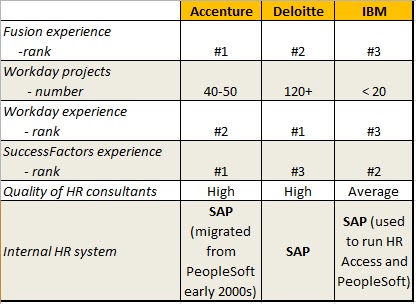
Accenture's strength lies in Fusion reflecting the strong relationship with Oracle. Accenture has more consultants trained on Fusion than any other SI and has carried out more projects. The quality of Accenture's HR consultants is also quite high evincing strong HR process expertise in all domains. Note that Accenture also leads when it comes to SuccessFactors.
Deloitte's HR credentials are as strong as Accenture's, but its focus is more on Workday. This reflects its strong HR system experience which dates back to its PeopleSoft alliance. I find them also quite good at local expertise.
IBM comes in third, and not only alphabetically, when it comes to cloud HR experience reflecting the dinosaur's reluctance to embrace the brave new world of SaaS. I found them to be quite unwieldy and at times a bureaucratic nightmare. I would recommend IBM only for the largest multinationals with a long experience of handling them. Otherwise it's no longer your project, but IBM's. Remember that these global brands have high overhead and an oversupply of processes whose costs you the customer will have to bear. If you're looking for innovation (often the rationale behind your decision to go SaaS) you are unlikely to find it here. The pure-play SIs are a safer route.
Interestingly, neither of the three major SIs has replaced its legacy SAP-based HR system of record with a cloud one. However, they are all implementing one of the three main cloud HR systems in some subsidiaries or regions of their own organizations. A big shift will take place when the three majors decide to throw in their lot with either Workday, Fusion or SuccessFactors. So far partner politics is proving stronger than cloud appeal.
One last thought. As you embark on an HR transformation project the bigger SIs will lobby you to provide help with the system-selection process, prior to bidding for the (far juicier) implementation work. They will swear on all the saints of the Catholic calendar that they have in place a Chinese wall between their advisory and implementation practices. If you believe that you will probably believe that Diana and Elvis are living happily on Easter Island surrounded by their children. A fundamental principle of project governance is to avoid the advisor having a stake in the chosen system. Ignore this tenet at your own peril.
(The blogger is currently helping a fast-growing, Nasdaq-listed, Paris-based multinational move from SAP to a cloud-based HR system)
 |
| Rushing to the cloud |
First, customers are now savvier about technology and no longer accept any proposal that comes their way lock, stock and barrel. Second, the SaaS model has put an end to the unfortunate tendency of integrators (henceforward referred to as SIs) to customize the business software out of recognition, indulging every customer's whim some of which were even encouraged by unscrupulous SIs. Now that customization as we've known it is dead, traditional SIs have had to reinvent a good part of their business - or risk becoming irrelevant in the long term. We all remember how, when SaaS first erupted on our radars, all the large SIs ignored it, refusing to countenance the possibility that an HR project which required (so they had us believe) 18 months then could now be done in less than 12 months. But reality has this ugly habit of sticking around and the SI landscape has been affected irreversibly.
One evolution has been the birth of cloud-specific SIs. Workday, to mention the leading SaaS HR system, has spawned a growing ecosystem of boutique integrators such as DayNine in the United States or Kainos and Kloud in the UK to which one can add the smaller everBe partner in France or Appirio. These small outfits have several strengths: nimbler, more focused, less expensive. However, you also have to be aware that their smaller size means they may have limited bandwidth (for instance, if you need an expert on Absence Mangement they may have them but for Compensation you'll have to reach out to another company) and they tend to be rather thin on the change management/ transformation/process reengineering side of things (without which your new HR project is unlikely to become a smashing success).
This is when, with a deep sigh, you may consider one of the bigger SIs of which there are two categories: the Indian powerhouses and the US majors.
The Indian SIs such as Wipro (my employer in 2013), Infosys and TCS have all created cloud practices, often as an adjunct to the current integration one they already had (SuccessFactors will, for instance, be part of the SAP practice for some.) They tend to offshore most of the work which results in a lower budget. However, distance can become an issue when the iterative design process involves countless meetings across time zones with different accents and cultures to contend with. Misunderstandings can easily arise and quality can differ markedly from firm to firm and across projects. To use an easy pun, testing your new system with an Indian-based outfit can become quite testing. Most of the Indian implementation partners are really just body shops and would still struggle with the the higher value tasks of process design and change management.
These tasks, on the other hand, are the forte of the three majors, all US-based: Accenture, Deloitte, IBM. (When PwC becomes a more significant player, I will add them in an update). Let's look at them in alphabetical order.
Accenture's strength lies in Fusion reflecting the strong relationship with Oracle. Accenture has more consultants trained on Fusion than any other SI and has carried out more projects. The quality of Accenture's HR consultants is also quite high evincing strong HR process expertise in all domains. Note that Accenture also leads when it comes to SuccessFactors.
Deloitte's HR credentials are as strong as Accenture's, but its focus is more on Workday. This reflects its strong HR system experience which dates back to its PeopleSoft alliance. I find them also quite good at local expertise.
IBM comes in third, and not only alphabetically, when it comes to cloud HR experience reflecting the dinosaur's reluctance to embrace the brave new world of SaaS. I found them to be quite unwieldy and at times a bureaucratic nightmare. I would recommend IBM only for the largest multinationals with a long experience of handling them. Otherwise it's no longer your project, but IBM's. Remember that these global brands have high overhead and an oversupply of processes whose costs you the customer will have to bear. If you're looking for innovation (often the rationale behind your decision to go SaaS) you are unlikely to find it here. The pure-play SIs are a safer route.
 |
| Do as we say, not as we do |
Interestingly, neither of the three major SIs has replaced its legacy SAP-based HR system of record with a cloud one. However, they are all implementing one of the three main cloud HR systems in some subsidiaries or regions of their own organizations. A big shift will take place when the three majors decide to throw in their lot with either Workday, Fusion or SuccessFactors. So far partner politics is proving stronger than cloud appeal.
One last thought. As you embark on an HR transformation project the bigger SIs will lobby you to provide help with the system-selection process, prior to bidding for the (far juicier) implementation work. They will swear on all the saints of the Catholic calendar that they have in place a Chinese wall between their advisory and implementation practices. If you believe that you will probably believe that Diana and Elvis are living happily on Easter Island surrounded by their children. A fundamental principle of project governance is to avoid the advisor having a stake in the chosen system. Ignore this tenet at your own peril.
(The blogger is currently helping a fast-growing, Nasdaq-listed, Paris-based multinational move from SAP to a cloud-based HR system)

