
NEW YORK
Last month saw France's president pay a state visit to the United States. Among the various topics on offer for Presidents Obama and Hollande one could mention the drop in foreign investment in France (due to the French government's idiotic policies), the impact of the NSA spying scandal (due to the US government's idiotic policies), both leaders' marital woes (alleged in Obama's case, true in the case of Hollande who regaled the nation with two First Ladies, one official, one hidden), the various crises around the world (Syria, Ukraine etc.) However, there is one topic which the two leaders probably didn't get to discuss: how their respective military failed spectacularly in implementing a payroll system for their armed forces.
The U.S. tries first... and fails first
As in so many other cases, the U.S. was a pioneer in the use of package software to run its HR and payroll operations. In the late 1990s it adopted the HR software leader of the time, PeopleSoft (which had developed a specific Federal product) to integrate over 90 different systems into a state-of-the-art HR/payroll system. Several hundreds Department of Defense (DoD) contractors and employees worked on the project which was supposed to go live in 2006. I will spare you the the details of this soap opera which comes with epic cost overruns and deadlines missed, but suffice it to say that in 2010, that is TWELVE years after project kickoff, DIMHRS (Defense Integrated Military HR Systems as the acronym goes) was announced dead on arrival (the system integrator was Northrop Grumman.) Oh, and it only cost $1 billion, by the way. Quite a lot for a payroll system that was never used.
The solution was...to go back to the 40-year old system (written in Cobol) and it did not fare markedly better as it results in countless payroll errors for many of the 2.7 million active-duty personnel: many soldiers get shortchanged on their pay, others get overpaid and then have to do with abrupt paycuts as DoD recoups the monies, which is hardly the best way to motivate troops who put their life on the line all over the world. In some cases deserters continue to be paid for years. Retirees who are rehired to find themselves in a bizarre situation: a glitch in the system often results in retiree records being updated to "dead" with condolence letters sent to the family of an otherwise quite healthy soldier. This happened to none other than the U.S. Army Chief of Staff.
It is quite mind boggling that an organization like the Pentagon which uses the most sophisticated technologies in the world can be defeated by something quite humdrum as payroll software.
Where the US leads, its oldest ally, France, follows
The French military is smaller in size than its U.S. counterpart (300,000 troops half of which in the Army) but it is proportionately as maddeningly complex, if not more. As in the US every branch of the military uses a different HR/payroll system, each originally custom-built and with pleasant names such as Concerto, Rh@psodie, Symphonie. Starting around 2005 each branch decided to move to a package software based on SAP. As the below diagram shows each branch had its own version of SAP HR which was interfaced to Louvois, a new custom-made payroll system, to be replaced in 2016 by ONP, an HR Access-based payroll system for all French government employees. Unfortunately for French servicemen and taxpayers Louvois, like its US counterpart, was an unmitigated disaster. Costing north of half a billion euros, with several hundred million more in overpayments, compensation paid to tens of thousands of military families who got shortchanged and additional implementation/maintenance costs to fix the issues, the French military will probably end up paying even more than the Pentagon for the same result: a failed payroll system. At least we French have one consolation: in one area, failed military payroll projects, we outdid the Americans. The French Minister of Defense had to recognize the failure since it was on such an epic scale and promise to build a new payroll system by the end of next year before it was to be replaced by ONP. Even the CEO of Steria, the IT company which built the system, appeared on TV for a prime-time attempt at damage control. And now the bombshell: I have it from confidential sources that even the ONP project will be scrappped: another half a billion dollars are thus being simply thrown out the window with this second project failure by the same government. Two spectacular HR IT failures two years in a row. Who can say that we in France don't do things better than in the United States?

What went wrong?
- Too many obsolete payroll and accounting systems which do not communicate with one another and HR systems. This issue has more than academic results: for instance, a soldier who is the beneficiary of payroll errors is wounded in Afghanistan and sent back to a hospital back home. According to the rules he should be forgiven all debts related to payroll errors. Except that since HR systems take for ever to be updated and when they are they are badly interfaced to payroll, our soldier finds himself without a "wounded warrior" status and he and his family have to go through unjustified financial hardships. Hardly the best way to reward someone who almost lost their life for the country.
- Absurd number of manual workaround and paper-based processes: staff data has to be written on a form, then physically sent to another location where it is manually entered into another system, by yet another employee. In 2014, when organizations are moving their HR operations to the cloud such an antiquated way of doing business is unbelievable
- The complexity of rules, pay levels and status types in both countries is mind-boggling. In the US the multiple basic pay/entitlements/housing allowance/re-enlistment bonus often results in a soldier's pay changing several times per day. The creativity of French legislators and bureaucrats is no less astounding: for instance, the Navy pays a €300 allowance to every single mother whose child has been recognized by one of the Republic's sailors whatever port city in the world she can be found in. Many Navy personnel have recognized up to 10 children. A senior naval officer even told me that he knows of one case where a sailor owned up to ...20 children! The French government, ever understanding (and generous with taxpayers' money) when it comes to such shenanigans, coughs up. And every payment has to comply with the tax rules of every country the child was born in. Only a particularly robust HR and payroll system can handle such complexity. It is obvious that some rules have to change, and Congress and Parliament will have to make the necessary changes. But many processes are not mandated by law: they are just the result of a decades-long practice of using paper and manual processes. These can be streamlined much more easily, and should have been done so. Why weren't they? Incompetence is one answer, and the vested interest that system integrators have in maintaining the staus quo: after all, the more complex the requirements are, the more need there will be for customization. Here, as we have seen in other industries, what is good for an SI is not good for the customer and, ultimately the taxpayer.
- The various HR systems used do not provide for an efficient way to track personnel and allocate them swiftly. The U.S. Marines are in an altogether different one. France, as shown in the previous diagram, replicates the madness: does it really make sense to have each branch with their own SAP implementation? Wouldn't have it been much more efficient to streamline HR processes first, arrive at a common set of requirements and then implement just one instance of SAP HR for all military personnel, something they will eventually have to do. And why spend years and hundreds of millions developing Louvois if it is to be replaced, upon implementation, by yet another payroll system? The strategy does not make sense at all.
- Change resistance by a reluctant bureaucracy and competing priorities are not helping, either. Change management was rarely given the importance it deserves, and the decision-making process was at best byzantine with defense committees and appropriations sub-committees fighting for control: this is hardly the hallmarks of success.
What to do about it?
Although some of the issues seem to spring from the unique circumstances of government organizations, most can be encountered in any industry, regardless of size or geography. Before some start hysterical attacks on the wastefulness of government, they should be reminded that failed IT project (whether HR or ERP) are prevalent in all industries: I know several well-known brand names whose HR systems are a shame, so let the company that has never known a failed IT project cast the first stone. However, in the case of government's failed projects one difference stands out: we taxpayers are paying for it. If a private business mismanages its HR budget, well, it's only the shareholders who are losing money; when government does, it's all of us.
- Reduce the complexity of rules. Sure, government is unique, but do you think that multinational companies that track and pay hundreds of thousands of employees (for some) across several time zones/dozens of currencies/scores of different legislations are easier to manage? If they can, whey can't Defense? When reengineering your processes, trace every requirement to a law or a policy; everything else should not be in the system. Ensure that there is a single point of contact to facilitate decision-making. When too many cooks fight in the kitchen, the result is rarely a great broth.
-Beware of requirements creep: a tendency seen in all industries, but particularly prevalent in the public sector is, in the absence of an agreement as to requirements, to revert to As-Is which undermines the whole business process reengineering exercize. Using a requirement-tracking tool is another great advantage in enhancing the quality of the requirements, something that few defense organizations do comprehensively.
- Realize that unlike wine, Cobol lines of code don't improve with age. Documentation, when available is long gone, as are those who created both. It is high time to move to the 21st century.
- Go vanilla! Eschew customization, one of the greatest ills to have been inflicted on corporate IT. The decision to go with off-the-shelf software was the right decision, however the military organizations decided to atone for it by customizing the software out of recognition (especially in France) and in the case of payroll, and some other HR functions, even use home-made software. In both the US and France, going back in time and re-adopting the old custom-made system is another grievous mistake.
- Build up your resources: government organizations tend not to be the leanest organizations with the availability of high-tech skills lagging other industries. They should set up Centers of Excellence (CoEs) and transfer knowledge from HR/IT vendors as soon as possible so that by the time the system integrator is gone, everything does not go down the drain or deplete state coffers by resorting to expensive contractors.
- Improve planning and be fast: I know it is a challenge to circumvent government bureaucracies, but decision-making should be sped up as much as possible. Because technology changes much faster than government bureaucrats can countenance, try and break down these huge projects into smaller ones based on relatively easy to define HR processes and sub-processes.
- Develop KPIs about progress, success factors, user satisfaction and ensure these are measured adequately: all deviations should be explained and accounted for. It is nothing short of scandalous that when French Defense Minister Le Drian was asked who should be blamed for the fiasco, he replied, "it is a collective responsibility," meaning that since everybody was guilty, then nobody was. And so far, not a single head has rolled reinforcing the culture of impunity so prevalent in the public sector. Are key product features missing from the HR and payroll products? Then how come that we didn't ask the vendors to include them in their roadmap? And if we did, how come that SAP/Oracle/HR Access didn't deliver them? And if they didn't when they were supposed to, then how come they are not held accountable and being asked to pay the hefty penalties that should have been part of the contract? If the issue is one of configuration and customization, then all eyes should turn to Northrop Grumman, Steria, HR Access: did they implement the system according to specifications? If not, then they should be held accountable. Were specifications provided in a clear, thorough and timely fashion to the system integrator? If not, then government employees and contractors should be held accountable. And who took the decision to unplug the older systems which worked and replace them by the newer ones which ended up not working? As we all know, a new payroll goes live only after several parallel processes are run and all issues are fixed. Somebody must have taken that decision. Who? Why?
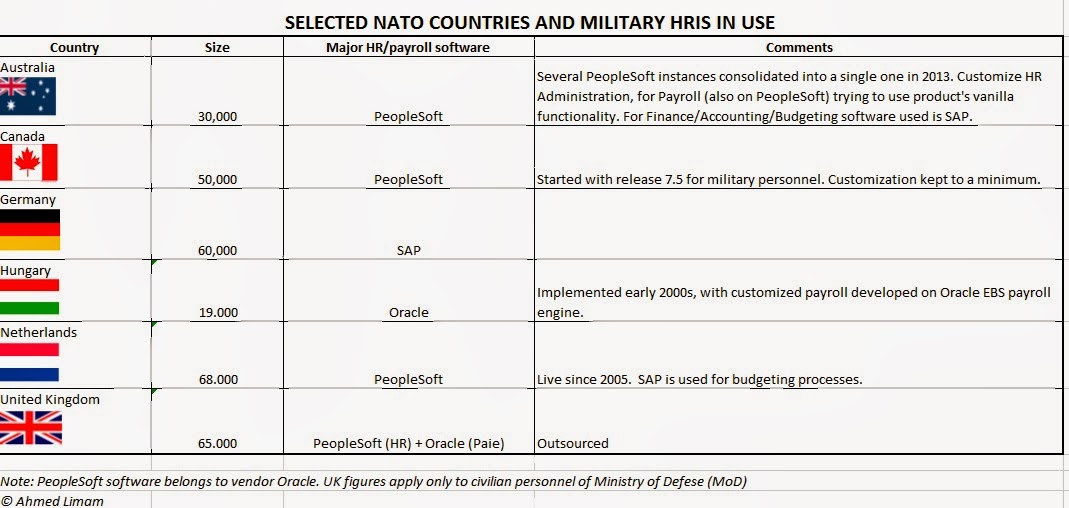
- Learn from others: Defense may be unique within every country, but since its roles and activities are replicated throughout the world, learning from others can yield great benefits, especially when comparing oneself with similar armies such as members of the NATO alliance.
- Start looking at the cloud: one advantage of being a laggard is that you can learn from others without paying the price of being a guinea pig. Some HR functions can be safely moved to the cloud with cost reductions and quality gains, others will require strategic product decisions by SAP, Oracle and Workday. So far none has seem ready to move their public-sector products to the cloud. A nudge from the customer would go a long way.
In summary, taxpayers, that is you and I, are right to wonder why in the private sector (well, the better managed businesses at least) to produce a payslip costs a couple of hundred dollars per year , whereas in the military the figure is closer to $1,000...when it works! How can our troops win the wars of the future (especially knowing that they will increasingly be IT-related) when they are defeated by a mere software? These are hard questions for which so far very few cogent answers have been provided.
Note # 1: As in all posts in this blog, text, charts and diagrams are Ahmed Limam's intellectual property. They cannot be used without his written authorization.
Note # 2: The blogger's advisory and consulting experience covers all industries, including government, both national (such as defense) and international (such as EU institutions and UN agencies- he worked five years for the latter in New York and Madrid.)
 |
| “Dulce
et decorum est pro patria mori,” ancient Romans used to say. It is not only good to die for one's country, but payroll software requires you do it for free |
The U.S. tries first... and fails first
As in so many other cases, the U.S. was a pioneer in the use of package software to run its HR and payroll operations. In the late 1990s it adopted the HR software leader of the time, PeopleSoft (which had developed a specific Federal product) to integrate over 90 different systems into a state-of-the-art HR/payroll system. Several hundreds Department of Defense (DoD) contractors and employees worked on the project which was supposed to go live in 2006. I will spare you the the details of this soap opera which comes with epic cost overruns and deadlines missed, but suffice it to say that in 2010, that is TWELVE years after project kickoff, DIMHRS (Defense Integrated Military HR Systems as the acronym goes) was announced dead on arrival (the system integrator was Northrop Grumman.) Oh, and it only cost $1 billion, by the way. Quite a lot for a payroll system that was never used.
The solution was...to go back to the 40-year old system (written in Cobol) and it did not fare markedly better as it results in countless payroll errors for many of the 2.7 million active-duty personnel: many soldiers get shortchanged on their pay, others get overpaid and then have to do with abrupt paycuts as DoD recoups the monies, which is hardly the best way to motivate troops who put their life on the line all over the world. In some cases deserters continue to be paid for years. Retirees who are rehired to find themselves in a bizarre situation: a glitch in the system often results in retiree records being updated to "dead" with condolence letters sent to the family of an otherwise quite healthy soldier. This happened to none other than the U.S. Army Chief of Staff.
It is quite mind boggling that an organization like the Pentagon which uses the most sophisticated technologies in the world can be defeated by something quite humdrum as payroll software.
Where the US leads, its oldest ally, France, follows
The French military is smaller in size than its U.S. counterpart (300,000 troops half of which in the Army) but it is proportionately as maddeningly complex, if not more. As in the US every branch of the military uses a different HR/payroll system, each originally custom-built and with pleasant names such as Concerto, Rh@psodie, Symphonie. Starting around 2005 each branch decided to move to a package software based on SAP. As the below diagram shows each branch had its own version of SAP HR which was interfaced to Louvois, a new custom-made payroll system, to be replaced in 2016 by ONP, an HR Access-based payroll system for all French government employees. Unfortunately for French servicemen and taxpayers Louvois, like its US counterpart, was an unmitigated disaster. Costing north of half a billion euros, with several hundred million more in overpayments, compensation paid to tens of thousands of military families who got shortchanged and additional implementation/maintenance costs to fix the issues, the French military will probably end up paying even more than the Pentagon for the same result: a failed payroll system. At least we French have one consolation: in one area, failed military payroll projects, we outdid the Americans. The French Minister of Defense had to recognize the failure since it was on such an epic scale and promise to build a new payroll system by the end of next year before it was to be replaced by ONP. Even the CEO of Steria, the IT company which built the system, appeared on TV for a prime-time attempt at damage control. And now the bombshell: I have it from confidential sources that even the ONP project will be scrappped: another half a billion dollars are thus being simply thrown out the window with this second project failure by the same government. Two spectacular HR IT failures two years in a row. Who can say that we in France don't do things better than in the United States?
What went wrong?
- Too many obsolete payroll and accounting systems which do not communicate with one another and HR systems. This issue has more than academic results: for instance, a soldier who is the beneficiary of payroll errors is wounded in Afghanistan and sent back to a hospital back home. According to the rules he should be forgiven all debts related to payroll errors. Except that since HR systems take for ever to be updated and when they are they are badly interfaced to payroll, our soldier finds himself without a "wounded warrior" status and he and his family have to go through unjustified financial hardships. Hardly the best way to reward someone who almost lost their life for the country.
- Absurd number of manual workaround and paper-based processes: staff data has to be written on a form, then physically sent to another location where it is manually entered into another system, by yet another employee. In 2014, when organizations are moving their HR operations to the cloud such an antiquated way of doing business is unbelievable
- The complexity of rules, pay levels and status types in both countries is mind-boggling. In the US the multiple basic pay/entitlements/housing allowance/re-enlistment bonus often results in a soldier's pay changing several times per day. The creativity of French legislators and bureaucrats is no less astounding: for instance, the Navy pays a €300 allowance to every single mother whose child has been recognized by one of the Republic's sailors whatever port city in the world she can be found in. Many Navy personnel have recognized up to 10 children. A senior naval officer even told me that he knows of one case where a sailor owned up to ...20 children! The French government, ever understanding (and generous with taxpayers' money) when it comes to such shenanigans, coughs up. And every payment has to comply with the tax rules of every country the child was born in. Only a particularly robust HR and payroll system can handle such complexity. It is obvious that some rules have to change, and Congress and Parliament will have to make the necessary changes. But many processes are not mandated by law: they are just the result of a decades-long practice of using paper and manual processes. These can be streamlined much more easily, and should have been done so. Why weren't they? Incompetence is one answer, and the vested interest that system integrators have in maintaining the staus quo: after all, the more complex the requirements are, the more need there will be for customization. Here, as we have seen in other industries, what is good for an SI is not good for the customer and, ultimately the taxpayer.
- The various HR systems used do not provide for an efficient way to track personnel and allocate them swiftly. The U.S. Marines are in an altogether different one. France, as shown in the previous diagram, replicates the madness: does it really make sense to have each branch with their own SAP implementation? Wouldn't have it been much more efficient to streamline HR processes first, arrive at a common set of requirements and then implement just one instance of SAP HR for all military personnel, something they will eventually have to do. And why spend years and hundreds of millions developing Louvois if it is to be replaced, upon implementation, by yet another payroll system? The strategy does not make sense at all.
- Change resistance by a reluctant bureaucracy and competing priorities are not helping, either. Change management was rarely given the importance it deserves, and the decision-making process was at best byzantine with defense committees and appropriations sub-committees fighting for control: this is hardly the hallmarks of success.
What to do about it?
Although some of the issues seem to spring from the unique circumstances of government organizations, most can be encountered in any industry, regardless of size or geography. Before some start hysterical attacks on the wastefulness of government, they should be reminded that failed IT project (whether HR or ERP) are prevalent in all industries: I know several well-known brand names whose HR systems are a shame, so let the company that has never known a failed IT project cast the first stone. However, in the case of government's failed projects one difference stands out: we taxpayers are paying for it. If a private business mismanages its HR budget, well, it's only the shareholders who are losing money; when government does, it's all of us.
- Reduce the complexity of rules. Sure, government is unique, but do you think that multinational companies that track and pay hundreds of thousands of employees (for some) across several time zones/dozens of currencies/scores of different legislations are easier to manage? If they can, whey can't Defense? When reengineering your processes, trace every requirement to a law or a policy; everything else should not be in the system. Ensure that there is a single point of contact to facilitate decision-making. When too many cooks fight in the kitchen, the result is rarely a great broth.
-Beware of requirements creep: a tendency seen in all industries, but particularly prevalent in the public sector is, in the absence of an agreement as to requirements, to revert to As-Is which undermines the whole business process reengineering exercize. Using a requirement-tracking tool is another great advantage in enhancing the quality of the requirements, something that few defense organizations do comprehensively.
- Realize that unlike wine, Cobol lines of code don't improve with age. Documentation, when available is long gone, as are those who created both. It is high time to move to the 21st century.
- Go vanilla! Eschew customization, one of the greatest ills to have been inflicted on corporate IT. The decision to go with off-the-shelf software was the right decision, however the military organizations decided to atone for it by customizing the software out of recognition (especially in France) and in the case of payroll, and some other HR functions, even use home-made software. In both the US and France, going back in time and re-adopting the old custom-made system is another grievous mistake.
- Build up your resources: government organizations tend not to be the leanest organizations with the availability of high-tech skills lagging other industries. They should set up Centers of Excellence (CoEs) and transfer knowledge from HR/IT vendors as soon as possible so that by the time the system integrator is gone, everything does not go down the drain or deplete state coffers by resorting to expensive contractors.
- Improve planning and be fast: I know it is a challenge to circumvent government bureaucracies, but decision-making should be sped up as much as possible. Because technology changes much faster than government bureaucrats can countenance, try and break down these huge projects into smaller ones based on relatively easy to define HR processes and sub-processes.
- Develop KPIs about progress, success factors, user satisfaction and ensure these are measured adequately: all deviations should be explained and accounted for. It is nothing short of scandalous that when French Defense Minister Le Drian was asked who should be blamed for the fiasco, he replied, "it is a collective responsibility," meaning that since everybody was guilty, then nobody was. And so far, not a single head has rolled reinforcing the culture of impunity so prevalent in the public sector. Are key product features missing from the HR and payroll products? Then how come that we didn't ask the vendors to include them in their roadmap? And if we did, how come that SAP/Oracle/HR Access didn't deliver them? And if they didn't when they were supposed to, then how come they are not held accountable and being asked to pay the hefty penalties that should have been part of the contract? If the issue is one of configuration and customization, then all eyes should turn to Northrop Grumman, Steria, HR Access: did they implement the system according to specifications? If not, then they should be held accountable. Were specifications provided in a clear, thorough and timely fashion to the system integrator? If not, then government employees and contractors should be held accountable. And who took the decision to unplug the older systems which worked and replace them by the newer ones which ended up not working? As we all know, a new payroll goes live only after several parallel processes are run and all issues are fixed. Somebody must have taken that decision. Who? Why?
- Learn from others: Defense may be unique within every country, but since its roles and activities are replicated throughout the world, learning from others can yield great benefits, especially when comparing oneself with similar armies such as members of the NATO alliance.
- Start looking at the cloud: one advantage of being a laggard is that you can learn from others without paying the price of being a guinea pig. Some HR functions can be safely moved to the cloud with cost reductions and quality gains, others will require strategic product decisions by SAP, Oracle and Workday. So far none has seem ready to move their public-sector products to the cloud. A nudge from the customer would go a long way.
In summary, taxpayers, that is you and I, are right to wonder why in the private sector (well, the better managed businesses at least) to produce a payslip costs a couple of hundred dollars per year , whereas in the military the figure is closer to $1,000...when it works! How can our troops win the wars of the future (especially knowing that they will increasingly be IT-related) when they are defeated by a mere software? These are hard questions for which so far very few cogent answers have been provided.
Note # 1: As in all posts in this blog, text, charts and diagrams are Ahmed Limam's intellectual property. They cannot be used without his written authorization.
Note # 2: The blogger's advisory and consulting experience covers all industries, including government, both national (such as defense) and international (such as EU institutions and UN agencies- he worked five years for the latter in New York and Madrid.)


