Further info and resources from my website

Showing posts with label Fusion. Show all posts

Tuesday, February 21, 2017

Cooking the books: How Oracle inflates cloud revenue figures and what it means for you

PARIS  
The truth will always out
Technology firms have never been stranger to hyperbole, whether discussing the alleged value their products bring, customer numbers or the size of their business. As I described in my book, High-Tech Planet: Secrets of an IT Road Warrior, being creative with facts is par for the course for most of them. However,  those vendors scrambling frantically to move from a legacy on-premise business to the brave new world of cloud-based systems, find themselves so desperate that creativity with reality takes on new forms.

Oracle, though by no stretch of the imagination the only offender, is doubtlessly the worst one. This is compounded by the fact that it came late and reluctantly to the cloud (watch this video of Oracle's boss Larry Ellison pooh-poohing the cloud). After its on-premise succession product Fusion failed to gain much traction and its Sun hardware acquisition turned out to be in the words of former Oracle Über -VP of Sales, Keith Block, " a dud", Oracle and Larry Ellison (the two are interchangeable) had no other choice but to go down the cloud route.

Unfortunately the software industry, among others, is known for its first-mover advantage meaning that by the time Oracle decided to do something about (in) the cloud, many of its customers had already defected to Salesforce (for CRM) and Workday (for HR.) Resorting to its good old ways, Ellison didn't hesitate to predict quite outlandishly that his company would bury Workday. Post-truth statements and alternative facts didn't premiere with the Trump administration; Oracle had started the ball rolling earlier. However, since "facts are stubborn" as Lenin said, Oracle felt it had to go one step further: falsify its cloud revenue figures.

Last June, a courageous Oracle employee, Svetlana Blackburn, a finance manager, came forward denouncing Oracle for pressuring her to inflate cloud sales figures (here's another report by Reuters). The various tricks used by a vendor trying to inflate its cloud figures include, but are not limited to, the following :

  • Lump on-premise and cloud figures together and then pretend it's all cloud
  • Give huge credit to customers moving their on-premise license value to the cloud and consider it as booked cloud sales
  • Give a cloud product for free and then extrapolate its sales value to other modules
  • Sell a cloud subscription for a pilot population but book it as if it were for the whole company headcount.
Of course, Oracle immediately fired the whistleblower claiming she was being terminated for low performance. Yeah, right! Ms. Blackburn went to court, Oracle stood its ground saying it had done nothing wrong until last week it capitulated by offering an out-of court settlement. As we all know, nobody offers a settlement unless they have done something wrong. Oracle hoped to put behind it the embarrassing scandal and avoid more damaging revelations to come forward.

What does this mean for you?

As a customer, you need to get a sense of how serious an offering is, what its long-term prospects are and how likely that a sizable customer base will ensure that continuing investment in the platform is assured. Most of the clients I work with and who include Oracle Fusion in the evaluation, end up not shortlisting it for various reasons including fuzzy economics and product strategy. 

As an employee/candidate, especially from the sales function, you need guarantees that your employer will not fiddle sales figures with the aim to shortchange you. Interestingly, the same week that it was confirmed that Oracle indeed forges its cloud sales figures (last week), the company was on the receiving end of a $150 million class-action lawsuit by sales employees complaining about the company's efforts to avoid paying them their commissions.

Finally, as an investor you want to ensure that your investment dollars are well used and that you are not throwing good money after bad*.  Interestingly, too, when the whistleblower revealed Oracle's accounting shenanigans last June, a group of investors launched another lawsuit against Oracle. And for the past (rolling) year, as the below graph shows, Oracle's stock has been languishing whereas its pure, native cloud competitors' has shot up by 40 to 50%. 


A tale of two vendor types: native and adopted cloud


In summary, we  can see that Oracle's desperate behavior, far from helping it, is making matters worse: customers are not joining in droves, cloud sales remain stubbornly a tiny fraction of its overall revenue, in spite of all the figure massaging, and the stock price evolution reflects that situation. Until and  unless Oracle makes some serious changes to its product strategy/sales approach, and culture, it is no rocket science to see what the end game is likely to be: increasing irrelevance. 

Losing steam


*The blogger's clients include not only end-user organizations evaluating/selecting/ implementing/expanding new HRIS systems, but also investors requesting analysis as to HR system vendors' market potential.

Tuesday, April 19, 2016

SOW - A Comparison of 3 Global Cloud HR vendors: SAP, Oracle and Workday

GENEVA & NEW YORK
The leader, the follower and the laggard
I have been asked for a while to share my system-evaluation and -implementation experience with the community and my readership by comparing the three most frequently shortlisted cloud HR systems: SAP (SuccessFactors), Oracle (Fusion) and Workday. I will from now on refer to them as SOW, to be pronounced either to rhyme with "low" (as in "low adoption") or to sound like a female pig since some of these vendors' features are no better than lipstick on a pig. *

Of apples and oranges
Although there are more than three cloud-based HR vendors, the reason I am limiting myself to the SOW usual suspects is because they are the only ones with a global reach to meet the complex requirements of multinational companies. Despite attempts to the contrary, Ultimate is still a US vendor, Meta4 has all but disappeared, HR Access has been folded into Sopra and Cornerstone has yet to make up its mind whether to develop a full-fledged HR Admin module - and without an HR system of record you cannot have a global HRIS worth its salt. ADP is mainly a payroll outsourcer with multiple products (some in the cloud and covering various HR processes) but not a global HR system of record. Infor has yet to rationalize its product offering à la Fusion and its Lawson offering was never a truly global HRIS. And some of these vendors' "cloud" offerings are really nothing more than a quick repackaging of their old hosting business. So, here we are, stuck with SOW.

This being said, it is worth remembering that to a large extent  we are comparing apples and oranges since there are such key differences between these vendors that some evaluation exercises can turn to the surreal. Oracle, for instance, is mainly a database vendor with a strong anti-cloud history and a PeopleSoft legacy customer base which has yet to endorse Oracle Fusion. SAP, which comes from the application world, has therefore more serious credentials, reinforced by its continuing investment in the SuccessFactors platform. Its main issue is that, in addition to some questionable product decisions, it has yet to articulate a cogent cloud-based ERP strategy.  This is the main reason why I refer to Oracle and SAP (along with some others) as dinosaurs in a popular blog post. Workday, on the other hand, is of course a native cloud vendor which has quickly shot to the top of the league table with an offering, business culture and service quality that the other dinosaurs can only dream of emulating. Yet, Workday is far from perfect and also has some serious issues.

SaaS and cloud
Some companies may not care about the differences between SaaS and cloud, some may even be ignorant of them, but it is good to remind my readership of the meaning of these  two concepts which are often and wrongly used interchangeably. SaaS is the most advanced form of the cloud where all parts of an offering (hardware, database, software) come from a  single vendor. All you the customer need to provide is a browser-toting device (desktop/tablet/smartphone) and you're in business. Workday is thus a true SaaS vendor. SuccessFactors, whose offering relies on some on-premise legacy features which are hosted, is getting there but cannot be considered 100% SaaS. As for Oracle, who first developed its Fusion product as  an on-premise solution, and can deliver it as a hosted system, it is therefore in the cloud but of course not SaaS. So remember this key differentiator: All SaaS systems are by definition cloud-based, but the reverse is not true.


Stats wars
As the community knows, I have zero tolerance for fanciful figures, especially around customer numbers. Some of the fairy tales I hear are so absurd that I am unsure whether to laugh or sob when I hear them. The below scorecards provide a reasonable count of LIVE customers as per each cloud system. If the customer is still on PeopleSoft for HR Admin and has interfaced it to Taleo or some Fusion talent modules, Oracle will refer to this misleadingly as Cloud HCM. I don't. Same thing for SAP: If Employee Central is not implemented, then I do not count SuccessFactors as a reference - it is only a talent project, not a global HR one. Workday is easier since, by definition, their system cannot run without core HR as a foundation (although some customers use a light HR version to start with talent processes such as performance.)

Integrated/interfaced/unified/organic etc.
After phony customer count figures, the biggest source of BS that comes from vendors has to do with how well integrated the offering is. Here misinformation is rife, with Oracle the undisputed leader. Fusion, which can come in different flavors as mentioned earlier (public cloud, private cloud, on-premise - see below) does not necessarily cover all HR processes and most customers prefer to hang on to the legacy core HR. Talent features can come from either Fusion or Taleo. And within Taleo remember that the Learn.com product was built on .NET technology whereas Taleo was built on Java.

SAP SuccessFactors at least developed Employee Central on its own technology stack; however Plateau was not a 100% SaaS offering, and Concur and Fieldglass are based on other technologies. The other SF modules are also on different technologies which means a customer running the whole suite will have different code bases AND versions. (And as for Multiposting, well, nobody knows when/if it will be integrated in SF/EC.) Not pretty, and not full SaaS. And, of course, Employee Central Payroll is anything but an Employee Central payroll.

Workday, on the other hand, as befits a product developed from scratch and organically, has the cleanest data model with all HR processes now available, except Learning. Payroll is largely work in progress, with the last two countries released (UK, France) yet to go live with a customer. I still have my doubts as to the ability of a single global SaaS payroll vendor to deliver the goods in an efficient manner.
I can already hear some jump and say, "Hold on a second. Workday, too, has integrated third-party technologies after acquiring Cape Clear and Identified." Most true, but there is a fundamental difference when you integrate a third-party product as part of your underlying technology and when you do it to cover a specific HR domain. With the latter you find yourself with a different look and feel, different workflows, a different data model. Any HR user who had to struggle with different products would tell you what a nightmare it is.

3 -VENDOR ANALYSIS: COMPANY COMPARISON


Oracle Fusion has come a long way from an on-premise, complex-to-implement, functionally limited product with an ugly look and feel (those overloaded screens with horrid blue!), to one that can be deployed in the cloud. To get a sense of Fusion's background, refer to my post "Error 404: Oracle Fusion not found".) Since then, it has made progress (especially on the  UI front when it moved from FusionFX to Skyros), but its two other competitors, both cloud natives, have moved faster and often better. Oracle still misses many key HR domains (see the product scorecard below) and its vision and roadmap at best are fuzzy, at worse don't make any sense: Why waste its time developing unneeded products such as Employee Wellness, Reputation Management, My Volunteering or low-priority ones such as HR Help Desk, and still miss, Tier-1 country localizations or Recruitment on the Fusion platform? The co-existence or hybrid approach is not a meaningful differentiator, but actually a sign of weakness: Missing key bits, Oracle tends to lump everything together and it's up to the customer to make sense of what is what and how to integrate it, not an easy task when Oracle is still not very forthcoming when it comes to its offering, as explained below.

Public Cloud, Private Cloud, and Cloud ServicesThe Taleo product line is a case in point: Officially rebranded as Oracle Talent Cloud (but on their website still referred to as Oracle Taleo Cloud) it is supposed to be the Recruiting offering to be interfaced to Fusion Core HR. However, the overlap issues (Fusion Performance vs Taleo Performance, say, or Fusion Compensation vs Taleo Compensation) has yet to be resolved. Ask the question and  you'll get a mumble from poor sales executives who are none the wiser. Note that Taleo is a hodgepodge of various acquisitions itself: Learn.com (with its scaling issues), Jobpartners, Recruitforce and Vurv, and Wordwide Compensation. (Not to mention that there are two Taleo flavors that go by the Enterprise and Business monikers)Talking about Compensation I find it a pity that Fusion does not allow user-defined logic to go into compensation elements, for instance to add a regional rate to a pay rate and calculate an employee's compensation on that basis.
Fusion, born as an on-premise product, can be hosted in a private cloud (customer's own environment) or shared (public cloud) with different deployment implications.
As if  the (con)Fusion was not enough, you have PeopleSoft Cloud Service which is as far from a SaaS offering as St Petersburg, Florida is from St Petersburg, Russia.
Then there is a host of other products such as Right Now Policy Automation (benefit eligibility), another acquisition, which Oracle throws at befuddled customers.
Making sense of Oracle's offering is clearly not for the faint-hearted.

Great products are built by great people. The converse is also true: Mediocre people build mediocre products. Oracle, with its stifling bureaucracy and awful management, has problems attracting and retaining quality people, especially in the HCM ¨product line. Add to that the fact that in Oracle's highly political culture the technology side has always had the upper hand versus product, and that HCM has always been the Cinderella application, only getting attention when a top leader emerges (first PeopleSoft, and now Workday.) This explains why the company never features in Great Places To Work league tables and has suffered from a steady hemorrhage of its best and brightest from PeopleSoft who have been poached from Workday, leaving a lot of deadwood behind.

An even bigger biggest issue with Oracle is how it (mis)treats its long-suffering customers. Just this week, an old customer, the  French Civil Aviation Authority, who has had enough of Oracle's abusive licensing and audit practices, decided to discontinue the use of all Oracle products. Last year, two other French companies, Carrefour and AFPA, went to court over the same issues and won. In 2014, a survey by the Campaign for Clear Licensing of 100 global Oracle customers found that 92% of them were deeply unhappy with the vendor. In the US, none other than the federal government decided in 2012 to ban Oracle from bidding for its business due to the vendor's questionable sales practices. Well, you get the idea. Unless you evince a particularly strong masochistic streak, selecting Oracle often  means tough times ahead.

On the technology front, Fusion, contrary to the vendor's spin, is not a "fusion" of its portfolio applications, but neither is it exclusively based on its unpopular EBS product line even if it borrows many features from it such as FastFormulas and Flexfields - the latter permeates Fusion even more than with EBS thus allowing good customization possibilities. However, Forms have mercifully been retired in favor of more modern Java and SOA-based technology. Outbound integration is a big headache as is data migration, even from Oracle's legacy systems. It is noteworthy that if many Oracle customers prefer to implement Fusion in the cloud rather than on-premise it is (in addition to the natural preference for the cloud), because, first, the HR Admin part has yet to reach functional parity with PeopleSoft (or Workday) and, second, the technical complexity of doing so is not to be ignored (just the sizing requirements would discourage the best-intentioned customer.)

Although initial pricing can be quite seductive (Oracle heavily discounts Fusion in order to drive up customer adoption, or offers a credit to swap on-premise applications for cloud-based Fusion), the vendor's customer-relations record, as mentioned earlier, is far from reassuring. Also, if you are an-on premise customer and are renewing/extending your license, Oracle will throw a cloud subscription at you included in the package. You might as well take it, even if you are unsure whether you'll actually move to the cloud.

In summary, customers  who already run an Oracle HR application (PeopleSoft, EBS, JDE), have a good rapport with the vendor (admittedly a rare occurrence), negotiate a financially interesting migration, do not need cutting-edge technology or terrific look and feel, and don't mind not being pampered or the complex integration behind products that come from disparate technological stacks, can look at Fusion seriously, especially when taking into account a strong point: its reversibility. Surprising as it may sound, there are still companies out there that are wary of the cloud (after the NSA snooping scandal and the current legal tug-of-war between US authorities and Apple and Microsoft you can't really blame them): With Oracle you can bring your HR system within your corporate firewall without having to switch systems and go through another complex implementation. This advantage comes at a hefty price, though: no single code line for all customers since, depending on what flavor of Fusion customers have, they can stay on their version much longer than public cloud customers. There are therefore multiple versions of Fusion at any given time, which increases the cost of running the product. And, as we all know, the customer always ends up bearing the costs. And if you are a customer who is still on the old look and feel, moving to the new one is not a straightforward process.


The world's largest business-software vendor, and the one with the most localized payrolls, took a leaf from its nemesis Oracle when it went down the acquisition road by acquiring SuccessFactors (SF). However, as I explained in detail in my blog post on their strategy just after the transaction was announced, SAP differs markedly from Oracle: Rather than build from scratch a product for the cloud, in which neither had any experience, SAP decided to continue investing in the SF platform by beefing up its Core HR/HR Admin product a.k.a. Employee Central (EC). Although the latter has grown significantly since its earlier releases, it has yet to catch up to the group's leader, Workday.

One increasingly important strong point of SF is that it belongs to a European vendor. With all the data-privacy issues raised by NSA snooping, many companies (especially European ones) are loath to go with a US-based vendor with a loss-of-data Sword of Damocles hanging over them.

Three weaknesses from SAP SF have yet to be solved:

-SF is still missing a payroll module based on its own platform, and the misleading Employee Central Payroll (in reality a hosted SAP Payroll) is no substitute for a truly integrated offering. SAP brought us the largest number of localized payrolls on earth; Why can't it use that expertise to enhance SF and make it a truly global and comprehensive HR offering? No full-fledged global HR system has come to market without its own payroll, so the jury is still out on whether SAP can be the exception that proves the rule.

- The multiple code lines and releases that make up the SF platform need to converge on a single code line and release based on EC. It is bad product design and worse customer support not to inform a customer that they are not enjoying a critical feature because they are on a older release  as happens with many customers. (Workday would never allow that to happen if only because the window customers have to move from one release to another is expressed in weeks, not months or years as is the case with SAP or Oracle.)

- SAP is also the vendor that brought us the integrated ERP. But it seems that all the strongly vaunted advantages of a single-platform ERP got lost in the move from on-premise to the cloud. All the HANA'ing in the world cannot hide the fact that the company that gave us the on-premise integrated business software is incapable of pulling the same trick in the brave new world of the cloud.

In a recent blog I compared SF's and Workday's pricing so no need for me to repeat myself since that analysis is recent and  therefore up to date. Oracle's talent-retaining issues are not unknown to SAP (I covered it in my recently updated blog post "Could the last executive leaving SAP turn the lights off, please?")

Another issue SAP needs to fix is the implementation methodology. SF came with its own methodology, SAP had another one, and integration partners are at times unaware of which is which. This will hardly help in building confidence in the offering. And the implementation template that SF provides does not list implementation activities in detail so you are often on your own. (Compare that with the fastidiously detailed documents you get from Workday)

Noteworthy is SAP's equivalent to Oracle's co-existence deployment model called here the Talent Hybrid model. The two approaches are not much to write home about since customers have been doing it for a while: Integrating their on-premise HR system of record with cloud-based talent features. Actually, customers started doing it even before SAP and SF found themselves under the same roof.

Who is the most likely customer for SF as a global HRIS? Experience shows that it is mainly SAP's on-premise customers who move to the cloud with it, especially if they are already using SF for their talent needs (in particular Performance or Learning.) However, an increasing number of SAP's on-premise customers include Workday in their cloud evaluation, and a worryingly lengthening list have decided to go with it. SAP, as a vendor, and SF, as a product, need to make themselves more attractive to retain these fickle customers.


3 -VENDOR ANALYSIS: PRODUCT COMPARISON


The HR thought leader and Wall Street darling has revolutionized the HR technology world (that search-based navigation was truly something out of this world when it first came out) and has just passed $1 billion in revenue (in comparison, Oracle's cloud HR business makes up less than 1% of its total revenue.) Workday also has more customers using it as a cloud-based HR system of record than Oracle and SAP  put together. They say that plagiarism is the best form of flattery; considering how many features of Fusion and SuccessFactors were obviously copied from Workday who premiered them, the newest kid on the block still retains its thought leader's crown.

What is attracting the crowds is a native-cloud product, built with consumer-grade usability, a depth of functionality that only those who built PeopleSoft could engineer, a customer focus and engagement that is still unique in the industry. The latter has made the vendor evolve its approach significantly: For instance, from the four releases a year at the beginning to a more manageable two now. Workday has also listened to customers and forsaken its rigidly neutral system-integrator (SI) approach: it will now recommend a specific SI for a specific project, something that was anathema for so long.

All the oohing and aahing about Workday, most of it well deserved, cannot hide that not everything is hunky-dory in the Pleasanton, CA-based HRIS heaven. You can read my Open Letter to Workday's founders for a discussion of these issues. There are still some surprising holes to plug in the offering such as the production of contracts and offer letters or some workflow limitations (despite the fact that their workflow framework is the best of the three.) So far, Payroll has been limited to North America and no date has been set for the release of the Learning piece. The talent features have been improved significantly, in no small measure through the addition  of a Recruitment module (some integration issues with their Core HR need  to be fixed), but Workday has yet to reach functional parity with SuccessFactors in the talent space.

Reporting is undoubtedly one of Workday's strongest suits. For those who use PeopleSoft, it is such a relief not to need to be a PeopleTools expert to write Workday reports. To a large extent you can even say that Workday is a collection of reports since wherever you are in the system you can pull up the relevant reports many of which are "actionable" to use the hackneyed word. But, careful, user-friendliness here is more for the HR team, not occasional users, and it may be better to restrict the creation of reports to a core reporting team rather than jeopardize consistency by having any/everybody duplicating existing reports.

Customization, or lack thereof, is the hallmark of SaaS systems. Unfortunately, in the  real world companies need a certain amount of customization which will not be lost when upgrading. Squaring the circle, you may think.  Workday's custom objects is a move in the right direction, but it has its limitations: There are only so many custom objects you can have, you cannot use them where you see fit and cannot pull them up necessarily where needed. SuccessFactors, with its Metadata Framework-based extensibility approach (especially in Employee Central), does a better job in that respect and so does Oracle (with Flexfields, as mentioned earlier), as befits a product that is available both on-premise and in the cloud.

Workday's greatest success has probably been that a significant segment of their customers comes from companies that either had a Tier-2 vendor or did not have a single, global HR system of record (they used various payrolls and different talent tools.) When these customers finally get their act together, they tend to look at Workday first, rarely at SAP or Oracle. However, cloud-seeking SAP and Oracle customers will almost always evaluate Workday, even if they don’t systematically select it: that does not bode well for the dinosaurs’ cloud future.


3 -VENDOR ANALYSIS: TECHNOLOGY COMPARISON

NOTE ON SCORECARD METHODOLOGY
The grading is based on the many RFPs I have worked on and demos I have attended, along with my own knowledge of these products (derived in no small part from my own use of the systems) and feedback from customers other than the ones I have worked for.
The analysis has been done based on three sets of criteria: Vendor, Product and underlying Technology. Where awarding a grade does not make sense (such as pricing: expensive does not in and of itself mean bad, since often quality comes at a premium) I have left the relevant cells colorless. An explanation of most of the grades can be found throughout this blog post, but I have also mentioned them in the scorecards so that the reader can understand why a vendor is getting a YELLOW rather than an AMBER, for instance.

NOTE ON SOURCES AND COPYRIGHT
All data and graphs are by Ahmed Limam who is hereby asserting his copyright. They can be referred to with proper copyright and authorship acknowledgement.

*Some of the ideas in this post were first presented in an article I wrote for TechTarget in January 2015.

(In addition to the vendor-specific posts I mention throughout this piece, there are many more I wrote in the past few years focusing on a vendor or a particular issue. The most popular ones can be found in the list provided in the top-right corner and automatically updated based on viewer number. For other posts, you'll have to scroll down and search for them one by one). 

Monday, January 11, 2016

Pricing and contracting with your cloud vendor: Tips and tricks

RIO DE JANEIRO

As a new year starts, many of you will be busy working on an RFP for a new HR or ERP system. One aspect that draws little attention from the myriad  reports and posts on system evaluation deals with pricing, contracts and other T&Cs (terms and conditions). This means that because of the inherent knowledge imbalance between vendor and customer, the latter is always the loser as they tend to learn after the fact (the reason for this knowledge imbalance being that vendors respond to RFPs all year long, whereas customers  engage in new RFPs only once in a while, and their procurement departments cannot be expert in all business domains and vendors -especially for smaller-sized companies.)

So, as a New Year's gift to my readers, here are some advice and information which I am sure you will find useful as you negotiate the perilous shoals  of cloud contracting.

No public price list
Unfortunately for user organizations, cloud vendors are playing this game with their cards close to their chest. It is almost impossible for a new customer to find out what is the "true" price of a specific module - "true" meaning how much a comparable company has paid for the honor of becoming a user. Don't expect any customer to share that information freely at Workday Rising, SuccessConnect, Oracle World or Cornerstone Convergence. And as for the vendor, mum's the word. In other words, you're pretty much on your own here.

The basics


(This post focuses on pricing issues related to software vendors. Of course, an HRIS project often involves another  vendor, a system integrator, which brings pricing and contracting issues of its own. I will discuss those in a later post)
    

Sunday, May 31, 2015

System integrators for the cloud: boutique, majors and other firms

PARIS
Rushing to the cloud
As we move from traditional on-premise ERP projects to cloud-based environments the role of system integrators is changing radically. Gone are the days when Accenture or IBM could command hefty fees for unlimited mandays and run projects unchallenged by awestruck (and often ignorant) customers.

First, customers are now savvier about technology and no longer accept any proposal that comes their way lock, stock and barrel. Second, the SaaS model has put an end to the unfortunate tendency of integrators (henceforward referred to as SIs) to customize the business software out of recognition, indulging every customer's whim some of which were even encouraged by unscrupulous SIs. Now that customization as we've known it is dead, traditional SIs have had to reinvent a good part of their business - or risk becoming irrelevant in the long term. We all remember how, when SaaS first erupted on our radars,  all the large SIs ignored it, refusing to countenance the possibility that an HR project which required (so they had us believe) 18 months then could now be done in less than 12 months. But reality has this ugly habit of sticking around and the SI landscape has been affected irreversibly.

One evolution has been the birth of cloud-specific SIs. Workday, to mention the leading SaaS HR system, has spawned a growing ecosystem of boutique integrators such as DayNine in the United States or Kainos and Kloud in the UK to which one can add the smaller everBe partner in France or Appirio. These small outfits have several strengths: nimbler, more focused, less expensive. However, you also have to be aware that their smaller size means they may have limited bandwidth (for instance, if you need an expert on Absence Mangement they may have them but for Compensation you'll have to reach out to another company) and they tend  to be rather thin on the change management/ transformation/process reengineering side of things (without which your new HR project is unlikely to become a smashing success).

This is when, with a deep sigh, you may consider one of the bigger SIs of which there are two categories: the Indian powerhouses and the US majors.

The Indian SIs such as Wipro (my employer in 2013), Infosys and TCS have all created cloud practices, often as an adjunct to the current integration one they already had (SuccessFactors will, for instance, be part of the SAP practice for some.)  They tend to offshore most of the work which results in a lower budget.  However, distance can become an issue when the iterative design process involves countless meetings across time zones with different accents and cultures to contend with. Misunderstandings can easily arise and quality can differ markedly from firm to firm and across projects. To use an easy pun, testing your new system with an Indian-based outfit can become quite testing. Most of the Indian implementation partners are really just body shops and would still struggle with the the higher value tasks of process design and change management.

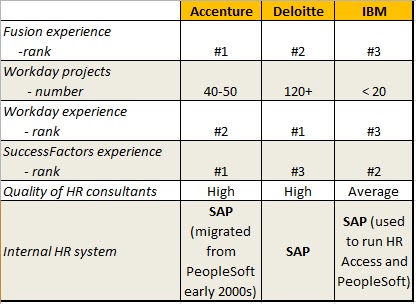
These tasks, on the other hand, are the forte of the three majors, all US-based: Accenture, Deloitte, IBM. (When PwC becomes a more significant player, I will add them in an update). Let's look at them in alphabetical order.

Accenture's strength lies in Fusion reflecting the strong relationship with Oracle. Accenture has more consultants trained on Fusion than any other SI and has carried out more projects. The quality of Accenture's HR consultants is also quite high evincing strong HR process expertise in all domains. Note that Accenture also leads when it comes to SuccessFactors.

Deloitte's HR credentials are as strong as Accenture's, but its focus is more on Workday. This reflects its strong HR system experience which dates back to its PeopleSoft alliance. I find them also quite good at local expertise.

IBM comes in third, and not only alphabetically, when it comes to cloud HR experience reflecting the dinosaur's reluctance to embrace the brave new world of SaaS. I found them to be quite unwieldy and at times a bureaucratic nightmare. I would recommend IBM only for the largest multinationals with a long experience of handling them. Otherwise it's no longer your project, but IBM's. Remember that these global brands have high overhead and  an oversupply of processes whose costs you the customer will have to bear. If you're looking for innovation (often the rationale behind your decision to go SaaS) you are unlikely to find it here. The pure-play SIs are a safer route.

Do as we say, not as we do


Interestingly, neither of the three major SIs has replaced its legacy SAP-based HR system of record with a cloud one. However, they are all implementing one of the three main cloud HR systems in some subsidiaries or regions of their own organizations. A big shift will take place when the three majors decide to throw in their lot with either Workday, Fusion or SuccessFactors. So far partner politics is proving stronger than cloud appeal.

One last thought. As you embark on an HR transformation project the bigger SIs will lobby you to provide help with the system-selection process, prior to bidding for the (far juicier) implementation work. They will swear on all the  saints of the Catholic calendar that they have in place a Chinese wall between their advisory and implementation practices. If you believe that you will probably believe that Diana and Elvis are living happily on Easter Island surrounded by their children. A fundamental principle of project governance is to avoid the advisor having a stake in the chosen system. Ignore this  tenet at your own peril.


(The blogger is currently helping a fast-growing, Nasdaq-listed, Paris-based multinational move from SAP to a cloud-based HR system) 

Tuesday, February 10, 2015

An open letter to Workday's Bhusri and Duffield: Time to fix Europe

RIO DE JANEIRO

Dear Dave and Aneel,
Drip-feeding country extensions
is NOT the right strategy

A great admirer of Workday's since its beginnings, for various reasons you will find summarized in several of my blog posts, the global and European person I am was more than gratified to see that you have decided to open an office in Germany. However, this cannot hide the fact that  before you open a new market, you should make sure the previous ones are up and running.

The Frenchman in me cannot therefore understand why you are expanding in Germany when you have yet to make France work. It was exactly three years ago  that you opened the French office and in that period of time you have only signed up two French customers: Lafarge and Sanofi. Even Oracle has managed to sign up more Fusion customers in France, which is the ultimate insult. With France being PeopleSoft's most successful market outside the United States, it should have been a piece of cake to convert many of these customers to Workday. Adding insult to injury, Danone, of all customers switched from PeopleSoft to... SuccessFactors when it should have been yours. A crime!

What has gone wrong?

The most serious mistake you have made is one typical of American multinaltionals: starting a presence in the UK and thinking that with that "Europe is solved." The UK, as many British people may have told you, is not in Europe, but off Europe. In a couple of years, they may no longer even be in the European Union. Opening an office in London is no more meaningful than opening one in Chicago. With most EMEA executives being UK-based (and British) you have made your EMEA organization EMEA in name only. As is natural they would focus on what they know best: the UK market, which explains your success in the UK, and then the "low-hanging fruit" of the Netherlands and Scandinavia. But the rest is as far away from them as planet Mars. The appointment of Chano Fernandez, a Spanish national, was a step in the right direction, but I have a feeling you didn't hire him because he hails from Spain, a country close to my heart (read my blog post "My 20-Year Affair with Spain") but because he was at SAP. And, anyway, since he was appointed, a year ago, I have yet to see a single Spanish company select Workday. Or an Italian company. Or a German one.

You have clearly made some casting mistakes, hiring the wrong people for the wrong roles in the wrong geography. Worse, many of the people you have hired in key positions have no prior experience in HR systems, your flagship product. Don't get me wrong: it may make sense sometimes to hire people from a  wider field, but when your product is first and foremost about HR, it boggles the mind to see so many people in key Workday EMEA roles who have no experience of talking to HR leaders, have no sense of the local HR ecosystem or a deep understanding of the competition.

As you know, every HR market is quite parochial. Sending to France a high-flying VP from HQ who speaks no French, cannot spell the name of some of the competitors, is not on a first-name basis with many opinion leaders and system integrators is a waste of your resources. And are you surprised at the results? Are you surprised that some of your better people,especially from sales, have left and are joining your competition?

Another key dimension of the local nature of HR is localization or what I  call "glocalization". I am
Marketing 101 mistake: English-language product screens
on  Workday's French website (As of  09-02-15 )
flabbergasted that it is taking you so long to develop the various country payroll localizations needed to be successful in the European market. You have waited for your 11th year in business to finally come up with your first European localization: the UK (well, not yet available, just announced for this year.) And France won't be available before next year. Wouldn't it make sense, from a product strategy perspective, to have swapped the countries and delivered France first?  That UK-centricity I mentioned earlier is again at work. Do you remember the number of European localizations (including Payroll) we released in PeopleSoft 8 between 2000 and 2001? EIGHT! Why this suspenseful drip-feeding of localizations at Workday? (And don't get me started on other regions of the world such as Asia or Brazil where I spend part of the year, and which are unlikely to get anything from you before eons - unless there is a clear change in product direction.)
Used to be one of the blogger's favorite 
Workday features. 
Now gone

You got so many things right from the beginning, and are still performing so brilliantly in many areas, that it pains me to see how you lost sight of the ball in Europe, and are making mistakes which, based on your previous PeopleSoft experience, you shouldn't have made. I guess you wouldn't be human if you didn't repeat some of your past mistakes.

Another thing. Please tone down the paranoid streak in your Partner and Alliance organization. So many positive things are already being written/said about you, you don't need to overdo it by becoming a marketing control freak who tries to prevent any constructive criticism to be published. All of your admirers, whose numbers include me, do not want you to turn into another evil company of which there are far too many in our industry.

I hope that my advice will help Workday grow into a better, more focused and successful SaaS company.

Oh, one last thing: Please bring back the Wheel. I miss it a lot.

Sincerely,
Ahmed Limam

Monday, July 21, 2014

No SaaS please, we're bankers!

PARIS
As traditional, on-premise corporate computing moves relentlessly to the cloud, especially its more sophisticated version, SaaS (software as a service)*, one business sector seems impervious to the march of History: the banking industry. Since banks spend more on IT than any other business, it is worth discussing what is holding up bankers (no pun intended) and wondering whether it is a question of time before the industry moves with the times, or will it remain as a quaint on-premise island in a sea of SaaS-based systems. In this post I'll focus on HR systems, since that is the corporate IT sector I have more experience in.

The changing landscape of international banking and how it will affect HR
Following the financial meltdown that started in 2007, banks are facing some unique challenges:

- More stringent regulations in all developed countries, though so far the bark has been worse than the bite. European banks have been faster at adopting so-called Basel 3 rules, thus giving them, counter-intuitively, an edge on US banks because, once the latter are hit, they will find their European counterparts better prepared. 

- Some of the new rules, especially in Europe,  have to do with bankers' compensation. Senior managers will have to learn to focus on profits (see below comment). One of the challenges of HR leaders will be how to enforce a new culture where greed is no longer good, and where other aspects of performance are taken into account, rather than the obsessive focus on revenue.

- One such regulation has to do with block leave (or garden leave) which mandates that during a certain period of time employees have no access to email/systems/phone in order to restraint heir ability to engage in fraudulent activities. (Of course, I still receive email messages from some senior executives who are on such block leave - and I'm talking here about their their bank email!)

-  Increased use of technology, such as complex trading algorithms, which means that many jobs formerly done by humans  are now done by machines which do not threaten to leave you for the competition nor demand exorbitant compensation.

- The days of unlimited profits are gone, and that will have an impact on IT budgets. This would be a driver to move to the cloud since costs can be reduced substantially when your HR system of record is migrated from on-premise to SaaS.

- Most of the global investment banks are retreating from their global operations and closing businesses. This deglobalization will affect all players, with global powerhouses shrinking their global operations, and the size of their workforce, and a larger number of regional/domestic banks will become even more local in nature. The challenge for all banks will be to trim fat without cutting muscle.

- In emerging markets, such as Brazil, Turkey, China and South Africa, local banks will matter even more than the global one, a trend not really new as I witnessed myself when I started spending part of the year in Brazil and was shocked to see that  the local HSBC subsidiary had little in common with the European parent company. It was quite surprising, and humbling, to see that Premier status, despite HSBC's marketing slogans, meant nothing there. In that market, as in India (think ICICI) local talent prevails and is giving the global banks a run for their money, if that is the phrase. If global banks want to survive, they will have to learn to fly the right talent on the right opportunity, say from London or New York, to São Paulo or Singapore, close the deal and then back home. The type of skills necessary will be markedly different from what we currently see.

Better be safe than sorry
There are various reasons why bankers are reluctant to move to a SaaS HR system of record (note that for other HR functions, such as recruiting or learning, the move to SaaS started a while ago.)

First, HR systems of record, along with  core banking tools, tend to be particularly sticky here. This most conservative of industries tends to favor status quo systems, stressing their advantages ("We've been using them for so long") while drawing attention to some problems associated with  the cloud. The financial crisis, which revealed banks' boldness, has put the brakes on many innovative ideas. The cloud suddenly became particularly risky, and it is a brave HRIS leader that will push for it. Rarely does a banking head of HR even bother about it, feeling s/he has more urgent battles to fight.

The banking industry also has a long history of home-made systems, in use next to packaged software, the latter often customized beyond recognition, thus adding another strong incentive to stick to legacy systems longer than other industries. And yet the complexity of their  legacy systems will eventually force the banks to move forward and start considering SaaS more seriously.

Security, for obvious reasons a predominant concern with banks, has them look at SaaS with particularly watchful eyes. And NSA snooping has not helped the SaaS movement, especially in Europe, where banks are not particularly keen on having the integrity of their core HR data  compromised along with privacy concerns. It is safe to say that SaaS vendors are losing 10% of their potential revenue in Europe because of this issue.

As everywhere else, moving to SaaS entails cultural change that banks are not finding easy to make. A bank 's IT department with an army of PeopleTools or ABAP consultants will be reluctant to consider that it has a problem, and that it may not need these skills anymore. Often, HR does not have enough clout to stand its ground and insist on having its own technology.

Leading by example...where there is no clear example
HR departments in the banking industry tend to display pack mentality. There is a lot of hand-wringing, indecision and wait-and-see among HR/IT leaders, with everybody watching their counterparts in other banks to see who will take the plunge first. (Interestingly, their brethren in the insurance industry didn't have such qualms and have moved to the cloud much faster.) As the following graph shows, there have already been a couple of banks that have made the move to SaaS HR (adopting mainly Workday) but they tend to be tier-2 banks. None of the global behemoths have pulled the plug on their legacy HR (usually PeopleSoft), although several are looking at the SaaS model seriously.


Whatever the geography, on-premise HR rules the roost

Action items for a successful transition
Any successful move from legacy HR to cloud HR in the banking industry will need the following:

  • Display bold HR vision from determined HR leaders. When considering the challenges facing the banking industry, this is a golden opportunity for HR leaders to lead change and transformation and try to show their value. The move to SaaS is a once-in-a-decade opportunity to do so.
  • Ensure that new rules are adhered to. The example I gave above of block leave is a good one. So far none of the heavyweight software vendors can cover that functionality satisfactorily which explains why many banks are not in compliance.  (Even Workday covers this requirement only partially)
  • Identify what needs to be available for a successful cloud implementation: Is the SaaS model good for us? Can the vendors' service level agreements meet our needs? Will they understand our way of doing business? If we, a European bank, select Workday, how confident are we that they will protect our data? I heard Workday's Aneel Bhusri the other day reiterate that HR data is safe because the customer can decide to have it stored in any of the regional data centers outside the US. That is simply not true. Even outside the US,Workday is still an American company, subject to US law and jurisdiction. If a US court orders it to provide the data stored in its data center in Ireland, will Workday refuse to comply? And if it complies,  what guarantees will a European bank (or any customer, for that matter) have that the data will not be subject to NSA abuse? No American vendor can provide any such guarantee.
  • Find the budget for the new investment. Considering the vast amounts banks have traditionally spent on IT, you might think that that should not be a problem. But with profit growth going south HR leaders need to beef up their ROI and make a more compelling case than in the past, something which, as mentioned earlier, they should be able to articulate cogently...if they know how to do it!
  • Realize that the move to a SaaS model requires a mental recalibration of people and organizations, along with revisited processes. That spaghetti environment that HR systems in banks have become over the decades should be disentangled and streamlined. What better opportunity than a move to a new next-generation system?


Banks should remember the unique characteristic of an HR system: it is the only IT system in a company where every employee is a user. Provide them with a rich interface and a modern user experience, and you are suddenly increasing your current and future employee engagement. Just as an earlier generation moved en masse from mainframe computing to a cloud-server environment, what are you waiting for, bankers, to move to SaaS?

No SaaS? You must be bonkers!


*For those who are confused about the terms "SaaS" and  "cloud", mainly because some  less-than-wholesome vendors use the two interchangeably, let me clarify some key differences. When a company's IT system no longer runs on its own data centers but is hosted by a third-party vendor, it is said to be "in the cloud" whether that IT system refers only to the hardware (network, for instance), the technology (database, OS) or the application (say, HR system.) When your application runs in the cloud, and the hardware and infrastructure are also managed by the same vendor, then we are talking about SaaS, the most advanced cloud offering. For software purists, as your humble servant is, you then have true SaaS (such as Salesforce, Workday, SAP's SuccessFactors) or faux-SaaS, a term I coined to refer to those products (such as Oracle's Fusion and the numerous legacy systems masquerading as SaaS) that were developed as an on-premise offering and then ported to the cloud, often in a single-tenant environment. True SaaS, on the other hand, is always multi-tenant, with a single line of code, is not available in an on-premise deployment, and only requires a browser to access the application.  In other words, a true SaaS product is always in the cloud; the reverse, however, is not true.

(Although the blogger, in his capacity as advisor-cum-consultant, has been involved with two banks on their legacy-HR-to-SaaS projects, the ideas defended in this post are his only, and do not reflect neither the banks' opinions nor their particular situation)


Monday, September 17, 2012

Dead software walking: PeopleSoft 7 years after its acquisition by Oracle

PARIS
With most PeopleSoft customers
having reached the end of the
toothpaste, time has come to
throw the tube away and get
something else
Two years ago I wrote a post on the waning of PeopleSoft and its corollary, the various options left to its customers. Back then I was heavily criticized by the Oracle/PeopleSoft ecosystem as exaggerating the reports of the death of the once-king of HR systems. And yet, today, developments are proving me right. As the following timeline graph shows, Oracle has stopped investing in any meaningful way in the PeopleSoft platform, no net new customers have been reported, the number of projects and resources are down and current customers are embracing the below options in greater numbers. It is therefore time to provide an update on these options.

ON DEATH ROW: Innovation goes out the window when Oracle comes through the door. Hardly surprising
when we realize that last time Oracle brought truly great innovation to the IT market was
THIRTY YEARS AGO with the modern relational database.

Since then Oracle has either copied its competitors (e.g. Apps -SAP, Fusion -SAP/Workday) or
 bought and killed them (e.g. PeopleSoft, Siebel, Hyperion etc.)


As the timeline graph shows, as an independent company PeopleSoft released a  new version every 12-18 months with substantial functionality in each one. However, in the seven years since Oracle took over, only two releases have come out. Yes, that's one every 3 ½ years which even in the glacial pace of ERP releases is quite unique. Now, if the features developed were game-changing and disruptive one might make the case that maybe it was worth waiting that long. But look at what has been delivered in those releases. Release  9.0 (December 2006) brought the first talent management feature (Talent Profile) aiming at stemming the hemorrhage of PeopleSoft customers going to the likes of Taleo and SuccessFactors. That concern was even more apparent with the next release, PeopleSoft 9.1 (September 2009), which delivered the back integration of Talent 9.1 to previous PeopleSoft releases (actually just 9.0 and 8.9.) It did not stop the hemorrhage and Oracle was left with no other solution than to buy Taleo five years later thus proving the futility of its PeopleSoft-based talent management offering. The only feature of note was the three localized payrolls (Argentina, China, Thailand - in the case of Argentina it was a partner-developed solution which  was productized in 9.1.) Apart from that you are more likely to find a four-leaf clover in the Mojave Desert than truly innovative PeopleSoft functionality in these releases.


OPTION #1: Upgrade to PeopleSoft 9.X and wait for 9.2 

To be thorough in the analysis, let us consider in detail the option of staying with PeopleSoft and upgrading to one of these two releases. The advantage is that you remain on the same product, your users will not be traumatized with having to learn a new user interface, you can use the Oracle maintenance for longer (remember that Oracle usually maintains the latest release for five years after general availability.) This could be the opportunity for you to implement features you never switched on and which could bring some business value. That's what some companies are doing and which I call "squeezing the PeopleSoft lemon."

The problem with this option is that, first, 9.0 didn't get much uptake from customers (and, anyway, support is ending this year) and, as shown in the graph, 9.1 is hardly any better in terms of features of value (unless you are a global company with a significant workforce in the three countries that got a new payroll.) Also, be aware that every upgrade requires more than just the latest release. For instance, moving from PeopleSoft 8.9 to 9.1 requires an upgrade from PeopleTools 8.46 to 8.51 and also a platform upgrade (from Oracle database 9 to 10, Weblogic and all other third-party software.) New hardware may also be required which, needless to say, Oracle would be glad to supply you with. And, of course, there is no guarantee yet on when 9.2 will be released and what it will contain. (Oracle is making noises about end 2012 meaning it will not be  available before mid 2013 at the earliest)

When taking into account the costs, time, resources, complexity and energy involved in carrying out this upgrade vs. benefits received, it is clear that this option does not make much sense. Why continue to invest on a product on its last legs? Investing in PeopleSoft now is like buying a roundtrip ticket on the Titanic after it has hit the iceberg.


OPTION # 2: Switch to Oracle Fusion

The main reason Oracle stopped investing in PeopleSoft is that it has been throwing all its R&D firepower on the successor product, Fusion. (For a detailed analysis of Fusion, read my post "Error 404: Oracle Fusion not found"  from November 2011.) So if you have a good relationship with Oracle (admittedly a rare occurrence for many customers) why not try and see whether Fusion can meet your needs? Because it is the same vendor there are some advantages, in particular license-wise. Like for like you are supposed to get a free license (but check that first.) Another advantage is that because it is the same vendor, some migration help is available in the form of an upgrade path (but not necessarily a direct one) depending on the point/major release (8.8, 9.0, 9.1 to Fusion.)

On the downside, if the customer uptake on 9.X was not as impressive as Oracle might have liked, Fusion is getting tepid response from the US and even less from Europe, despite a better user interface and good analytics features. And of those who have decided to take the leap of faith, very few hail from the ranks of PeopleSoft, making it even less of an obvious choice for you. (One exception in Europe is French banking giant SocGen which is currently implementing some Fusion HCM modules*.) Clearly Oracle customers are reluctant to be the guinea pig for a largely unproven product, especially knowing Oracle's track record when it comes to beta releases. Many modules are still not ready for prime time, neither are many country localizations (If with PeopleSoft you could manage your workforce in 10 countries, why would you be ready to settle for less in Fusion?) Because the Fusion code is different all the upgrade help Oracle promises cannot hide the fact that we are talking here about a full-fledged reimplementation.  And any help in the form of an upgrade path or an upgrade script is limited, only for those customers on 8.8 or 9X, meaning that you have to upgrade from, say 8.3, to one of these point releases and then to Fusion. Going through two implementations may be asking too much and will prompt the search for alternatives.

One variant of the two previous solutions is to maintain your HR system of record on PeopleSoft and move everything else to Fusion or vice versa: adopt Fusion Core HR but interfaced to the other PeopleSoft products you have already implemented. One key advantage is that it allows you to test the Fusion waters before you decide whether Fusion is ready for prime time and expand the footprint. The biggest drawback of this son-of-Frankenstein approach is that, contrary to Oracle's statements, you'll have to do all the integration work which largely preempts the point of a full-Oracle solution. A recent ZdNet article ("Oracle's Cloud Fusion app integration: More complicated than it has to be") explains some of the issues with this mongrel  approach: I love the reporter's comment that "No, Mr. Customer, you don't need to do the integration work, Oracle does!" (I'm paraphrasing.)


OPTION # 3: Third-party support

Considering the limited value that releases 9.0 and 9.1 bring, one might wonder why on earth any customer has upgraded. And even if not large in numbers, there are PeopleSoft customers that have moved to one of these two releases. Why? Shall we question their sanity? Apart from ignorance and mistakes, which we all make, the main reason can be seen from the below support table.


End of the line? Dead in the water? Whatever you want to call it, PeopleSoft's
best days are behind it... and its customers!

Sadly, most PeopleSoft customers who have upgraded have done so not because of the carrot of high-value functionality but because of the stick of desupport. Caught between the rock of an upgrade to 9X and the hard place of moving to Fusion, many have chosen what they feel is the least of the two evils.

And yet, if the issue is support, there is an alternative: third-party support. If you are unsure of which final alternative to pursue (see Options # 4 and 5 below) but are unhappy about paying Oracle a hefty maintenance fee and getting little in return you can move to a company like Rimini Street which will take over supporting your implementation at half of what you are currently paying. In Europe, for instance, companies such as Deutsche Post and Sita have done exactly that. In these days' tough economic climate saving 50% of your maintenance bill is not something to be scoffed at. Some of the savings can then be used to research other more permanent options, while doing it at your own pace without being pressured by your vendor to upgrade to a new platform that you don't feel is right for you.


OPTION # 4: Switch to a new HCM system

Once you start looking at non-Oracle alternatives, the first obvious choice is to expand your ERP footprint. Since a large proportion of PeopleSoft HR customers run SAP for Finance, it therefore makes sense to look at whether running SAP HCM brings value. If the business case, which you will of course have done comprehensively, shows many integration points between HR and Finance (e.g. employee data needed for expense refunds or employee skills for project management) then SAP HCM is a  valid choice. (I am discarding Oracle EBS HR since its shelftime is as limited as PeopleSoft.) Many large PeopleSoft customers have adopted this approach, such as French banking giant BNP which has discontinued using PeopleSoft as its HR system of record and is moving to SAP.

Another variant is to look at HCM suites (vendors that only focus on HR) which would make sense if your project is domestic or limited to a single region of the world. If you are US-centric Ultimate or Lawson could be a good choice, if European/Latin American why not Meta4?


OPTION #5: Going SaaS 

You can cast your net wider and, if ready to move your HR system to the cloud, rip and replace it completely with a SaaS system. Of course I am talking here of a true SaaS system, so that will rule out the cloud version of Oracle Fusion which purports to be SaaS when it is just hosted. Revealingly, a majority of Fusion early adopters have picked the on-premise flavor.

SAP has a promising true SaaS offering based on the SuccessFactors platform: its HR admin module (Employee Central) may not be as robust as its on-premise counterpart but is a good way to start. Workday is the other true SaaS vendor, the one that started the whole SaaS ball game rolling, and has replaced many PeopleSoft implementations. For a full comparison of Workday vs. PeopleSoft, you can read my post of a year ago, recently updated, PeopleSoft vs Workday - Old vs New, which became this month my most popular post, further evidence that momentum is shifting from on-premise to SaaS, with PeopleSoft customers looking at Workday even more actively. Among PeopleSoft's customers defecting to Workday (I gave some examples in the previously mentioned blogpost) a historic customer, computer maker HP,  is adding its name to the list.

In both cases the advantages of a SaaS system, if you are ready for this delivery model and want a full web-based system, are just phenomenal: unlike PeopleSoft you don't have to pay for any database license, hardware, third-party system, middleware nor maintain an army of in-house IT consultants. And you get the most modern of HR systems, with some of the best user experience around. On the minus side: if your requirements are truly unique, and the configuration capabilities of the SaaS system do not meet all these requirements, then customization is necessary and SaaS will not work for you. Also, be careful not to underestimate your resource needs when doing your business case: you may not need the cast of thousands required by a traditional PeopleSoft implementation, but every Workday update will require several FTE days of work per quarter to test the new features.

SOFTWARE GRAVEYARD:
After three decades of

invaluable service
to the business community
it is time for PeopleSoft
to rest at Oracle, where
all software products
go to die


With PeopleSoft way past its sell-by date, time has come, for those who haven't done so yet, to look even more seriously at the various available options. One option, though, is no longer available: do nothing. Stay on an antiquated HR platform at your own risk and peril, and see how your HR and business objectives are hamstrung by old, obsolete technology.

*UPDATE Jan. 2014: SocGen, like Dutch bank ING, have stopped their Fusion implementation and keeping PeopleSoft...for the time being!

(Ahmed Limam spends a large part of his time on 3P activities: Post-PeopleSoft Planning, helping organizations from different geographies and industries make an audit of their PeopleSoft implementation and decide on the best course forward.)


Monday, November 7, 2011

Error 404: Oracle Fusion not found

PARIS
As any experienced observer of our industry knows, the weaker the message a software company has on offer, the higher in the corporate hierarchy it has to go to deliver it. Oracle did not fail the tradition as a posse of vice-presidential bigwigs led by the head of its HCM development organization, descended a couple of weeks ago upon the City of Light (the home of yours truly) as part of their Fusion global roadshow.

The stakes are high. As soon as Oracle finalized its acquisition of PeopleSoft in 2005, it announced it was starting work on the successor product. Although I was among many chagrined by the demise of the jewel in our industry, I couldn't really blame Oracle: from a purely business perspective it didn't make sense to keep having several parallel products. Four years later, in 2009, there was still no Fusion on the horizon but Larry Ellison, rarely detracted by reality, famously announced that Fusion was going to be the SuccessFactors and Workday killer. More than two years later (almost six years after first announced) and with scores of Oracle and PeopleSoft customers defecting to SuccessFactors and Workday, where is Fusion?

When it was demoed at the HR Technology Conference in Chicago a year ago (see my post on it) release was announced for early 2011. Then it was pushed to the second quarter of 2011 and only in the summer was "something" finally made available.

First comment: the product is available for download, putting to rest any notion that it is SaaS-based. As anybody with a modicum of interest and knowledge in the matter knows, if you can install it on your server then it is NOT SaaS. Call it a hosted solution and the vendor an ASP or whatever alphabet soup you feel comfortable with, but SaaS it sure ain't. Also, the price list for Fusion is only available for the on-premise implementation, not the "cloud" variant which Oracle claims it has: another proof of how fuzzy and half-baked this mock-SaaS offering is.

Second, if I used "something" to describe the scope of what is available, it is not to belittle the hard work that went into it (and I know that many people did work hard on it), but it is an honest description of the functionality which is mainly based on compensation, one component of talent management, itself just one part of any overall HCM offering. Where is recruiting? (Wouldn't Fusion have been a great opportunity for Oracle to fix the double failure of its Oracle iRecruit and PeopleSoft eRecruit products?) And Learning/development? and Succession planning?

Who in their right mind would believe for a second that SuccessFactor has anything to fear from a product with such limitations? And as for Workday, it started work on their ground-breaking product at the same time as Fusion with $100 mn in seed money (Oracle makes profits in the billions), and a few dozen employees (Oracle has a cast of thousands working on Fusion - and, as few people know, this was supplemented by resources from Indian IT giant Infosys). As of today, Workday has not only delivered an entirely new HR system of record, two payrolls, strong talent functionality (even if missing some key parts), but also a financial management system. Where are Fusion's country localizations? The HR Admin, Payroll, Benefits modules may look good in demos (but what product doesn't?) but no company has selected them (let alone is running them) which is very suspicious.

To call Fusion half-baked would be very, very charitable. Rarely, if ever, in the history of software making have so many taken so long to produce so little. In less the time it took Oracle to present us with a Fusion embryo, Alexander the Great conquered the world. Now, that's perspective.

At last month's HR Technology Conference in Las Vegas, I ran into a senior Europe-based Fusion executive whom I had known for over a decade. As those who attended the event know, the South Pacific section of the conference grounds has many nooks and crannies. So, cornering my old Fusion pal into one of them, I managed to extract a confession from him.

"How many European Fusion early adopters do you have?" I asked.

"Larry will announce them tomorrow at Open World," came the less-than-assured reply.

"Come on, don't give me that marketing crap. We go back a long time. If anybody should know, it's you. For God's sake, you're based out of  Europe. So, spit it out." For those who know me, I am nothing if not tenacious. All I got, though, was an embarrassed smile.Of course, the next day at Oracle's annual jamboree Larry in an uncharacteristically lackluster performance was long on vague customer numbers, but short on actual names, and none of them from Europe.

The Paris event, a few weeks later, didn't bring any new names either. Software vendors are rarely shy about trumpeting their customer wins, especially when attached to new products to which they lend the credibility needed to succeed on the market. Sometime they even overdo it - in Europe, think of SuccessFactors and Siemens, or Workday and Aviva, to use the two competitors Larry Ellison had singled out. If Oracle, which nobody by any stretch of the imagination would call a shy, timid or bashful company, cannot produce any European customer, then you and I can only come to a single conclusion: there isn't any.

I can't say this came as a surprise to me. The dozens of Oracle and PeopleSoft customers I have asked in Europe are all unanimous: we will not touch Fusion with a ten-foot pole. Can you really blame them? Functionality that is so limited that it verges on the absurd, the less-than-glorious development and customer-support track record, the realization that Fusion apps, and HCM within them, are just a tiny part of Oracle's portfolio and, even more seriously, the doubts about the strategy behind it.

As I said earlier, the strategy to rationalize all of Oracle's acquisitions into one single product made business sense. But does this strategy devised in the first half of the past decade make sense now when much nimbler vendors  whose products have deeper functionality are churning out new releases on a  quarterly basis and five years on we are still waiting for Fusion 1.0? Does buying Sun to provide hardware and software together (as Oracle's great slogan goes) make sense when companies are increasingly going to be renting rather than buying their software needs and will therefore no longer require any servers within their corporate walls?

Fusion, and Oracle, look increasingly like today's solution to yesterday's problems. The market has moved on but the big ocean-liner is proving hard to turn around. Actually, considering that Fusion is barely here, it would be more accurate to say that Oracle and Fusion represent tomorrow's solution to yesterday's problems. 

A major French bank, BNP Paribas (160,000 employees worldwide), after pulling the plug on PeopleSoft said, "Fusion? Thanks, but no, thanks." Then, adding insult to injury, BNP went to their pre-PeopleSoft vendor, HR Access. It is worrying for Oracle to have its next-generation product rejected in favor of one based on older technology. (With SAP also being used.)

And France is not the only European country where Oracle customers are dumping Oracle, rejecting Fusion and moving to Workday. In a  recent interview in ComputerWeekly, the head of HR of UK-based insurance company Aviva, explained why he eliminated Oracle HR and selected Workday: "[with Oracle] when the CEO asked me how many staff we had in Europe, I could not tell him. It took weeks to find out. Now [with Workday] I can do that in 30 minutes." He then goes on to explain why he did not choose Fusion: "The technology was not there, Fusion was not ready, and its software-as-a-service model was not a true SaaS model." He also echoed a common complaint of Oracle customers that "communicating with Oracle was very difficult."

In several forums, I predicted that Fusion would not make any significant traction before 2015. So far, I have seen nothing to amend my analysis. And as for Mr. Ellison's claim of burying Workday or SuccessFactors, even after taking into account the typical hyperbole-prone statements so much favored by our industry, it is simply preposterous and betrays the fear that the reverse may well happen.