Further info and resources from my website

Showing posts with label Europe. Show all posts

Thursday, May 4, 2017

The French presidential election: Going blank

PARIS
Facing off for the top prize
So, here we are, just a few days' away from the runoff election that will decide who will be the most powerful man in the Western world. Yes, I mean it: the French president has more powers than his American counterpart who has to deal with Congress, a more often-than-not independent judiciary and a highly decentralized country where most decisions affecting people's lives are made by mayors or governors rather than by the Federal government. And other European leaders tend to be heads of government, sharing power with a head of state (elected or hereditary, depending on the case). As one of the major candidates reminded the nation in his campaign (see below), we live under a presidential monarchic who, apart from being elected, maintains most of the power and trappings of the "kings who built France," as the phrase goes (Les rois qui ont fait la France).

And, for once, the finalists are as different as can be, with two radically different views of what ails France and how the country should be run. After many decades of pretending otherwise, voters have finally realized that there is no difference between the mainstream parties and gave the Socialists and their partner-in-crime the Gaullists what Churchill called "the order of the boot". Something I have been calling for in as far back as 2011, when I wrote in a post subtitled "Democracy 2.0" that throughout the Western world whether you pick Party A or Party B makes no difference. They are just the two faces of the same coin, the establishment party. Or, to quote my beloved Gore Vidal, they are just the two wings of the single party.

Let me give you my two cents on the four candidates who made this campaign by being within a whisker of each other in both polls and actual election results, before I share with you my vote - and why.

François Fillon, a.k.a The Crook, had what was  undoubtedly the best program, and it certainly wasn't the most popular one as it offered the French some belt-tightening ahead. The only issue with it, were actually two, both related to how credible its plan is: First, when Fillon was in charge for five years, why didn't he implement  it? What guarantees do we have that once in charge he will deliver on his promises? Remember that when a private business makes false claims on its products, it can be penalized and fined; not so with politicians, who can promise you the moon and the stars and, once elected, do the opposite and still keep their seat. Second, the little credibility Fillon had disappeared with the financial scandal he got engulfed in. French voters can tell a liar and crook when they see one, and rewarded his campaign with the dubious distinction of  being the one which, in a 60-year period of time, managed to get a Conservative candidate disqualified for the runoff. If there is a dustbin of history for politicians, Fillon is heading straight for it.

The Gang of Four that made history


Marine Le Pen, a.k.a. The Loony or The Fruitcake (have your pick), has the silliest of all manifestos, basically based on hatred: of Arabs, Muslims, immigrants, Europe, the euro. Anything that can be offered to the people's anger as the source of their miseries, you'll find it in Ms Le Pen's bag. French politicians have been doing this for centuries: It used to be the Jews (in the Middle Ages) and Huguenots (in the 16th and 17th centuries). Nihil novi sub sole, as ancient Romans used to say (in their times, Christians were the scapegoats - food for thought.) Her success resides only on two facts: Her denunciation of the elite's abject failure in running the country (which hardly anybody can dispute) and that, having never been elected to office, she can claim the benefit of the doubt. Apart from that, her program of Fortress France does not make any sense at all.

Jean-Luc Mélenchon, a.k.a. The Commie (or Bolshie.) His sharp tongue, quick wit, consistent philosophy, grasp of details, brilliant, inventive campaign (those videos, holograms and the cruise on the Ile-de-France canals!) made him my favorite. He is the only one of all candidates, who realized that the corrupt leaders we got and their ineffective policies couldn't be separated from the sick political system we have. I fully agree with his calls for revamped political institutions, which he calls the 6th Republic, and many of its tenets such as the ability to recall all politicians. Is it normal that we  have to put up with a deeply unpopular and incompetent president as Hollande for so long? Is it normal that neither you and  I can decide on our compensation or rules governing most of our career, but politicians can? Is it normal that when we commit a felony or crime we go to court (and jail if found guilty) like everybody else, but not politicians who have their own court (Cour de justice de la  République) who rarely finds politicians guilty: and small wonder - its membership is largely made up of...fellow politicians! And even when they do find them guilty, they make the bizarre ruling that no punishment should be meted as we saw with the recent Christine Lagarde trial. Mélenchon is right to say that the system is rotten at the core and propose to do something about it, beyond the mere superficial slaps on the wrist for wayward politicians. I also fully support his call to move to real environmentally friendly policies, not the vague lip service most other politicians adopt.

However, on the economic front, I deeply disagree with Mélenchon. We already have the highest tax burden of the developed group of nations. If that could have translated in higher growth and more employment, we would have seen it. And I feel very uncomfortable with his anti-"rich" rhetoric. What is wrong with being rich, if you've earned it through your hard work - or inherited it? Unless the rich have gotten there through fraud and murder, confiscating their wealth strikes me as deeply unfair and demotivating for society at large.

Emmanuel Macron, a.k.a The Dapper (or the Charmer). Let's give credit where credit is due: His is the most amazing political career France has ever seen, and few countries can boast a novice with no experience of running a campaign, no party, no funds, coming from nowhere and about to win the ultimate prize. For sheer audacity, vision, and management skill, one has to acknowledge his amazing talents and wonder what he could do for the country if he continued to evince the same skills once in office. For a while, he was my favorite. Even when I couldn't completely shake off a feeling that he may just be a manipulator, who saw an opportunity and seized it. (Even then, still a brilliant one.) However, as  I shared several times with my old friend, C.T.H., a member of his campaign team, as soon as Macron put meat on the bone of his program, that's when he lost me. Freeing 80% of French households of the Taxe d'habitation (a kind of property tax) is typical of the worst of the French political-administrative establishment. First of all, that's a local tax, so what is he doing, apart from being generous with other people's money? And then, the lucky ones aren't exactly exempt from this tax, it's the central government that pays it to cities and towns on  their behalf, but should the rate go up, then you will still be liable for it. Again, what's the point  of putting in place such a complicated scheme when the objective, increasing people's purchasing power, could be done via levers the central government controls such as VAT, income rebates or credits. A bad idea, to be jettisoned immediately, as the idea to increase the CSG-based social security taxes, another tax created in the 1990s: then with a 1.1% rate, it currently stands at 15;5% and he wants to increase it? Wasn't he supposed to be a liberal (in the European sense?) As for his non-reform of the net-worth tax (ISF), it is absurd to remove most assets from it, except the one that affects most people who don't make money out of it: homeowners.

Worse, unlike Mélenchon, he seems to be very happy to keep the political system as it  is. Maybe just tinker a little bit here and there ("moralisation de la vie publique"), but over all, let's not rock the boat. Which rekindles my suspicion that Macron may just be all PR and marketing, all fluff, with some Conservative economic policies, some left-wing social policies,  all repackaged by a nice smile and endearing family life. But still a politician bent on grabbing power. And his will to rule by decree is alarming - this is the "presidential monarch" Mélenchon is right to denounce.

Le protest vote
Based on this, I just can't bring myself to vote for Macron. And I won't cast a negative vote: voting for him, to block the Loony. Since neither of the two has managed to convince me, then I'm voting blank. I do hope that Macron will prove my concerns wrong, and manage to fix some of the country's most serious issues. If  he does, then in five years' time, I will be more than glad to vote for him. As for Blondie, I do hope that they commit her either to an institution or behind bars: either way we'll be free of that nightmare. Until 2022 when, should Macron fail, then the National Front could finally grab the elusive prize it has been after for several decades. After all, that's a French political tradition: Fight long enough, and you end up in the Elysée Palace.


Friday, October 9, 2015

Burying the bad, sad joke of Safe Harbor and what it means for cloud users and vendors

LONDON

Apart from famous Mozart and infamous Hitler, Austria is not known for its oversupply of men who will leave their mark on mankind. Since this week we must add to the list Max Schrems who, with admirable boldness, stamina and single-mindedness, has convinced the European Court of Justice to pull the plug on the charade that the so-called EU-US Safe Harbor agreement was.

For those of you who hear about Safe Harbor for the first time, suffice it to say that it was a cosy arrangement whereby (mainly US) technology firms pretended to ensure their customer data were safe (especially from an increasingly nosy US government) and European governments and companies pretended to believe them.

Enter the young Austrian and things will never be the same again. Although an early and enthusiastic advocate of the cloud, I have repeatedly warned my Europe-based clients that going with a US cloud vendor now entails significant data-privacy risks. This does not mean you should stop considering Salesforce or Workday, but you should be aware of the risks posed by your employee and customer  data being siphoned off to the US and finding their way to a competitor – or worse. One of the largest European manufacturers, whose only competitor is based in the US, is about to move from SAP HR to a cloud solution (NDA commitments prevent me from mentioning the client's name). It has the option of either sticking with its well-known vendor and adopting SuccessFactors, or picking HR's favorite, Workday (with Cornerstone for LMS.) The option is therefore between a comforting European vendor and two US vendors which could pose a significant risk since this client's business is basically a duopoly between them and the American competitor.

European hero
Let’s not be naïve. Industrial espionage is a reality and just like European governments try and help their companies win new markets so does Uncle Sam. Except that the US government  has at its disposal cutting –edge technology and an arsenal of acts of  Congress that gives it unparalleled  power to do basically what it wants. If the US government had the moral stature of the Dalai Lama we probably wouldn’t worry. Unfortunately, trust in the US government (never very high to start with - remember Nixon, the Criminal-in-Chief of the 1970s?) has been steadily eroded by the Bush and Obama administrations’ continual assaults on public freedoms and individual rights.

In Europe, whose contribution to civilization includes the two most powerful totalitarian regimes of the 20th century, we take data privacy way more seriously than across the Pond. Hence the Safe Harbor agreement we insisted on for lack of a better alternative. Except that the agreement soon turned out not to be worth the paper on which it was written, as we realized that technology firms’ self-certification didn’t amount to much.

With Safe Harbor now in tatters, we have a unique opportunity to fix this issue in a more credible way. One key demand of Europe which must be met is to put an end to America’s extra-territorial laws. Just as European laws cannot apply in the US, the arm of American law cannot extend beyond its shores. Facebook/Google/Apple/Amazon/Workday/Salesforce/Microsoft must NOT be forced by US courts to hand over data stored offshore. (Hats off to Microsoft for steadfastly refusing to comply with orders to hand over European customer data) User organizations must insist on their data being stored in their own region with full guarantees that no access from the US would be allowed.  Of course, this is easier asked for than complied with. If a vendor’s California-based support technician accesses a   European customer’s system to fix an issue,  the data may well find itself replicated on a US server where it would fall under US jurisdiction. (And careful about that spreadsheet of employee bonuses being emailed from a European office to a manager in the US - that may no longer be legal).

At Cornerstone's Convergence event in London this week, I asked their founder and CEO, Adam Miller about it. He promised they would never transfer European customers' data to the US.
"What if a  US court requests you to hand over the data? Will you refuse to comply?"
"We will not  hand the data over, because it is not  ours. It is our customers'," Adam replied categorically.

I always find it very entertaining to see some SaaS vendors insist that, during implementation, all customer data to be migrated can only be  sent via a secured, encrypted STP server, never by email or a thumb drive in order to ensure system integrator (SI) consultants never have  a copy of your data. Well.... Many screens or reports can easily be exported in Excel or PDF format on a desktop or laptop. No SI checks at the end of the day that their consultants’ laptops are clean. Nor do they prevent external hard drives being hooked up to their computers.

My advice to my clients: be vigilant. Model clauses are a way to go, but may not be enough.  Know what is at risk, what you can live with and what you can’t. And challenge your cloud vendor. Tell them that being compliant with their home government is fine, and even mandatory in many cases, as long as it doesn’t adversely affect you. But one thing's for sure: with this landmark ruling , data privacy in Europe will no longer be the bed of roses it has been for American vendors. Their cost of doing business has clearly gone up one notch.

Tuesday, February 10, 2015

An open letter to Workday's Bhusri and Duffield: Time to fix Europe

RIO DE JANEIRO

Dear Dave and Aneel,
Drip-feeding country extensions
is NOT the right strategy

A great admirer of Workday's since its beginnings, for various reasons you will find summarized in several of my blog posts, the global and European person I am was more than gratified to see that you have decided to open an office in Germany. However, this cannot hide the fact that  before you open a new market, you should make sure the previous ones are up and running.

The Frenchman in me cannot therefore understand why you are expanding in Germany when you have yet to make France work. It was exactly three years ago  that you opened the French office and in that period of time you have only signed up two French customers: Lafarge and Sanofi. Even Oracle has managed to sign up more Fusion customers in France, which is the ultimate insult. With France being PeopleSoft's most successful market outside the United States, it should have been a piece of cake to convert many of these customers to Workday. Adding insult to injury, Danone, of all customers switched from PeopleSoft to... SuccessFactors when it should have been yours. A crime!

What has gone wrong?

The most serious mistake you have made is one typical of American multinaltionals: starting a presence in the UK and thinking that with that "Europe is solved." The UK, as many British people may have told you, is not in Europe, but off Europe. In a couple of years, they may no longer even be in the European Union. Opening an office in London is no more meaningful than opening one in Chicago. With most EMEA executives being UK-based (and British) you have made your EMEA organization EMEA in name only. As is natural they would focus on what they know best: the UK market, which explains your success in the UK, and then the "low-hanging fruit" of the Netherlands and Scandinavia. But the rest is as far away from them as planet Mars. The appointment of Chano Fernandez, a Spanish national, was a step in the right direction, but I have a feeling you didn't hire him because he hails from Spain, a country close to my heart (read my blog post "My 20-Year Affair with Spain") but because he was at SAP. And, anyway, since he was appointed, a year ago, I have yet to see a single Spanish company select Workday. Or an Italian company. Or a German one.

You have clearly made some casting mistakes, hiring the wrong people for the wrong roles in the wrong geography. Worse, many of the people you have hired in key positions have no prior experience in HR systems, your flagship product. Don't get me wrong: it may make sense sometimes to hire people from a  wider field, but when your product is first and foremost about HR, it boggles the mind to see so many people in key Workday EMEA roles who have no experience of talking to HR leaders, have no sense of the local HR ecosystem or a deep understanding of the competition.

As you know, every HR market is quite parochial. Sending to France a high-flying VP from HQ who speaks no French, cannot spell the name of some of the competitors, is not on a first-name basis with many opinion leaders and system integrators is a waste of your resources. And are you surprised at the results? Are you surprised that some of your better people,especially from sales, have left and are joining your competition?

Another key dimension of the local nature of HR is localization or what I  call "glocalization". I am
Marketing 101 mistake: English-language product screens
on  Workday's French website (As of  09-02-15 )
flabbergasted that it is taking you so long to develop the various country payroll localizations needed to be successful in the European market. You have waited for your 11th year in business to finally come up with your first European localization: the UK (well, not yet available, just announced for this year.) And France won't be available before next year. Wouldn't it make sense, from a product strategy perspective, to have swapped the countries and delivered France first?  That UK-centricity I mentioned earlier is again at work. Do you remember the number of European localizations (including Payroll) we released in PeopleSoft 8 between 2000 and 2001? EIGHT! Why this suspenseful drip-feeding of localizations at Workday? (And don't get me started on other regions of the world such as Asia or Brazil where I spend part of the year, and which are unlikely to get anything from you before eons - unless there is a clear change in product direction.)
Used to be one of the blogger's favorite 
Workday features. 
Now gone

You got so many things right from the beginning, and are still performing so brilliantly in many areas, that it pains me to see how you lost sight of the ball in Europe, and are making mistakes which, based on your previous PeopleSoft experience, you shouldn't have made. I guess you wouldn't be human if you didn't repeat some of your past mistakes.

Another thing. Please tone down the paranoid streak in your Partner and Alliance organization. So many positive things are already being written/said about you, you don't need to overdo it by becoming a marketing control freak who tries to prevent any constructive criticism to be published. All of your admirers, whose numbers include me, do not want you to turn into another evil company of which there are far too many in our industry.

I hope that my advice will help Workday grow into a better, more focused and successful SaaS company.

Oh, one last thing: Please bring back the Wheel. I miss it a lot.

Sincerely,
Ahmed Limam

Friday, November 28, 2014

Of Switzerland, the country, its HR practices and technology landscape

ZURICH
Lake Zurich became the blogger's temporary home last August,
and many a weekend were spent crisscrossing
this eminently bikable town
(Picture by the blogger)
I have been visiting the Alpine country for a good decade and a half now, with a strong focus on the French-speaking area around Geneva and Lausanne. In the late 1990s I was a frequent rider on the Paris-Lausanne train visiting a client, La Suisse Assurances, to help them move to a package HR system (that ancient insurance company is no longer, its parent company, Swiss Life, having decided to fold it several years ago.) I still remember vividly my favorite restaurant, le Vieux-Lausanne, at the foot of the cathedral, for its delicious food. Then, in the early 2000s, I would become a frequent traveler to Geneva, where Oracle's European headquarters is located, for internal meetings and customer presentations, especially at UN agencies; I dedicated a full chapter to Geneva in my book, High-Tech Planet.

The German-speaking part, though,was largely unknown territory to me until last August when I set up camp in Zurich to help Credit Suisse, the country's second largest bank,  on their new HR system. This more intense exposure to the country has given me further insight on what is one of the most original countries on earth.


Politics: Swiss exceptionalism
For someone used to the continental size of the US or Brazil where, despite the huge landmass and population, a single language prevails, diminutive Switzerland with its three main languages (German, French and, in one state, Italian)* can be puzzling. And yet, despite ethnic, religious and linguistic differences, Switzerland is a haven of peace, prosperity and serenity (and also, let's face it, at times stultifying dullness) unequaled anywhere else on earth. A lot of it has to do with its unique system of (semi-)direct democracy, which those of us who suffer from renewed gridlock in the US or stagnation in France under the most incompetent and despised president in history can only envy. In Switzerland, no topic is too important not to ask citizens to vote on it. This month, the question is whether the country's central bank should increase its share of assets held in gold from 8% to 20%. In any of the mock-democracies of Europe and North America, the decision would have been taken by a politician or an obscure committee behind closed doors. Not in the Helvetian Confederation where the people are asked to vote on what may sound as too an arcane topic to most. I always wondered why I never see political protests and demonstrations in Switzerland. Now I know why. Who are you going to protest against? Yourself? Your neighbors? Most decisions are made by citizens directly, you can't blame anybody but yourself if you aren't happy with the results. (I have always been a keen advocate of direct democracy, those interested can read my post,"Technology-enabled Democracy 2.0.")

Global business: punching above its weight
Except for the Netherlands, which has twice its population, no other small country in the world boats such a roster of successful global companies: Roche and Novartis (pharmaceutical), Nestlé (food), UBS and Credit Suisse (banking), Adecco (staffing), Swiss (airlines) are world class champions. This success lays to rest the cliché about the Swiss excelling only at clocks and chocolate, although some of the challenges facing the banking industry with the looming end of banking secrecy will have a not insignificant impact on the overall economy.

Rules-based engine
Another key feature of the Swiss national psyche is the strong, almost obsessive, adherence to rules. Peter Ustinov, the great actor/director/writer, who lived many years in Switzerland, once said, and quite accurately so, "In Switzerland, everything is either mandatory or forbidden; nothing is optional."  Woe betide you if you dare cross the street with the red light still on, even if there is no incoming traffic for as far as you can see. I mischievously jaywalk from time to time just to see how many Swiss will get a stroke at the heinous crime I am committing. And don't you even consider being late at a meeting; I know of an employee who was fired for his tardiness. For the Swiss punctuality is up there with cleanliness, motherhood and apple pie. It also helps that their public transportation system is amazingly efficient and in this town trams, buses and trains run on time. I have yet to witness a tram that didn't pull into its stop at the exact time advertised on the monitor. In comparison with another country I know well, Brazil, Switzerland is the anti-Brazil in every respect. Whereas a Swiss takes their job very seriously (the worst insult you can throw at a  Swiss is, "You are not professional!"), telling the same thing to the average Brazilian will elicit nothing more than a hearty laugh and a shrug.

Small wonder then that managing Swiss companies requires quite complex HR rules made even more so by the decentralized nature of the country where every state (or canton as they are known here) is quasi-independent and sets its own rules.


Small country but specific requirements
Of all Swiss statistics, one figure stands out: the traditionally low unemployment rate which, in 2014,  is around 3%.  Labor-market tensions are not going to improve with the greying workforce since more workers are retiring than are being replaced by young arrivals. This explains the high proportion of foreign workers in Swiss companies, and not only in border areas, but all over the country. Another reason for the strong reliance on foreign workers is the presence of many multinational companies (along with international governmental organizations such as the UN in the Geneva area) and the fact that Swiss mid-sized companies tend to be  strong exporters.

  • As part of an HR system multi-assignment/contract is a key requirement: somebody can be working in a canton hospital, teach at university and  oversee a small business. All these jobs will have to be tracked and, when fed into a payroll system, the latter will have to split the relevant taxes.
  • The French-speaking area tends to have more of a focus on competency management than the German area where companies tend to spent HR and HRIT investments on regulatory aspects of HR.
  • Make sure that your HR system covers work permit extensions by date along with alerts and reminders. Local state offices are as efficient in granting work permits as they are stern when it comes to non-compliance with reporting requirements.
  • The Swiss take their data privacy very seriously, even more so than other Europeans, and certainly more than the US.  Any foreign company doing business in Switzerland will need to take into account this Swiss variant on work-life balance.
  • If you are expanding to Switzerland and need to manage your Swiss workforce as part of your global HR system, check that your vendor is Swissdec certified. It'll ensure that HR and payroll data are stored and sent to government agencies in the required format and scope.
  • Several reports are key such as the Beschäftigungsstatistik.
  • Support for SEPA bank format has become a recent requirement as well, although Switzerland is not part of the euro area.You may be puzzled by the fact that you can easily wire funds into a euro-denominated account abroad but not not the other way round. 

It is worth specifying that although Switzerland is not part of the EU, most of its trade is with the EU, many of its workforce comes from EU countries, as mentioned earlier, especially neighboring Germany, Austria and France.  As part of an agreement with the EU, there is a free movement of labor between Switzerland and the EU (it remains to be seen how a recently held referendum will jeopardize this arrangement).


HR vendor landscape
Although Zurich hosts a prestigious technology university (ETH) and  is a research hub for several technology firms such as Google, Switzerland has not sprouted strong local software firms. Actually über-technology firm Amazon is not even present in Switzerland since its small size, difficult terrain (all those mountains are a transportation nightmare) and prosperous citizens do not justify the investment. As can be expected, neighboring Germany's SAP,  reigns supreme, especially in the German-speaking majority area. The only Swiss software firm of note is talent-management vendor Haufe (based in St-Gallen, home of another prestigious university) whose Umantis offering is one of the few, if not the only one, in Europe to have been developed organically.

The Google campus in Zurich, on my way
to/from the Credit Suisse office
(Picture by the blogger)

This most conservative of countries is moving its HR systems to the cloud at a glacial pace as legacy vendors are finding out. Oracle's Fusion implementation at banking giant UBS has been beset with product-quality issues that have delayed the go-live date several times. Workday, on the other hand, a virtual unknown this side of the Alps, without even a local presence, has managed to  sign up a couple of local companies including well-known travel firm Kuoni.

As we move into the second half of the decade it will be interesting to see how Swiss on-premise customers migrate to the cloud and, in doing so, which system they select. So far, no single unchallenged winner has emerged, so the market is still up for grabs.


*Actually, there is even a fourth national language, Romansh, spoken by a small minority. Speaking of languages, it is interesting to note that whereas Swiss French is quasi-identical to the one spoken in France, Swiss German is a dialect that differs markedly from standard German (Hochdeutsch). Adding to the complexity, Swiss German (Switzerdeutsch) is only spoken whereas standard German is the one used in writing giving a sense of Swiss schizophrenia

NOTE: It goes without saying that the opinions expressed in this post are the blogger's only, and do not reflect the position or  policies of Credit Suisse or any other Swiss company I have been/am associated with.

Monday, July 21, 2014

No SaaS please, we're bankers!

PARIS
As traditional, on-premise corporate computing moves relentlessly to the cloud, especially its more sophisticated version, SaaS (software as a service)*, one business sector seems impervious to the march of History: the banking industry. Since banks spend more on IT than any other business, it is worth discussing what is holding up bankers (no pun intended) and wondering whether it is a question of time before the industry moves with the times, or will it remain as a quaint on-premise island in a sea of SaaS-based systems. In this post I'll focus on HR systems, since that is the corporate IT sector I have more experience in.

The changing landscape of international banking and how it will affect HR
Following the financial meltdown that started in 2007, banks are facing some unique challenges:

- More stringent regulations in all developed countries, though so far the bark has been worse than the bite. European banks have been faster at adopting so-called Basel 3 rules, thus giving them, counter-intuitively, an edge on US banks because, once the latter are hit, they will find their European counterparts better prepared. 

- Some of the new rules, especially in Europe,  have to do with bankers' compensation. Senior managers will have to learn to focus on profits (see below comment). One of the challenges of HR leaders will be how to enforce a new culture where greed is no longer good, and where other aspects of performance are taken into account, rather than the obsessive focus on revenue.

- One such regulation has to do with block leave (or garden leave) which mandates that during a certain period of time employees have no access to email/systems/phone in order to restraint heir ability to engage in fraudulent activities. (Of course, I still receive email messages from some senior executives who are on such block leave - and I'm talking here about their their bank email!)

-  Increased use of technology, such as complex trading algorithms, which means that many jobs formerly done by humans  are now done by machines which do not threaten to leave you for the competition nor demand exorbitant compensation.

- The days of unlimited profits are gone, and that will have an impact on IT budgets. This would be a driver to move to the cloud since costs can be reduced substantially when your HR system of record is migrated from on-premise to SaaS.

- Most of the global investment banks are retreating from their global operations and closing businesses. This deglobalization will affect all players, with global powerhouses shrinking their global operations, and the size of their workforce, and a larger number of regional/domestic banks will become even more local in nature. The challenge for all banks will be to trim fat without cutting muscle.

- In emerging markets, such as Brazil, Turkey, China and South Africa, local banks will matter even more than the global one, a trend not really new as I witnessed myself when I started spending part of the year in Brazil and was shocked to see that  the local HSBC subsidiary had little in common with the European parent company. It was quite surprising, and humbling, to see that Premier status, despite HSBC's marketing slogans, meant nothing there. In that market, as in India (think ICICI) local talent prevails and is giving the global banks a run for their money, if that is the phrase. If global banks want to survive, they will have to learn to fly the right talent on the right opportunity, say from London or New York, to São Paulo or Singapore, close the deal and then back home. The type of skills necessary will be markedly different from what we currently see.

Better be safe than sorry
There are various reasons why bankers are reluctant to move to a SaaS HR system of record (note that for other HR functions, such as recruiting or learning, the move to SaaS started a while ago.)

First, HR systems of record, along with  core banking tools, tend to be particularly sticky here. This most conservative of industries tends to favor status quo systems, stressing their advantages ("We've been using them for so long") while drawing attention to some problems associated with  the cloud. The financial crisis, which revealed banks' boldness, has put the brakes on many innovative ideas. The cloud suddenly became particularly risky, and it is a brave HRIS leader that will push for it. Rarely does a banking head of HR even bother about it, feeling s/he has more urgent battles to fight.

The banking industry also has a long history of home-made systems, in use next to packaged software, the latter often customized beyond recognition, thus adding another strong incentive to stick to legacy systems longer than other industries. And yet the complexity of their  legacy systems will eventually force the banks to move forward and start considering SaaS more seriously.

Security, for obvious reasons a predominant concern with banks, has them look at SaaS with particularly watchful eyes. And NSA snooping has not helped the SaaS movement, especially in Europe, where banks are not particularly keen on having the integrity of their core HR data  compromised along with privacy concerns. It is safe to say that SaaS vendors are losing 10% of their potential revenue in Europe because of this issue.

As everywhere else, moving to SaaS entails cultural change that banks are not finding easy to make. A bank 's IT department with an army of PeopleTools or ABAP consultants will be reluctant to consider that it has a problem, and that it may not need these skills anymore. Often, HR does not have enough clout to stand its ground and insist on having its own technology.

Leading by example...where there is no clear example
HR departments in the banking industry tend to display pack mentality. There is a lot of hand-wringing, indecision and wait-and-see among HR/IT leaders, with everybody watching their counterparts in other banks to see who will take the plunge first. (Interestingly, their brethren in the insurance industry didn't have such qualms and have moved to the cloud much faster.) As the following graph shows, there have already been a couple of banks that have made the move to SaaS HR (adopting mainly Workday) but they tend to be tier-2 banks. None of the global behemoths have pulled the plug on their legacy HR (usually PeopleSoft), although several are looking at the SaaS model seriously.


Whatever the geography, on-premise HR rules the roost

Action items for a successful transition
Any successful move from legacy HR to cloud HR in the banking industry will need the following:

  • Display bold HR vision from determined HR leaders. When considering the challenges facing the banking industry, this is a golden opportunity for HR leaders to lead change and transformation and try to show their value. The move to SaaS is a once-in-a-decade opportunity to do so.
  • Ensure that new rules are adhered to. The example I gave above of block leave is a good one. So far none of the heavyweight software vendors can cover that functionality satisfactorily which explains why many banks are not in compliance.  (Even Workday covers this requirement only partially)
  • Identify what needs to be available for a successful cloud implementation: Is the SaaS model good for us? Can the vendors' service level agreements meet our needs? Will they understand our way of doing business? If we, a European bank, select Workday, how confident are we that they will protect our data? I heard Workday's Aneel Bhusri the other day reiterate that HR data is safe because the customer can decide to have it stored in any of the regional data centers outside the US. That is simply not true. Even outside the US,Workday is still an American company, subject to US law and jurisdiction. If a US court orders it to provide the data stored in its data center in Ireland, will Workday refuse to comply? And if it complies,  what guarantees will a European bank (or any customer, for that matter) have that the data will not be subject to NSA abuse? No American vendor can provide any such guarantee.
  • Find the budget for the new investment. Considering the vast amounts banks have traditionally spent on IT, you might think that that should not be a problem. But with profit growth going south HR leaders need to beef up their ROI and make a more compelling case than in the past, something which, as mentioned earlier, they should be able to articulate cogently...if they know how to do it!
  • Realize that the move to a SaaS model requires a mental recalibration of people and organizations, along with revisited processes. That spaghetti environment that HR systems in banks have become over the decades should be disentangled and streamlined. What better opportunity than a move to a new next-generation system?


Banks should remember the unique characteristic of an HR system: it is the only IT system in a company where every employee is a user. Provide them with a rich interface and a modern user experience, and you are suddenly increasing your current and future employee engagement. Just as an earlier generation moved en masse from mainframe computing to a cloud-server environment, what are you waiting for, bankers, to move to SaaS?

No SaaS? You must be bonkers!


*For those who are confused about the terms "SaaS" and  "cloud", mainly because some  less-than-wholesome vendors use the two interchangeably, let me clarify some key differences. When a company's IT system no longer runs on its own data centers but is hosted by a third-party vendor, it is said to be "in the cloud" whether that IT system refers only to the hardware (network, for instance), the technology (database, OS) or the application (say, HR system.) When your application runs in the cloud, and the hardware and infrastructure are also managed by the same vendor, then we are talking about SaaS, the most advanced cloud offering. For software purists, as your humble servant is, you then have true SaaS (such as Salesforce, Workday, SAP's SuccessFactors) or faux-SaaS, a term I coined to refer to those products (such as Oracle's Fusion and the numerous legacy systems masquerading as SaaS) that were developed as an on-premise offering and then ported to the cloud, often in a single-tenant environment. True SaaS, on the other hand, is always multi-tenant, with a single line of code, is not available in an on-premise deployment, and only requires a browser to access the application.  In other words, a true SaaS product is always in the cloud; the reverse, however, is not true.

(Although the blogger, in his capacity as advisor-cum-consultant, has been involved with two banks on their legacy-HR-to-SaaS projects, the ideas defended in this post are his only, and do not reflect neither the banks' opinions nor their particular situation)


Sunday, April 13, 2014

Work-life balance, French-style: No after-hours work email

PARIS
If you liked the 35-hour workweek, then you'll love the ban on after-office-hours email which has become law in France this week (actually it is an agreement between business and union which as such as the force of law.) Since there is little doubt that many employees are overworked and stressed out  anything that could restore a healthier work-life balance can only be applauded. Few people realize that France, supposedly a worker's heaven, is also home to frequent corporate suicides.

There is clearly a cultural bias here. Whereas in Europe in general, and in France, the country of la joie de vivre, in particular, work-life balance is seen as enhancing workers' rights, in the United States, the country of 24 x 7 business, it is considered  a cost on business.

First, let us clarify what this new policy is all about. It does not apply to all French employees, only to those working in consulting and technology companies, therefore at most one million employees. Actually, when you take into account executives (cadres) who do not have a strict work schedule, probably just a few hundred thousand employees will be impacted by this law. Of course, nothing can prevent the current administration from extending the law to all French employees, say, before the next election, when it is desperate to emerge from the abysmal approval ratings it has sunk into.

Second, enforcing this law is not going to be easy. Actually almost impossible. There are so many ways to circumvent it that one wonders why they even bothered to adopt it. For example, even if you are one of those employees prevented from sending email after 6 pm, nothing can prevent you from copying  on a thumb drive any documents you need, go home, work from there and then shoot an email from your private email address. People have been doing this for years, and will now be encouraged to do it even more.

Then, there is the case of those road warriors, especially when traveling across time zones. It may be 6 pm in Moscow, but because France is a couple of hours behind it means you still have a few more hours to shoot that criminal message before your email server goes dead.

And, of course, nothing can stop you from writing zillions of messages offline, and the next morning, as the email server wakes up, it'll find itself busy dispatching tens of thousands of messages which  will create even more anxiety, pressure and workload on the recipient workers.

So, why is the government (in France no labor agreement happens without the state's blessing) bothering about a law which for all practical purposes will not protect burnt-out employees, but can work as a disincentive for foreign investors in France? The problem is the disconnect between politics and business/technology. No matter how fast you adopt a law, it always lags behind technological advances which are so much faster.

Controversial or pioneering? France goes where others fear to tread


If government bodies had any idea of what the business world REALLY looks like and how disruptive technology can be, they would not stop at email. What about social media? Government should also stop corporate employees sending business-related tweets, or updating information on LinkedIn. And yet, none of this is contemplated.

And what about business software? A lot of the work that people do now is done through ERP-type systems many of which can be accessed via the cloud anywhere, anytime. As a manager, you can still finalize a performance appraisal after having served dinner to your children. You could check on the recruitment status of some job vacancies in your team after having watched your favorite TV show. Again, the law does not  even seem to realize that such technology use is even more prevalent than email and can impact a worker's work-life balance even more significantly.

Worse, as I mentioned earlier, this new policy could have an adverse impact on workers by reducing the number of jobs available to them. Just as I have never known in my adult life France with a balanced budget, I have rarely seen an unemployment rate lower than 8% or 9%, it usually hovers around 10%. This new law is not going to encourage companies to hire more workers in France; and, honestly, what kind of work-life balance are we talking about here when we know that without work you don't have much of a life?

In summary, this new law won't change much. It will just add more compliance costs to companies, deter foreign ones from hiring in France and put even more pressure on employees to do more within the 9-to-5 work  schedule, thus achieving the exact opposite of what it set out to do.

Oh, mon Dieu! I am posting this business column on a Sunday. I am in full violation of French labor laws that forbid work on  the Lord's Day. If you don't hear from me in the next couple of weeks, that will mean that the Labor Inspector has knocked on my door and I am languishing in jail for contempt of the laws of the Republic.


Friday, December 28, 2012

1992-2012: My 20-year Affair with Spain

From the blogger's collection, a painting of the
Alhambra's Courtyard of the Lions in Granada.
When Boabdil, the last Arab ruler in Spain, was
expelled from Granada he cast a last glance at
his palace and shed a tear.  To which
his mother said, "Weep like a woman  over
what you couldn't defend like a man."
MADRID
Twenty Christmases ago, almost to the day, I bade farewell to four years in the United States, boarded a Spain-bound flight which delivered me to a new life in this town. I had never been to Spain, did not speak Spanish, had no home, no friends or family there and was starting a new job with a company I knew little about, except that it was the United Nations World Tourism Organization (UNWTO.) *

I was to spend the next three years calling Madrid home before moving to the country I was born in and where I still have my main residence (for how much longer is a legitimate question, though.) For the ensuing 17 years I have been visiting Spain, and especially Madrid,  for either business or pleasure, at such frequency that it still feels as if I have not left the place.**

And yet so much has changed, and so much remains the same, and so much have I learned about it, that this anniversary is a good opportunity to share my views of Spain then and now.


EL AÑO DE ESPAÑA - THE YEAR OF SPAIN
The country I had landed in had just been celebrating the double-whammy 500th anniversary of the Reconquista paving the way to unification and the discovery of the Americas, as well as the twin events of the Universal Exposition  in Seville and the Olympic Games in Barcelona. After the nation's long decline culminating with the loss of most of its colonial possessions in the 19th century, and the long night of the Franco dictatorship (1939-1975) there was clearly a feeling that the country was finally on the right track. Just 10 years ago Spain had joined the European Union, money galore was flowing into the country which was setting about developing large-scale infrastructure projects and there was a clearly perceptible sense of optimism.


BUSINESS AND HR 
In one respect, things don't seem to have changed much. When I arrived in Spain the unemployment rate was around 23%, going up to 40% for under-30-year-olds. Most of the friends of my age that I was to make were still living with Mom and Dad, making me an oddity with my own apartment (something which of course was completely normal in the United States I had just left.) Fast-forward 20 years and things seem not to have changed at all. The sad reality of Spain is that unfortunately things had changed: the jobless rate steadily declined to an unprecedented single digit before, thanks to the financial meltdown first and then the debt crisis, moving back to those horrible  levels that we all thought belonged to the past.

Town hall meeting Spanish-style. Protests on the
Puerta del Sol in the summer of  2011.
Occupy Puerta del Sol, if you will.
The true measure of the Spanish tragedy is that human nature is such that we can live without something for a long time (back then rarely did people demonstrate against high unemployment) but take away from us something we had gotten used to and we feel particularly bad about it, which explains the constant protests these days.

As a reaction to the current crisis, Spanish labor laws have been overhauled so radically that trade unions are still too dizzy to react. Much of the employee protection (especially in the firing department) that had been in place from time immemorial is gone and with salary levels frozen, the workforce is about to become competitive. Whether this will be sufficient to put a dent in the unemployment rate remains to be seen since some inherent Spanish workforce problems are still present, in particular low productivity levels. Spanish companies (or the various government training schemes) will have to invest massively in  bringing their employees' skills up to speed to what is necessary to turn the economy around. One area where Spaniards tend to be particularly bad are in sciences and languages. Unlike their fellow Iberians in neighboring Portugal, most Spaniards are only fluent in their own language. Many, especially young graduates, are  looking at job opportunities abroad, especially in Germany or the UK, but are hampered by poor linguistic skills. And Spain's political leadership is not leading by example: the four Prime Ministers the country has had in the past 20 years have had one thing in common - bad to no command of the English language, or any other for that matter.

A MORE GLOBAL SPAIN AND COSMOPOLITAN MADRID
The blogger with friends celebrating  Bastille Day 1995 at
a garden party held at the French Ambassador's residence
The latter point comes a bit as a surprise since in the 20 years I have know Spain it has become markedly less parochial. The first years after I arrived in Madrid I still felt I was a guiri since foreigners were very rare and everywhere you went you only heard Spanish or saw Spaniards (how unlike the city I had just left.) You rarely saw blacks or Arabs and as for Latin Americans they were not any more visible. A decade later  and foreign-born residents had risen to 10% of the country's population. Walk down any street in Madrid and you are bound to see people who manifestly hail from Spain's former American colonies something unheard of when I lived there. Some Spanish companies have become true global giants such as Telefónica, whose foreign revenues exceed what it makes at home home or Spain's wunderkind Armancio Ortega's Inditex whose Zara brand of clothing is ubiquitous all over the world and is consistently profitable, even in recession time. Santander, who was my first Global Payroll customer when I was at PeopleSoft, is Europe's largest bank and well-established in Latin America, especially in Brazil where it is one of the two foreign banks of consequence.

One of the most impressive companies to have come out of Spain and gone global was an improbable software company, Meta4. Spain is well-known for many things but the Silicon Valley it sure ain't. And yet in the 1990s, literally out of nowhere, came this HR software company with modern object-oriented technology, great user interface and a very seductive knowledge-management product. It was soon to become the leader in its home market before expanding to other European countries (mainly France) and Latin America (in particular Mexico, Argentina and Colombia where large government organizations and private businesses run their HR processes on Meta4.)

Madrid as the nation's capital and foremost business center reflects that global outlook. Starbucks is everywhere; Broadway musicals,  something unheard of when I lived there, are popular with currently The Lion King and The Sound of Music on offer at some of the several theatres on the Gran Via, Madrid's main thoroughfare. Foreign cuisine has also made its entrance. Last time I was in Madrid I walked down Calle Lavapiés to go the square of the same name. I was stunned to see both sides of the street lined with Indian and Pakistan restaurants. Hangers-on also offered me another, illicit type of nourishment.

HR AND CORPORATE TECHNOLOGY
Although IT budgets are tight and the decision-making process longer than usual, Spanish companies could benefit from renewed investment in technology, in particular more modern HR systems. Here are some of the Spain-specific drivers and issues:

     § The new labor law and regulations (Estatuto de los trabajadores) put in place by the current (center-right) administration mean that HR admin and payroll systems are in for a big overhaul. Updating the various systems is a project in and of itself and could be the opportunity to launch into other higher-value projects.

     § Of these, a comprehensive competency-based model and learning system would go a long way to solve some of the productivity and low-skill issues of the Spanish workforce. Spanish companies have always had a vested interested in training if only to solve some of their endemic health and safety issues. To improve their H&S record what better way than invest in training, with online training becoming the default choice.

     § Spanish payroll, although a  bit simplified by the new laws, still remains, like most payrolls, complex to implement, although I would not rate it as complex as in Italy or California. It is also the cornerstone of most HR systems. This explains why local vendors such as Meta4 or Grupo Castilla still lead the pack of HR vendors (Meta4 dominates in the Ibex35 roster of large Spanish companies), followed by global vendors such as SAP and PeopleSoft who took a long time to understand and adapt their products to Spanish requirements (Oracle never managed to have a localized offering for Spain.) Here are some quirks of Spanish payroll:  parallel payroll process, peculiar retro calculations, the multiplicity of labor agreements which cover every aspect of a worker's with their employer.

     § Spanish companies have yet to fully leverage the functional value and financial advantages of SaaS- based HR systems, especially in the talent-management space. As for moving their entire HR system to a cloud-based model that will take a bit longer, when the economy stabilizes and true SaaS vendors like Workday decide to enter the Spanish market. If I have one recommendation to make to Workday and similar vendors it is not to waste any more time to establish a local presence. The best moment to start planting the seeds of  future growth is when things are rough.

     § Not only is the SaaS model slow to take off in Spain, but another key ingredient of a modern corporate IT system is going to be a drag on its modernization: the corporate mobile revolution is not going to take place soon. Blame the deep recession for this backward trend. In 2011 Spain was the country with the highest cell phone penetration rate in the world, with 96% of Spaniards owning a mobile device. This year a whopping 2 million mobile phones went off the air as both consumers and companies reduce their costs and cancel their mobile contracts. That is 5% of the country's population deciding to forgo going mobile. Meaning that BYOD (Bring Your Own Device)  is one trend that Spanish companies will not have to deal with soon.

     § Hard times may be pushing Spaniards away from cell phones, but the internet is as popular as ever and unleashing their creativity in unexpected ways. Some of them are using the Web to express their frustration at the recession and the results can be hilarious and insightful like Españistán, a brilliant graphic novel published last year by a Barcelona cartoonist. The popular web series Malviviendo (Living Badly) is quite revealing of a down-and out youth which tries to find comic relief on the internet. Its dark humor is shared by other Web comedies like Las asqueadas (The Disgusted Ones) and the self-explanatory Parados (The Jobless) and are much more revealing about Spain's economic distress than any lengthy report by the IMF or the European Commission. This also shows that this lost generation is quite talented, come to think of it.

     § Recruiting (which in Spain usually goes by Selección de personal) should be a hot area for both suppliers and user organizations. If you think this statement is counterintuitive considering the recession in Spain, think about the following: a high unemployment rate means that a higher number of candidates are sending in their applications. Without a modern talent-acquisition tool, of which many Spanish companies are in sore need, it will be challenging to deal with the increase in workload. So, even if you are going to turn them down, at least you owe it to them to do it speedily  and correctly, something which antiquated systems do not allow.

     § The larger number of foreign-born workers I mentioned earlier, means that for the first time Spanish employers are dealing with a new HR reality: diversity in the workplace. Tools, processes, corporate culture will have to change to reflect this new dimension.

     § As for which global HR technology vendors are best equipped to handle Spanish companies' requirements, here is my league table. It is based on functional depth, localization quality, number of references, resource availability, quality of support and strategy.

LITERATURE
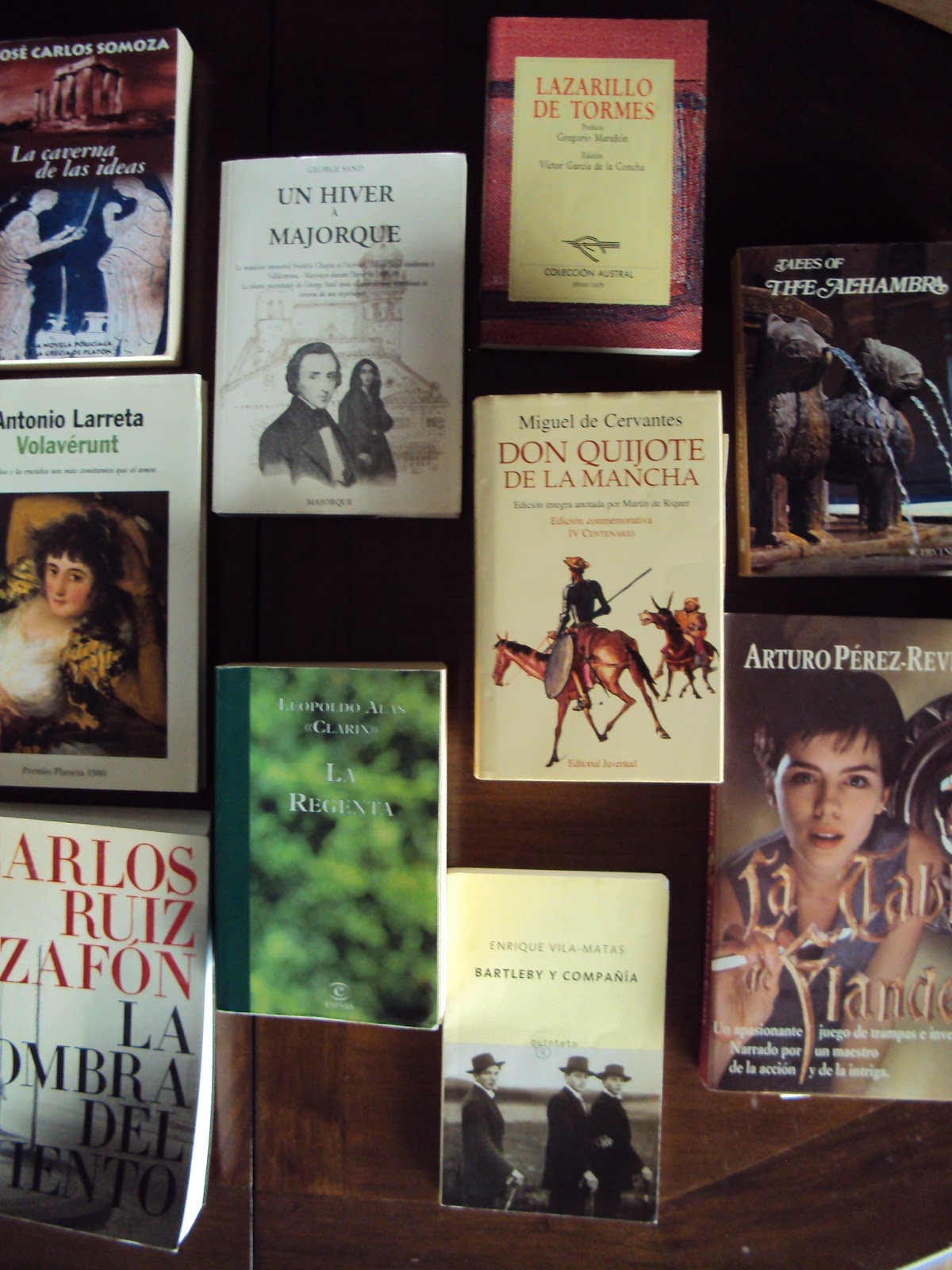
The avid reader I am means that in these two decades that I have practised Spain I have read dozens of works by Spanish writers or foreigners writing about Spain. Here is a list of the ones I have enjoyed and strongly recommend:

     § As soon as I became fluent in Spanish one of my colleagues at WTO lent me Antonio Larreta's Volavérunt. A historical novel set at the early 19th century court in Madrid, it won the Premio Planeta, one of Spain's major literary prizes, in 1980.  I was lucky that for my foray into Spanish literature I was regaled with a great novel on two quintessential Spanish historical characters, painter Goya and the 13th Duchess of Alba (see more of her namesake and distant heiress below under Art.)

     § Anonymous Lazarillo de Tormes is a delightful picaresque novel from the mid-16th century, before Cervantes wrote Don Quixote. I only read the latter in its full edition last year and was captivated by it. I now understand why the opening line, "Somewhere in La Mancha, whose name I do not wish to recall...", have become immortal words. Grahame Greene's latter-day take on the story of the Knight of the Sad Countenance, Monsignor Quixote, is a brilliant tale of 1980s Spain.

     § La regenta, by Leopoldo Alas aka Clarín, is another classic Spanish novel, from the century of great novels, and is Spain's answer to France's Madame Bovary or Russia's Anna Karenina. While reading it I found myself several times checking its publication date: I could hardly believe it came out in the late 19th century so modern is the treatment of the story and characters.

     § Reporter-turned-writer Arturo Pérez-Reverte has been Spain's best-selling sensation for as far as I can remember, writing thrillers and historical adventures. My favorite is The Flanders Panel (La tabla de Flandes in its original title) of which a movie was made under the title Uncovered. I do not recommend to see the movie before reading the novel since I found the movie a big spoiler, even if well made. The Club Dumas, similarly set in the world of antique booksellers, is also pretty good.

     § Carlos Ruiz Zafón's The Shadow of the Wind is a page-turner set in post-war Barcelona, and became  the best-selling Spanish novel of all times (and the second one in the Spanish-language.)

     § If you ever wondered what would happen if writers decided to stop writing, then read Enrique Vila-Mata's Bartleby & Co, a brainy and erudite disquisition on the power, or mania, of saying "no."

     § For lighter fare, especially of the crime variety, Barcelona-based Manuel Vázquez Montalbán's novels featuring Pepe Carvalho are great, authentic reads.

     § Finally, Cuban-born but Madrid resident José Carlos Somoza wrote a unique book, The Athenian Murders (La caverna de las ideas in Spanish.) It is actually two parallel stories, one being the echo of the other in the form of footnotes which grow into a full-fledged plot until the story's dénouement when the two storylines merge. Imaginative and creative, it is truly astounding. A virtuoso achievement.

     § Although not Spanish, Washington Irving has probably done more than anybody else to publicize the country's number one tourist attraction: the Alhambra (see the above painting.) With his romantic Tales of the Alhambra, the  American writer contributed to rescue from neglect and decay the splendor of Arab Spain in the city of Granada. When I visited the palace in the early 1990s it was still a mundane affair. Now, you need to book your ticket weeks in advance. Question: which royal dynasty has reigned the longest in (and not over) Spain? Answer: the Ummayads in Cordoba for 300 years, whereas the current Bourbons have barely reached 250 years.

     § French writer George Sand wrote a travelogue covering part of Spain and mainly the island of Majorca. At times condescending, her book is a great read to get an idea of what tourism was like 200 years ago. Traveling from France to Spain, now a simple hour-and-a-half flight, then felt like visiting another planet. A Winter in Majorca (Un hiver à Majorque in the original French) actually says more about her (yes, George Sand was a female writer) than about  Spain or Majorca.
From the blogger's library some great books by Spanish
writers (and a couple of foreigners writing about Spain)


MOVIES (AND MUSIC)
Spain has been blessed with some distinguished filmmakers.

     § Luis Buñuel's Viridiana  (1961) with the great actor Fernando Rey is loosely based on a novel by Pérez Galdós, a great 19th century Spanish writer. Banned by the Catholic Church and Franco's regime (yes, in those days there was a list of films and books which Catholics were forbidden from watching or reading under threat of roasting in Hell's eternal flames), it went on to win the Palme d'Or at the Cannes Film festival. And deservedly so as this subversive tale of old Spain is a true masterpiece. The dinner party with the beggars taking over  the masters' home is a piece of cinema anthology.

     § Made in the early 1970s but set in 1940s rural Spain, The Spirit of the Beehive (El espíritu de la colmena) is a spellbinding movie about the mysteries, anxieties and fears of childhood.

     § Bigas Luna's comedy  Jamón, Jamón was the first Spanish movie I saw after arriving in Spain where it had just been released. It served to introduce two young actors, Penélope Cruz and Javier Bardem, years before they were catapulted to Oscar-winning  super-stardom status and became husband and wife. 1992 also saw another good Spanish movie with Ms. Cruz, Belle Epoque. When its director, Fernando Trueba went to pick up his Academy Award for Best Foreign Film, he stated: "If I believed in God, I'd thank him for this. But since I don't believe in God, then I'll thank Billy Wilder." By then there was no Caudillo Franco or Catholic Church Index to cast aspersion on him and his movie about the years leading up to the Spanish Civil War. (Belle Epoque was the movie that earned the national treasure that Almodóvar girl Chus Lampreave is her only Goya award)

     § A terrific talent since his film debut, Thesis, (1996) is Alejandro Amenábar. His third (English-language) film with none other than la Kidman, Gothic thriller The Others, (2001) established his global filmmaking credentials (the ending will leave you speechless) which were further enhanced by the Academy Award for Best Foreign Film for his next project, Out to Sea (2004) with an astonishing performance by Javier Bardem. I met Alejandro in Madrid a couple of years ago and he struck me as a most relaxed and normal person which, for somebody who works in the film industry, is quite a feat.

     § None, of course, approaches even remotely the astonishing international success of Pedro Almodóvar. When I arrived in Spain, the movida madrileña was in full swing. The term refers to the explosion of freedom  in the arts (see below), nightlife, music and movies  following the 40 years of repressed life the country had endured under Franco's dictatorship. No one epitomized the movida more than the irrepressible Almodóvar who has dominated Spanish cinema for the past 30 years becoming one of the best Spanish global brands abroad (I should have added him to the list above next to Zara et al.) With a unique style mixing kitsch, melodrama, screwball comedy (especially in the early movies), irreverent humor and unconventional, graphic sex, Almodóvar has managed one feat that few have in contemporary cinema: remaining true to his national roots. *** All his movies are grounded in Spain, with Spanish themes such as the downtrodden housewife and the return to one's pueblo (or rural origins). My favorites are:

          ¤ Women on the Verge of a Nervous Breakdown (1989) is a hilarious film that ranks among  the best comedies ever shown on the big screen. It is up there with the works of Lubitsch and Cukor.

          
¤ High Heels (1991) with a terrific rendition of the song Piensa en Mi by Luz Casal      which sets every string of my soul aquiver with emotion, the way Joaquín Rodrigo's Concierto de Aranjuez does. (Spanish popular songs are a hallmark of Almodóvar's films.)

          ¤ The Flower of My Secret came out as I bade farewell to Madrid. Maybe that is why I am so fond of it, but there is no denying that Almodóvar matured with this movie.

          ¤ With All About My Mother (1999) Almodóvar reached even higher critical heights. The movie, a paean to past actresses such as Bette Davis (the title is inspired by one of her most famous movies, All About Eve) received Oscars, Cannes prizes, Golden Globes and other awards galore.

          ¤ Bad Education (2004) about child abuse, drugs, sexual transgression is particularly well-written with plots and subplots that seem at first confusing until you realize the point the writer-director is trying to make.
Penélope Cruz, one of Almodóvar's muses,
 is Spain's answer to Italy's Sophia Loren.
Volver was another great success by the Spanish
director and won a Best Actress award for the
entire female cast at the 2006 Cannes Film Festival 

      § Although made by Mexican director Guillermo del Toro and a Mexican studio, Pan's Labyrinth (2006) is set in 1940s Spain and includes a largely Spanish cast (Sergi López, Maribel Verdú, Ariadna Gil). It is a stunning dark fantasy tale which won a host of awards (including several Academy Awards) as well as enthusiastic critical reviews.

Finally, the film buff that I am can only be saddened by the relentless pace at which movie theatres are closing in Spain, especially in Madrid, where the main drag, the Gran Via, is seeing almost all of its cinemas closing one after the other. The Palacio de la Música, one of the grandest of the film palaces, will now be turned into a store. I have counted them and since my days in Madrid and now, 10 movie theatres on Madrid's answer to Broadway have closed: Along with the aforementioned Palacio de la Música, the Azul is going to be made into a restaurant, the Luna has been closed for a while and makes a sad sight, the Avenida is also closed and it is unclear what it will become etc. Sic transit gloria cinemae...

MUSIC-wise, 1992 was the year that Manolo Tena's Sangre española came out. This song, along with the ones by Luz Casal (mentioned earlier), Alaska, Azucar Moreno, the soundtrack of Las cosas del querer, among so many others, would delight me during my Madrid years. Special mention have to go to Joaquin Rodrigo and his out-of-this-world Concierto de Aranjuez which still gets my heart aflutter when I listen to it.

ARTS
The year of my arrival in Madrid was also a vintage year for the arts. Until then if you were into arts you headed for the Prado Museum where you could admire some of Spain's greatest works of art by the likes of Goya, Velázquez, Zurbarán housed in a lovely 18th-century building. One of my favorite painters is Hieronymous Bosch whose Garden of Earthly Delights still amazes me. Whenever I visit the Prado I always make sure I go check it out. Great as the Prado is it was basically the only truly great museum in Madrid until 1992 when two terrific museums opened: the Reina Sofía galleries, dedicated to more modern fare, and the Thyssen Museum which houses the private collection of Baron Thyssen who, to Spain's luck, married a Spanishwoman. The Baroness made sure that their awe-inspiring collection remain in her native land**** and the result was that Madrid over the years has developed what is now known as The Art Triangle.

If you are visiting Madrid over the Christmas/New Year's holidays through next spring, I cannot recommend enough checking out the marvelous expo "Legacy of the House of Alba" housed in the wedding cake building of what in my days used to be the main Post Office.

Apart from Britain, Spain is the only country in Europe where the aristocracy not only is recognized by the government but has also retained  much of its fortune in the form of large estates and grand palaces. Of these great Spanish aristocratic families the House of Alba is second to none. Headed by the 18th Duchess of Alba (unlike Britain, Spain's titles are passed to women), who is one of the most colorful (some would say eccentric)  people in Spain for as far back as one remembers, the House of Alba has been accumulating riches and patronizing the arts for over half a millennium: the third Duke, in the 16th century, was   viceroy of Naples (then a Spanish possession), brutally suppressed the Dutch (Dutch children are still being scared out of their naughty ways by being threatened with "Be good or I'll call the Duke of Alba") and conquered Portugal, among other minors feats. The 13th Duchess, in the 18th century, was the most famous woman in Spain and had her Madrid home (Buenavista Palace) right across from where the exhibit takes place (before she sold it to the Spanish government who turned it into the army HQ) and was the heroine of that first book I mentioned earlier.

A portrait by Goya of the 13th Duchess of Alba
adorns the cover of the exhibit catalog,
a copy of which is now part of
the blogger's library
The current Duchess, who as a child was a playmate of Britain's Queen Elizabeth II in London where her father was ambassador, is a direct descendant of the Stuart kings who reigned over Scotland and England (the short version of her last name is Fitz-James Stuart y Silva) and her great-aunt was none other than the (Spanish-born) French Empress Eugénie (Napoleon III's consort) who went to live with the family after losing throne, husband and son (respectively.) She died, in 1920, at the family's Madrid home (Liria Palace) and bequeathed to them all her possessions. You don't get more blue-blooded than that - literally: according to  the Guinness Book of Records the Duchess of Alba holds more titles of nobility than anybody else and her wealth is estimated at around €4 billion. As the saying goes, "the Duchess of Alba is the only person who can travel from the north to the south of Spain without ever leaving her lands."  

With such a pedigree, history and cashflow you can expect amazing works of art to grace the family's multiple homes (the three best known ones are in Madrid, Seville and Salamanca.) Because they are part of a  private collection they are rarely seen in public so when an exhibit like the current one is put together  it is an opportunity not to be missed.  Since I was in Madrid during the 20th anniversary of my first arrival in Spain, what better way to celebrate it than visit an exhibit which celebrates an even great longevity? Here are amazing works by Titian, El Greco, Rubens, Fra Angelico, Goya, Chagall, medieval manuscripts, letters and maps made by Christopher Columbus himself (the Duchess counts the Great Discoverer of America as one of her ancestors and inherited many of his personal papers.)

Should you be visiting Madrid and looking for a great hotel experience, my favorite is the grand Palace Hotel  smack in the middle of the Art Triangle. It occupies the spot where used to be the home of another leading aristocratic family, the Dukes of Medinaceli, and is also celebrating an anniversary this year: its 100th. I recommend getting a room with a view on the leafy Paseo del Prado and the Neptune Fountain (right across is its competitor, the Ritz.) Having a drink or coffee under its dazzling stained-glass cupola is a religious experience. I used it as the setting of a scene in my book, High-Tech Planet. Among the rich and famous who have stayed there is Madrid lover Ava Gardner. The legendary screen goddess would come back in the wee hours of the morning after having danced the night away in a tablao flamenco often accompanied by a torero, as bullfighters are known. Not bad for the daughter of a South Carolina sharecropper. (In an interesting twist on how art imitates life, one of Ava Gardner's best-known roles, in Joseph L. Mankiewizc's The Barefoot Contessa, is that of a Madrid flamenco cabaret dancer who rises to Hollywood fame before her life ends in tragedy.) A word of caution: don't ask a Madrilian, not even a cabdriver, for the Westin Palace (as it is officially known now that it is part of the Starwood Hotels family.) You are likely to draw a blank before they reply, "Oh, you mean el Palace!." For us Madrilians, whether native or adopted, it will always remain the Palace.

THOUGHTS ON THE SPANISH LANGUAGE
Since I speak several languages fluently, I am often asked what my preferred one is. The Emperor Charles V  was in Renaissance times the most powerful man in Europe of which he owned large chunks, including Spain whose first king he was (and as such he rests for eternity in the magnificent royal necropolis at the Escorial, just outside Madrid.) To manage such diversity of people, he found it convenient to be a polyglot and used to say: "I speak Italian to ladies, French to men, Dutch to horses, German to soldiers and Spanish to God."

I don't necessarily agree with the great man (great because being master of the world, he abdicated of his own volition to finish his days in a remote Spanish monastery) but I find English a flexible language, French a precise one, Arabic very flowery, Portuguese (especially the Brazilian variety) colorful and Spanish friendly. By that I mean that I enjoy using the Spanish language (usually referred to in Spain as Castilian) in informal settings. I feel particularly relaxed using it.

Every language has its own quirks which reflect the national characters of its people. Some Spanish words have always held a particular spell on me.  Here are some of them:

     § Spanish is the only language that I know of which has a specific word for "fingertips" ("yema"). All other languages use compound words to refer to the tip of one's fingers so it has always captivated me that Spaniards would "bother" to create a specific word for it. It is noteworthy, though, that whereas French has orteils, English toes and German Zehe, Spanish uses the same word (dedo) to refer to the digits of both hand and foot.

     § "Asomarse" is used to refer to someone appearing at a window or balcony, but never at a door. Other languages don't make such a distinction: if you come out of your house, does it really matter whether you do it on the porch or a top floor? Obviously it does in Spain.

     § There are few rules you can make about languages, but one that in my opinion and experience holds true is that the most common words tend to be short ones, just one or two syllables. Thus the English hole is trou in French, qar in Mauritanian Arabic, buraco in Portuguese, an even shorter buco in Italian but a four-syllable word in Spanish: agujero. Same thing for acantilado (cliff) or ordeñar (to milk an animal) which tend to be just one or two syllables long in other languages but three or four long in Spanish. Why so long?

     § "Desasosiego" means "uneasiness, disquiet" and like its English equivalents it is also created by using a negative prefix. Except that the Spanish root word is sosiego so in desasosiego we have two negative prefixes as if to reinforce the condition being described. Are Spaniards particularly anxious people?

     § "Ensimismado" is another fascinating Spanish word. It means "deep in thought" or "pensive." Created from en si mismo it literally means "into-oneselved." 

SPAIN THEN AND NOW
I have witnessed so many changes over the years in Spain in general, and in Madrid in particular, that it would take a book to cover them all. In addition to some comments already made above, here are some, most on the plus side though.

My first reaction when I arrived in Madrid over Christmas 1992 was how loud, chaotic and smoke-filled a place it was. It is such a pleasure now to be able to go to bars, restaurants, clubs and not having to start coughing after a while before going back home with stinking clothes. I remember parking my car on the sidewalk between the Calle de Alcalá and the Gran Via before a night out: no qualms about it since everybody parked anywhere. That is now a thing of the past, thank God. And my favorite is the large pedestrian-only areas that grace the city center: Calle Fuencarral, Calle Arenal all the way to the Opera House and the Royal Palace. It allows you to sit outside and enjoy the lovely spring/summer weather and the great quality of light. (How retarded Paris is that we still have cars contending with passersby in those narrow streets of the Marais.)

The infrastructure program the government embarked on when I arrived in 1992 has delivered stunning results: the Madrid metro has become one of the best I know (unlike the dreadful one we have in Paris or the antiquated London Tube) allowing you to go from downtown to the airport in 20 minutes and at the cost of a few euros. Bullet trains now link the two major cities of Madrid and Barcelona (it used to take me half a day at least to drive between the two cities) thus obviating the need for the puente aéreo air shuttle (Brazilians would be well inspired to go ahead with their plans to do the same between Rio de Janeiro and São Paulo.)

Spain, whose kings carried the title of Most Catholic Monarchs,  has undergone one of the most amazing social changes in modern times. Divorce, abortion and gay marriage have come so fast you could barely utter "amen!" Already in the 1990s I was surprised to see that every small town in Spain had its gay bar, which was quite a big change coming from the conservative (some would say intolerant) United States.

Politically, the country has wisely alternated between left and right, having had until last year only three Prime Ministers in 20 years, ample proof of the strong social and political consensus which was so lacking in the 1930s. Hard to believe that just the previous decade before my arrival Spain suffered a coup attempt that threatened to send it back to military dictatorship. Hats off to King Juan Carlos who stood firm and managed to rally people, political parties and  most of the military command to his side to protect the democratic system (the King was luckier than his brother-in-law, King Constantine of Greece, who faced a similar crisis but was outmaneuvered by the Greek Colonels.) Few people realize that Don Juan Carlos is the world's only political leader who once held absolute power and willingly let go of it to allow democratic government. During all the time I lived in Spain, and for years afterwards, the King was highly respected and never criticized but recently, due to the economic crisis, people have become more critical of the royal institution as they have of all other institutions.

You can't stop change, it comes one way or another. Last week saw the demise of Banesto, one of Spain's oldest banks. Wonder what will happen to its grand head office on Calle Alcalá. Another Madrid institution, the Preciados department store, was also gone by the end of my stint there. Only a street remembers its name. The Prado has built an ugly annex next to the medieval Jeronimos church. Somebody ought to be shot for having defiled that gorgeous church. Four giant towers have sprung up north of the city. They are now largely empty, a testament to real-estate speculation gone completely berserk and responsible for the crisis the country finds itself in. (Boom is a great tell-all novel by insider Laura Anguera who reveals in it all the mechanics and shenanigans of the real-estate boom-and-bust cycle in Spain.) And yet nobody has been prosecuted for the mess. Total impunity seems to be the rule in Spain and most of the Western world as far as the culprits are concerned.

Spaniards may have accepted to put an end to their public smoking addiction, but there is one tradition they are clinging to ferociously: keeping late hours. There seems to be no way they will adapt the "decent" lunch and dinner times that most of the rest of the world keeps. I still find it hard, and even more so as middle age has relentlessly crept up, to get used to having lunch at 3 pm and dinner at 10/11 pm. Going out for post-prandial drinks or some partying means coming back home at a "normal" 4 or 5 am time, especially on weekends.

Since New Year's Eve is upon us, another reflection of how things have changed. In 1992 young people still dressed up for the Nochevieja partying: tuxedos and bow ties were ubiquitous in clubs, something you are hardly likely to see now. Also, pop music ruled the waves in those discos but, suddenly, the DJ would play something completely different: sevillanas (a type of flamenco dance) and everybody, young and less young, would start making the elaborate moves on the dance floor. Intoxicating. Nowadays, unless you go to a specialized flamenco joint, you are as likely to see people dancing sevillanas in Madrid clubs as you are to see Mayoress Ana Botella selling her body on the street.

Speaking of which, one street in Madrid has barely changed in 20 years. Calle Montera has become a pedestrian-only area, but is still home to streetwalkers who tout their wares and ply their trade in full view of everybody. Whereas in other world cities it would be considered shocking to see prostitutes in the city center, in Madrid locals and tourists walk by with utter indifference. One evolution, though, reflects the extent to which Madrid's ethnic make up has also changed between 1992 and 2012: back then the ladies of the night on Calle Montera used to be old and ugly and mainly Spanish, before their ranks swelled with Africans and Latin American immigrants. Now, they are mainly young, pretty and from Eastern Europe. The national origin may change, but the business remains the same.

Pelasperras chicas and sábanas are also gone as Spaniards
enthusiastically  adopted the euro a few years
after I left. They are now wondering
whether they did the right thing.
As for Spain's ethnic makeup, I am still impressed that the country has gone quickly to absorb large populations of foreign-born residents (Arabs, Latinos, black Africans, Eastern European) and yet you never see riots and tensions between native and immigrant groups the way you have them in Paris, London and other large European cities. Xenophobic, far-right political groups are unheard of in Spain, another proof of how tolerant and open modern Spanish society is. Even now, with the country in deep crisis, native Spaniards have yet to show any hostility to foreigners or to blame them for their economic travails. Quite impressive.   

Another major Spanish tradition, bullfighting, which was huge in 1992 is losing in popular appeal and coming under attack. Just as I could never make sense of American football, in spite of four years in the States, I could never understand the love that Spaniards have for corridas. I love many Spanish traditions but find goring bulls quite resistible.***** This being said, banning it altogether as they have done in secession-prone Catalonia smacks more of political score-settling than any true consideration for animal rights. In other less controversial sports, Spaniards keep on excelling, especially at tennis and soccer where they have become the undisputed masters. That is a legacy of all the preparation and investment that went into the 1992 Olympic Games.

Finally, on the foreign-policy front, one issue remains as strong now as it was then: the dispute with Britain over Gibraltar. Here I disagree with my Spanish friends since (a) a democratic country cannot seriously countenance forcing a territory which has been ruled separately for three centuries to join you if the overwhelming majority of residents are against it, and (b) why do you insist on granting yourselves this "unification" right which you refuse to Morocco with which you have an identical dispute?


I expect the country will go through many more changes this decade, none probably so wrenching as the ones triggered by the current economic tragedy. But one thing is unlikely to change: my bond with the country.  Of all my love stories none has been deeper, more intense and more enduring than the one with Spain, its people, its land, its culture and its language.


*Back then this UN agency was simply known as WTO until, a couple of years later,  a rival, Geneva-based organization (World Trade Organization), decided to have the same English-language initials, thus obliging the older, Madrid-based organization  to change its acronym by adding UN to the initials.  

**I was in charge of the localization of the PeopleSoft HR product line for Spain for a couple of years in the early 2000s before I moved to Oracle where, as director of Business Development for the European region for 5 years, I regularly traveled to Spain to further develop the equivalent product line. Then between 2007 and 2009 as vice-president with Fidelity HR Access, I regularly worked out of the office in Madrid, city which I still visit several times a year. Annual vacations in Madrid, the Costa Brava or other places also contribute to tie me to the land, although since I went freelance in 2009 Spain has had to contend with Brazil for my time, both professional and personal. 

***Almodóvar also tends to be loyal to his cast, such as Carmen Maura, Penélope Cruz, Antonio Banderas, Rossy de Palmas. Look out for Chus Lampreave, a delightful (now elderly) actress who typically plays the role of  a "portera".

****Margaret Thatcher, whose government was trying to lure the Thyssen collection to Britain, is said to have asked her advisors, "Couldn't we find an English girl for the Baron?"


*****It is worth reading Vicente Blasco Ibánez's, Blood and Sand, the classic torero rags-to-riches tale set in early 20th-century Spain. Several movie versions were made, of which the best are the 1941 Hollywood film with Tyrone Power and the Spanish one in 1989 with Sharon Stone and strikingly handsome Christopher Rydell in the role of the bullfighter Juan Gallardo (Rydell looked so convincing - as was his dubbing in Spanish - that I initially thought he was a Spanish actor until I found out he hailed from the U.S. of A.)

NOTE ON PICTURES: All, except the "Volver" poster, were taken by the blogger