Further info and resources from my website

Showing posts with label responsible government. Show all posts

Monday, July 17, 2023

Tax Freedom Day: France's National Day of Shame

PARIS
A couple of day ago, July 14,  we celebrated our National Day of Glory: Bastille Day, that commemorates the day we shook off the shackles of an absolutist monarchy. Today, July 17, is a sad day as it is the first day in the year when French citizens can keep the result of their hard-earned income. Yes, from January 1 until July 16, every single penny a Frenchman makes goes straight to the government via income tax, VAT, payroll taxes and a myriad other levies French lawmakers show so much creativity for.

No other European or developed country has to wait so late in the year to be freed from the weight of such quasi-confiscatory tax policy. But then no other government inflicts such a punishing tax burden on its citizens the way the French government does. As the below map shows, on average the French government takes away 54.1 % of an employee's full salary (including the employer's share.) Austria is number 2 with 53.4%; followed by Germany. The UK only taxes a reasonable 35.2%, meaning that the UK Tax Freedom Day comes much earlier than for France: on May 9. Even Spaniards are better treated: They are freed of their government obligations almost a month and a half earlier than their French neighbors: on June 8. And this, despite having had to endure 5 years of a Socialist-led coalition government  with the radical left.


Now, nothing intrinsically wrong with living in a Communist society. If that's what the French want, they're entitled to it. Except that something is clearly not right. Having the government tax you more and more in order to fund better quality public services is a perfectly legitimate choice. Except that the quality of public services in France has been heading south for the past decades:

-Healthcare is no longer what it used to be: Two decades ago, you didn't have to pay anything when you went to see your GP or presented a prescription at your local drugstore. Now, Social Security only pays a fraction of your healthcare and medicine, and the percentage is decreasing year after year. And that's if you're lucky to find a doctor: Seeing a specialist make require you to wait 2 or 3 months, some operations have longer wait lists. 

-Education is going down the drain with an increasing number of  French students leaving high school unable to write a French sentence correctly.

-Recently we went through weeks of mass protest because pensions are getting miserly and you have to work longer to get them.

-And as for law and order, just as the dreadful riots we saw two weeks ago are proof enough, that is not something that our high taxes are able to guarantee. Justice isn't faring any better: File a lawsuit in any court of law and you'll be lucky if you get a resolution within one year. 

A book every French citizen
should read

I could go on and on, but you get my drift: We French citizens are paying more and more in taxes and getting less and less in public services. Shouldn't it be the other way round? 

 Why do we put with this? Are we masochists? Or mere fools? 

On that Bastille Day I mentioned earlier in my post, King Louis XVI wrote in his diary: Nothing. The possibility that his family, having ruled the country for almost a millennium, could be out of a job just couldn't cross his mind. After all, for centuries French citizens would put up with all sorts of injustice and vexation and discrimination and high taxes (then paid only by the poor, the rich being exempted!) But then, one day, the people said "Enough is enough" and rose up.

Just as with Communist regimes in Eastern Europe. As a teenager vacationing in my mother's hometown in Romania, I would tell her, "Mom, I really don't think that people will put up with this for ever." And my mother would answer with a fatalistic sigh, "Well, look around. No country that embraced Communism has gotten rid of it." She was right...and wrong, since a few years later all Communist regimes tumbled one after the other, when people just said, "Enough is enough."

That is why I have every confidence that the Second French Revolution is on its way, and may arrive faster than we think. We will finally get rid of this discredited political class and its incompetent civil service partner in crime.

Tuesday, March 11, 2014

America and France: Two countries united by failed military payroll

NEW YORK
“Dulce et decorum est pro patria mori,” ancient Romans
used to say. It is not only good to die for one's country,
but payroll software requires you do it for free
Last month saw France's president pay a state visit to the United States. Among the various topics on offer for Presidents Obama and Hollande  one could mention the drop in foreign investment in France (due to the French government's idiotic policies), the impact of the NSA spying scandal (due to the US government's idiotic policies), both leaders' marital woes (alleged in Obama's case, true in the case of Hollande who regaled the nation with two First Ladies, one official, one hidden), the various crises around the world (Syria, Ukraine etc.) However, there is one topic which the two leaders probably didn't get to discuss: how their respective military failed spectacularly in implementing a payroll system for their armed forces.

The U.S. tries first... and fails first
As in so many other cases, the U.S. was a pioneer in the use of package software to run its HR and payroll operations. In the late 1990s it adopted the HR software leader of the time, PeopleSoft (which had developed a specific Federal product) to integrate over 90 different systems into a state-of-the-art HR/payroll system. Several hundreds Department of Defense (DoD) contractors  and employees worked on the project which was supposed to go live in 2006. I will spare you the the details of this soap opera which comes with epic cost overruns and deadlines missed, but suffice it to say that in 2010, that is TWELVE years after project kickoff, DIMHRS (Defense Integrated Military HR Systems as the acronym goes) was announced dead on arrival (the system integrator  was Northrop Grumman.) Oh, and it only cost $1 billion, by the way. Quite a lot for a payroll system that was never used.

The solution was...to go back to the 40-year old system (written in Cobol) and it did not fare markedly better as it results in countless payroll errors for many of the 2.7 million active-duty personnel: many soldiers get shortchanged on their pay, others get overpaid and then have to do with abrupt paycuts as DoD recoups the monies, which is hardly the best way to motivate troops who put their life on the line all over the world. In some cases deserters continue to be paid for years. Retirees who are rehired to find themselves in a bizarre situation: a glitch in the system often results in retiree records being updated to "dead" with condolence letters sent to the  family of an otherwise quite healthy soldier. This happened to none other than the U.S. Army Chief of Staff.

It is quite mind boggling that an organization like the Pentagon which uses the most sophisticated technologies in the world can be defeated by something quite humdrum as payroll software.

Where the US leads, its oldest ally, France, follows
The French military is smaller in size than its U.S. counterpart (300,000 troops half of which in the Army) but it is proportionately as maddeningly complex, if not more. As in the US every branch of the military uses a different HR/payroll system, each originally custom-built and with pleasant names such as Concerto, Rh@psodie, Symphonie. Starting around 2005 each branch decided to move to a package software based on SAP. As the below diagram shows each branch had its own version of SAP HR which was interfaced to Louvois, a new custom-made payroll system, to be replaced in 2016 by ONP, an HR Access-based payroll system for all French government employees. Unfortunately for French servicemen and taxpayers Louvois, like its US counterpart, was an unmitigated disaster. Costing north of half a billion euros, with several hundred million more in overpayments, compensation paid to tens of thousands of military families who got shortchanged and additional implementation/maintenance costs to fix the issues, the French military will probably end up paying even more than the Pentagon for the same result: a failed payroll system. At least we French have one consolation: in one area, failed military payroll projects, we outdid the Americans.  The French Minister of Defense had to recognize the failure since it was on such an epic scale and promise to build a new payroll system by the end of next year before it was to be replaced by ONP. Even the CEO of Steria, the IT company which built the system, appeared on TV for a prime-time attempt at damage control. And now the bombshell: I have it from confidential sources that even the ONP project  will be scrappped: another half a billion dollars are thus being simply thrown out the window with this second  project failure by the same government. Two spectacular HR IT  failures two years in a row. Who can say that we in France don't do things better than in the United States?


What went wrong? 
- Too many obsolete payroll and accounting systems which do not communicate with one another and HR systems. This issue has more than academic results: for instance, a soldier who is the beneficiary of payroll errors is wounded in Afghanistan and sent back to a hospital back home. According to the rules he should be forgiven all debts related to payroll errors. Except that since HR systems take for ever to be updated and when they are they are badly interfaced to payroll, our soldier finds himself without a "wounded warrior" status and he and his family have to go through unjustified financial hardships. Hardly the best way to reward someone who almost lost their life for the country.

- Absurd number of manual workaround and paper-based processes: staff data has to be written on a form, then physically sent to another location where it is manually entered into another system, by yet another employee.  In 2014, when organizations are moving their HR operations to the cloud such an antiquated way of doing business is unbelievable

- The complexity of rules, pay levels and status types in both countries is mind-boggling. In the US the multiple basic pay/entitlements/housing allowance/re-enlistment bonus often results in a soldier's pay changing several times per day. The creativity of French legislators and bureaucrats is no less astounding: for instance, the Navy pays a €300 allowance to every single mother whose child has  been recognized by one of the Republic's sailors whatever port city in the world she can be found in. Many Navy personnel have recognized up to 10 children. A senior naval officer even told me that he knows of one case where a sailor owned up to ...20 children! The French government, ever understanding (and generous with taxpayers' money) when it comes to such shenanigans, coughs up. And every payment has to comply with the tax rules of every country the child was born in. Only a particularly robust HR and payroll system  can handle such complexity. It is obvious that some rules have to change, and Congress and Parliament will have to make the necessary changes. But many processes are not mandated by law: they are just the result of a decades-long practice of using paper and manual processes. These can be streamlined much more easily, and should have been done so. Why weren't they? Incompetence is one answer, and the vested interest that system integrators have in maintaining the staus quo: after all, the more complex the requirements are, the more need there will be for customization. Here, as we have seen in other industries, what is good for an SI is not good for the customer and, ultimately the taxpayer.

- The various HR systems used do not provide for an efficient way to track personnel and allocate them swiftly. The U.S. Marines are in an altogether different one. France, as shown in the previous diagram, replicates the madness: does it really make sense to have each branch with their own SAP implementation? Wouldn't have it been much more efficient to streamline HR processes first, arrive at a common set of requirements and then implement just one instance of SAP HR for all military personnel, something they will eventually have to do. And why spend years and hundreds of millions developing Louvois if it is to be replaced, upon implementation, by yet another payroll system? The strategy does not make sense at all.

- Change resistance by  a reluctant bureaucracy and competing priorities are not helping, either. Change management was rarely given the importance it deserves, and the decision-making process was at best byzantine with defense committees and appropriations sub-committees fighting for control: this is hardly the hallmarks of success.

What to do about it? 
Although some of the issues seem to spring from the unique circumstances of government organizations, most can be encountered in any industry, regardless of size or geography. Before some start  hysterical attacks on the wastefulness of government, they should be reminded that failed IT project (whether HR or ERP) are prevalent in all industries: I know several well-known brand names whose HR systems are a shame, so let the company that has never known a failed IT project cast the first stone. However, in the case of government's failed projects one difference stands out: we taxpayers are paying for it. If a private business mismanages its HR budget, well, it's only the shareholders who are losing money; when government does, it's all of us.

- Reduce the complexity of rules. Sure, government is unique, but do you think that multinational companies that track and pay hundreds of thousands of employees (for some) across several time zones/dozens of currencies/scores of different legislations are easier to manage? If they can, whey can't Defense? When reengineering your processes, trace every requirement to a law or a policy; everything else should not be in the system. Ensure that there is a single point of contact to facilitate decision-making. When too many cooks fight in the kitchen, the result is rarely a great broth.

-Beware of requirements creep: a tendency seen in all industries, but particularly prevalent in the public sector is, in the absence of an agreement as to requirements, to revert to As-Is which undermines the whole business process reengineering exercize. Using a requirement-tracking tool is another great advantage in enhancing the quality of the requirements, something that few defense organizations do comprehensively.

- Realize that unlike wine, Cobol lines of code don't improve with age. Documentation, when available is long gone, as are those who created both. It is high time to move to the 21st century.

- Go vanilla! Eschew customization, one of the greatest ills to have been inflicted on corporate IT. The decision to go with off-the-shelf software was the right decision, however the military organizations decided to atone for it by customizing the software out of recognition (especially in France) and in the case of payroll, and some other HR functions, even use home-made software. In both the US and France, going back in time and re-adopting the old custom-made system is another grievous mistake.

- Build up your resources: government organizations tend not to be the leanest organizations with the availability of high-tech skills lagging other industries. They should set up Centers of Excellence (CoEs) and transfer knowledge from HR/IT vendors as soon as possible so that by the time the system integrator is gone, everything does not go down the drain or deplete state coffers by resorting to expensive contractors.

- Improve planning and be fast: I know it is a challenge to circumvent government bureaucracies, but decision-making should be sped up as much as possible. Because technology changes much faster than government bureaucrats can countenance, try and break down these huge projects into smaller ones based on relatively easy to define HR processes and sub-processes.

- Develop KPIs about progress, success factors, user satisfaction and ensure these are measured adequately: all deviations should be explained and accounted for. It is nothing short of scandalous that when French Defense Minister Le Drian was asked who should be blamed for the fiasco, he replied, "it is a collective responsibility," meaning that since everybody was guilty, then nobody was. And so far, not a single head has rolled reinforcing the culture of impunity so prevalent in the public sector. Are key product features missing from the HR and payroll products? Then how come that we didn't ask the vendors to include them in their roadmap? And if we did, how come that SAP/Oracle/HR Access didn't deliver them? And if they didn't when they were supposed to, then how come they are not held accountable and being asked to pay the hefty penalties that should have been part of the contract? If the issue is one of configuration and customization, then all eyes should turn to Northrop Grumman, Steria, HR Access: did they implement the system according to specifications? If not, then they should be held accountable. Were specifications provided in a clear, thorough and timely fashion to the system integrator? If not, then government employees and contractors should be held accountable. And who took the decision to unplug the older systems which worked and replace them by the newer ones which ended up not working? As we all know, a new payroll goes live only after several parallel processes are run and all issues are fixed. Somebody must have taken that decision. Who? Why?

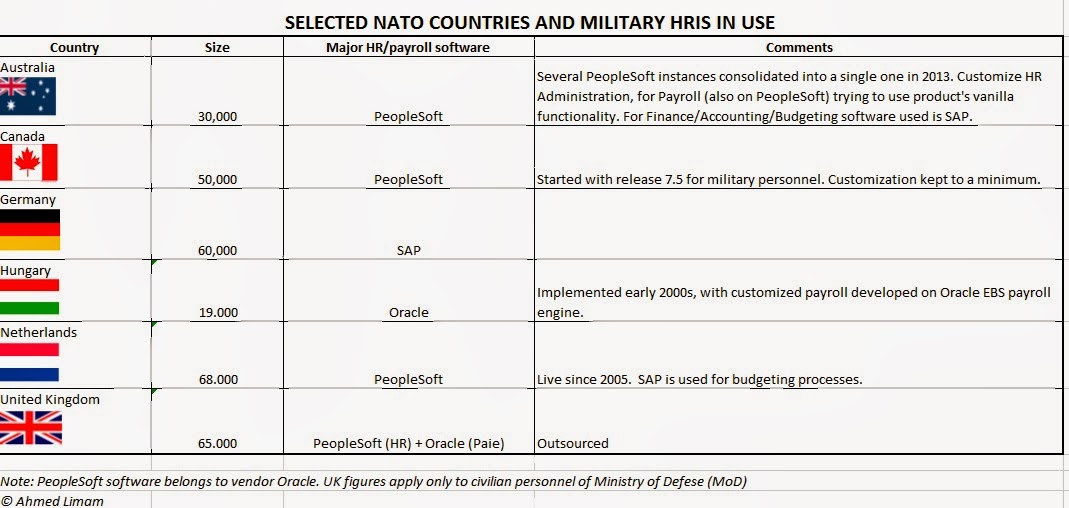
- Learn from others: Defense may be unique within every country, but since its roles and activities are replicated throughout the world, learning from others can yield great benefits, especially when comparing oneself with similar armies such as members of the NATO alliance.


- Start looking at the cloud: one advantage of being a laggard is that you can learn from others without paying the price of being a guinea pig. Some HR functions can be safely moved to the cloud with cost reductions and quality gains, others will require strategic product decisions by SAP, Oracle and Workday. So far none has seem ready to move their public-sector products to the cloud. A nudge from the customer would go a long way.


In summary, taxpayers, that is you and I, are right to wonder why in the private sector (well, the better managed businesses at least) to produce a payslip costs a couple of hundred dollars per year , whereas in the military the figure is closer to $1,000...when it works! How can our troops win the wars of the future (especially knowing that they will increasingly be IT-related) when they are defeated by a mere software? These are hard questions for which so far very few cogent answers have been provided.


Note # 1: As in all posts in this blog,  text, charts and diagrams are Ahmed Limam's intellectual property. They cannot be used without his written authorization.

Note # 2: The blogger's advisory and consulting experience covers all industries, including government, both national (such as defense)  and international (such as EU institutions and UN agencies- he worked five years for the latter in New York and Madrid.)

Saturday, December 10, 2011

Sailing away: Time for Britain to leave the European Union

PARIS
I haven't read the British press following last week's milestone decision by European Union (EU) leaders to move towards a more federal system with financial and budgetary convergence between their countries in order to solve the debt-induced crisis, but I wouldn't be surprised to see the following headline: "Europe isolated as Britain votes NO to treaty changes." Once again, and probably more radically than ever, Britain stands alone with 26 countries (using the euro and outside the eurozone) forging ahead on a new pact, and she standing in splendid isolation, the cornerstone of her policy towards Europe for a couple of centuries. Except, of course, that as a middle-sized power Britain cannot afford it any longer

To understand the current situation, just imagine that your friends have recommended you to the neighborhood club and upon joining it you requested a few privileges. First, that you be allowed to bring not only one guest but two. Then, that your dues should be only half of what other members pay. Plus a couple of other such exemptions which, considering how important you are to your friends, they all accepted to get you in. Then, as time goes by, you start making more and more demands, for instance that the club be open longer hours to accommodate your personal schedule; that you be allowed to bring your own caterer as the food served does not please your palate and a couple more requests of the same ilk. At that point, the other members rightly fed up join in unison with a rude expletive, the meaning of which is that everybody would be better off with you outside the club than inside.

This is exactly where Britain and the European Union find themselves now. Facing the admittedly worst crisis the Union has had since its inception 60 years ago, when all bandied together to come up with a solution, Britain said, "If I don't get my own, deal I won't sign to this one." The answer from the rest of the Club was to politely ignore Britain and move ahead with their agreement, anyway.

Are we surprised? Not really. Ever since the European Union was born, Britain had pooh-poohed it, when not tried outright sabotage. First, when it was set up (as the European Community) in the 1950's, Britain refused to join. Then, when it saw how successful the club was, it begged to join and did so in 1973 as a beggar,  rather than a founder, which meant it had to accept less good terms. Throughout the following decades, Britain kept on behaving in a most un-European way: Thatcher asked for a contribution rebate (the famous "I want my money back"); then they got exemptions on social issues; and, more pointedly when the single currency was formed, they refused to join. And last week, they asked for the unacceptable: exemption from financial rules. Considering that the current crisis is the consequence of lax regulations of financial institutions, this demand is completely crazy. Cameron claims that he wants to maintain the preeminent status of the City (London's financial district) which under the new rules might lose out to Frankfurt and Paris. This is a lot of hogwash: since Paris and Frankfurt will be subjected to the same rules as London, then we are talking about a level playing field. If London loses, then it means it wasn't competitive to start with, something the Tories, super-champion of competition should accept - but as we know they only accept competition when they are guaranteed to win. Also, last time I checked I thought Europe was operating as part of a single market (which the British always defend.) Now, Let David Cameron explain how we can have a single market without a single set of rules (never mind a single currency.) The truth of the matter is that the Tories are nothing more than the bankers' party and are determined to fight tooth and nail to protect the interest of their (pay)masters, even at a high cost to their own people and the rest of Europe.

With this latest rejection, the British have reached a crossroads. Their position will soon be untenable since at every EU summit, you'll have one set of meetings with 26 members making decisions and then calling the other EU member who will have little choice but accept, especially when it is about decisions where unanimity is no longer the rule. Britain's worst nightmare will become reality: there will be a two-tier Europe, a Tier 1 with all other EU members and a Tier 2 with Britain (unless in their self-delusion the British think that on their own they can be Tier 1, and all the rest Tier 2!) Permanently isolated an outvoted, Britain will find itself having to comply with rules it has had no say in their creation. How long will she put up with it?

I lived in Britain in the 1980s and since then have been a frequent visitor either on business or vacation and can claim to know the country pretty well. And one thing that still has not changed is their island mentality. I still hear many Britons when crossing the Channel saying "We're going to Europe," or "We in the UK do it this way, but in Europe they do it that way." The British have clearly psychologically never felt European. Will they ever?

So it is time the British (or, to be more accurate, the English) made up they mind. They have played obstructionist in Europe for too long, which is fine, if they have such a radically different view from Europe from all other 26 countries. I'm not saying their views are better or worse, right or wrong, but different. Then, David Cameron should do something that the so-called mother of democracies hates to do, ask the British people, in a referendum, what they want: be part and parcel of the European Union, not a mere free-trade area, with all that that implies, or keep their own views, maintain their sovereignty (or what remains of it) and therefore leave and make other arrangements.

These arrangements could entail:

- Negotiating a free-trade or special-partnership pact with the European Union (maybe like what is being offered to Turkey)

- Move closer to the US and Canada (maybe in a North Atlantic free-trade area) since they feel so much in sync with their "cousins" from across the pond

- Decide to focus on what Britain does best (media, culture) and become  a high-value-add export oriented country which will allow it to survive alone outside the European Union.

Of course, there are risks involved. Britain trades more with the EU than any other country or bloc, so a realignment is not easy to achieve. At home, if the UK leaves the EU, it is almost certain that Scotland will split and apply for readmission as an independent nation, which would mean the end of the United Kingdom. The EU will also suffer a bit, as it loses an important economy and important population, but considering it has 500 million people, a 12% loss and corresponding reduction in GDP will not be insurmountable and anyway will be replaced by the arrival of new countries such as Croatia in 2013 and subsequent ones. An EU-less Britain is likely to suffer way more than a Britain-less EU.

Whatever the solution, it is crunch time for the British. Since EU rules do not consider ejection, please do us and yourself a favor and make up your mind, which you seem to have already done, and leave. It is always sad when a marriage comes to an end, but it is always preferable to end it sooner, and on amicable terms, than later and bitterly, especially when the house is on fire.  

Thursday, June 16, 2011

DirDem comes to Europe - Time for technology-enabled Democracy 2.0

As luck would have it I arrived in Madrid on June 12,
the very  last day of this two-month-old grassroots
movement occupation of the Puerta del Sol square.
But as the sign says, "we are not going away,
we are moving to your conscience." 
MADRID
While in Madrid on business, I took the opportunity that I was staying downtown to visit the nearby Puerta del Sol camping ground of the Indignados  or "Outraged Citizens." These are the protesters who have taken over the Spanish capital's main square and, just like the Cairenes did in Tahrir Square earlier this year, the Madrilians are making themselves heard, rejecting a political-cum-economic system which has left the youth with a staggering unemployment rate of 45%. Most analysts forecast that it will take Spain a decade to get back to where it was prior to the crisis.

What a far cry from the three years when I lived in Madrid in the mid-1990's when the square, the heart and pulse of the city, was mainly congregated on for festive occasions such as New Year's Eve, to gulp down as many grapes as you could while the clock would chime the twelve strokes of midnight. The clock is attached to the building which houses the Madrid regional government whose president,  Esperanza Aguirre, clearly irritated at these noisy neighbors, said on TV, " If people aren't happy with the current political parties, they should constitute themselves into a new party and run for office at the next election." Sounds reasonable except that Ms. Aguirre, who belongs to the Conservative People's Party, is just not getting it

The issue issue is not whether it's party A or B which is in power, or a third party, it's the whole political system which is being challenged by citizens who realize that the old system might have had its use in the past but clearly it is now broke as it can't deliver the goods and therefore needs to be jettisoned. The same message is being broadcast every evening on Bastille Square, down the street from where I live in Paris, by fellow protesters who use the same slogan: "Real Democracy Now."  The financial meltdown and its aftermath of debt-related and construction boom-to-bust crises have brought home the realization that the political system is no longer here to serve the interests of the majority but those of a well-off minority (the bankers who creates the mess and demanded that average taxpayers bail them out) and a privileged group of self-serving politicians. (You can read a post I wrote a few months ago on what the debt crisis really means.)

A placard held by a woman protester in the Puerta del Sol encapsulates people's outrage: Crisis? Robos! (Crisis? Theft!) it loudly claims. How come that jails are full of people whose crime is "just" to have pushed or consumed drugs when those who are responsible for sending millions into unemployment, emptying the retirement nest eggs of millions more and almost destroyed the livelihood of entire countries, how come that those bankers and their regulators are still allowed to walk around free? How come that while millions are still hurting, losing their homes and seeing their living standards plummet, that banks are reaping billions in profits and awarding their executives indecently fat bonuses? How come that the political class, supposedly voted into office by citizens to represent them, perpetuates itself in power and does nothing to alleviate the majority's suffering while clinging to its privileges and that of its sponsors, mainly in the financial industry? 

How else can you explain that billions of dollars' in taxpayers' money were handed over to the banks when they made losses, but their profits are still being kept by the few? Citizens' sense of outrage with the public losses/private profits arrangement is understandable. It reminds me of the pre-revolutionary situation in France when over 95% of the wealth was in the hands of less than 5% of the population (the aristocracy and the clergy) and yet they were exempt from paying taxes, a "privilege" reserved to the poor. Small wonder that when the economic crisis became more acute people rose up and overthrew the old political system. Small wonder that two hundred years on, their descendants are going back to where it all began in July 1789 and protesting at a similar situation: privileges for the few and hardships for the many.

The reason the political system has become so dysfunctional is that it is based on representative democracy (or RepDem, for short) invented in the 18th century. While there is little doubt that it has served the West well for two centuries, it is no longer fit for the 21st century.  Much of the gridlock in the US political system can be ascribed  to the Americans' absurd adherence to the principles edicted in the Constitution by aristocratic gentlemen farmers wearing breeches and wigs. Direct Democracy (DirDem for short) was not practical when England, France, and even more so the United States, were large countries with big populations scattered all over the land. How could you summon all of your country's voters in your capital to vote on a  policy or a leader? So we had to settle for a proxy: smaller and more manageable constituencies would vote for a congressman/Member of Parliament/deputy and send him (then there was no "her") to the capital (Washington, London, Paris) to represent our interests. Except that two centuries on, as the current crisis shows all too clearly, that "representative" represents other interests and when those conflict with the voters' it is clear to all whose interests prevail.

Look at Obama, about to become a brilliant failure. He is a politician who came to power through a grass-roots movement. On Inauguration Day he announced (and signed) the closing of Guantanamo Bay camp, a blot on America's conscience, where hundreds of men have been kept in jail for a decade without any due process of law, no trial, let alone any conviction, a complete violation of the lofty principles those bewigged 18th-century gentlemen bequeathed to the nation. Also, Obama supporters expected tougher regulation and sanctions on those who, through their greed, fraud and incompetence, provoked the crisis. On the foreign-policy front, Obama promised a new dawn for the Middle East by promoting democracy and putting pressure on Israel to pull out from occupied Palestinian lands.

And what did we get? Zilch. Guantanamo is still shamefully open for its ghastly business; the Middle East peace process has resulted in neither peace nor a meaningful process, Obama caves in to the pro-Israeli lobby; Bahrain has instituted a reign of terror against its Shiite majority to America's silent acquiescence; and as for bringing the bankers to account for their (mis)deeds and reforming the system that produced the crisis from which the US is still reeling, two words summarize the situation: full impunity. In case you think I am exaggerating just read this report on the financial crisis by nobody else than the U.S. Senate or the one published by Stanford University. Both show unequivocally that the financial crisis was largely criminal and yet  none of the perpetrators has been made to pay for their crimes. Could it be that after the "military-industrial complex" of Eisenhower's days we have now entered the age of the "political-financial complex"?

Today outrage spread to the cradle of Western democracy with thousands of Greeks battling police in Athens while protesting against those who put them in that situation: the rent-seeking and maximizing elite. The Socialist Prime Minister George Papandreou's offer to form a national unity government with the Conservative opposition is not going to change much since it is exactly the same situation I alluded to earlier: Party A or Party B will not change anything. They have both been in power and turned a blind eye, when they didn't actively encourage, the behavior that led to the current mayhem. In Barcelona, Spain's second city, what Gore Vidal would call the ruling class has resorted to tactics which we associate more with the Arab dictatorships in Libya and Syria than a  Western pseudo-democracy: planting plainclothes police as violent elements in an otherwise peaceful demonstration of the Outraged Citizens, in order to sabotage and delegitimize the movement. You can watch the video on YouTube (comments in Catalan.)

So, enough of describing the disease which we are all aware of. What can be done? The RepDem political system has shown its limitations and is increasingly losing its legitimacy as people lose faith in it. Citizens are no longer willing to elect a politician and then give them carte blanche for four or five years since that will just entrench them and their moneyed sponsors. What is needed is to move to a DirDem system.

If, as I said earlier, in the 18th century it already was not feasible to gather all voters in one place, in the 21st century it is even less so. But is it?  Maybe physically, but what about virtually? Technology, which has become so pervasive through every nook and cranny of society, can help bring people together in ways unthought of before ― in many countries now you can fill your income-tax return, and pay your taxes, online. If internet is good enough for my taxes, why can't it be used to get my opinion as a citizen and my vote? Why can't I vote directly on proposed laws? a privilege hitherto reserved for an elite that has done such a dreadful job of it. Any citizen should be able to suggest an initiative or law through a Facebook-like tool where its pros and cons could be discussed by the electorate at large (your user name would be your unique national identifier such as Social Security number, with maybe some biometric identification to prevent voters from selling their votes.) Such discussion of the proposed laws through comments would enlighten and enrich the political process and at the end of this debating process (akin to a political campaign) all interested voters could cast their vote online and, if a majority supports the initiative it becomes law. No more need for parliament or congress, half of which (the upper chambers) were completely useless anyway as they just served to provide cushy jobs for the well-heeled (case of the Senates in many countries such as France and Spain; in the case of the British House of Lords it is just indefensible that almost 100 members of this body are there just because they inherited the seat from some distant ancestor.) As for the other half (for example, the Chamber of Deputies in France) they often tend to just rubber-stamp whatever decisions the executive branch has decided on.

With technology we can get rid of the political middleman who served only his interests or powerful interest groups and lobbies, rarely the average citizen. This disintermediation process which has radically changed many businesses (brick-and-mortal travel agencies and  bookstores are on their way out as people buy directly from producers such as publishers and airlines) can be applied to politics as well. With the legislative branch technologized out of existence and the people finally regaining what has been until now a nominal sovereignty, we can shift our attention to another class of politicians: those in the executive branch of government, whose function will be maintained since somebody will have to implement laws and administer policies.

Bringing executive-branch politicians to heel is even more important since elected parliaments have anyway always be supine and deferring to the unelected administration of the day. One typical example in this pseudo-democracy that France is  can be seen through the use of décrets d'application whereby a law, although voted on by the people's "representatives," cannot be enforced until the government has decreed so. As an HR person I have always been shocked that the law voted on by the elected French Parliament in 2006 on anonymous CV's is still not enforceable (and therefore not adopted by companies) because the unelected government has yet to give it its stamp of approval And you call this a democracy?

The same technology used to bypass lawmakers can be used to keep executive-branch politicians and officials in check. For one thing, not only presidents and prime ministers  (I'd call them "Chief Executive") could be elected directly online but also any citizen would be free to run for office (with, of course, some conditions such as the number of certified friends they would have on Facebook to make the process manageable.) Why should politics be reserved to professional politicians? I don't remember who said that "the business of politics should be everybody's business" but they were damn right, and a public social media allows just that. For efficiency reasons, the members of a cabinet or administration would still be chosen by the Chief Executive but confirmed by the people (the way the US Senate confirms ambassadors and other officials) after hopefully vigorous online hearings. This should help weed out incompetence, nepotism and dishonesty, because, and this would be a marked departure with RepDem practice, at any moment citizens would be able to recall any official, starting from the Chief Executive down. That carte blanche given for several years to politicians to do as they please would thus be a thing of the past.

By the same token, every policy (war, taxes, budget etc.) will start with an online discussion and end with a formal vote where citizens sign off on it ― or not! By the way, if you think this is a novel approach, a little historical perspective is in order. In Republican Rome, during Cicero's time, decisions by the Senate were then read out on the Field of Mars to gathered citizens who would then vote them up or down. If it worked for ancient Romans, why can't it work for us int he 21st century?

Debating society's ills in central Madrid.
I was impressed at how peaceful,
well-organized and disciplined
the protesters were


Finally, technology is only an enabler as I have discussed in so many of my posts, articles, presentations and speaking engagements (mainly in the business arena.) There are also other cultural symbolic measures that can be taken to keep politicians and public officials on their toes and remind them that they are supposed to serve the people, and not the other way round. To go back to ancient Rome, when a general was granted a triumph after a big victory, he would parade through Rome in full glory but there was a slave standing next to him and whispering repeatedly in his ear, "Remember you are mortal." Our politicians need a similar type of reminder: You are here to serve the people. 

I have always been flabbergasted by the total lack of accountability of politicians in our pseudo-democracies. When  you give instructions to your cleaning lady, you can pretty much expect her to carry them out as well as show some respect to you. Same thing with your employees at work. Why? For a simple reason: you are the one who have hired them, you are the one describing their duties, paying them a salary and if you are not happy with them you can always fire them. That's why you usually tend to get from them what you need. But not with politicians. You are the one hiring them, because you vote them into office; you give them their job description, by choosing their political program over their adversaries' (I almost wrote partners in crime); you pay their salaries through your taxes; and you can fire them when you vote them out of office. And yet politicians behave as if they were the boss and you the employee, or the servant.

I would therefore suggest some symbolic changes to remind politicians who the real boss is and that the word public servant should mean what it means. One way would be to have direct access to them ―say, one day a week. Every public official from the Chief Executive down to a small-town mayor, should set aside a day a week where any citizen can come and talk to them. Since obviously it would not be feasible to see all citizens, the lucky visitors could be selected on a first-come, first-served basis or, after signing up online, be selected at random. Then, during the meeting, the citizen could ask any question they want, have access to any document (why did you pick this supplier? what was this expense for?)  and film with their smartphone the whole proceedings to be posted then on YouTube for the whole electorate to view, post comments on and, if they feel like it, initiate a recall procedure.

I can already see my detractors shouting down my proposals on the grounds that they would lead to chaos, demagoguery and populism. If you ask people whether they want their taxes raised, you can be sure they would vote it down. Ask them if they want welfare spending to be raised and you can expect them to click yes enthusiastically. How could you then ever be able to balance a budget? True, DirDem could lead to some messy outcome, but then many governments have been running deficits for years (the French government has NOT presented a balanced budget for over 30 years!) DirDem can't be worse. And then, I am pretty sure that most people would rather live with a mess of their own than one imposed on them by self-serving politicians and greedy bankers.

Other critics might point out that in Europe many legislative and executive functions have moved one level up to the European Union institutions. My proposals are even more valid since most people, not less national politicians (who see the mote in somebody else's eye) have always decried "Europe's" democratic deficit. For issues that are a country's responsibilities (for instance taxes or labor relations) only national voters would participate in the Facebook-like voting system. For issues that are dealt with at European level (including the appointment of European commissioners) all European voters would participate. And as for the European Parliament it will join the national ones in the graveyard of history.

This is the longest blog post I have ever written, and I doubt I will soon be able to match its length. But then the stakes described here are higher than any other I have tackled in my one-year-old blog. My sincerest hope is that it would generate a lot of positive debate to fix what has become an untenable system. I still have confidence in my fellow humans and believe that many of my ideas make sense and, if implemented, could solve many of the current issues in our 21st-century polity.

What do you think?


Saturday, April 30, 2011

Abolish the monarchy or reinvent it?

Let's hope for Catherine Middleton
that she 
escapes the fate of the three
Catherines Heny VIII married (out
of a total of six wives) :
he divorced one (Catherine of Aragon),
beheaded another (Catherine Howard)
with the last one, Catherine Parr,
surviving  a similar 
fate only by the
King's timely death.
PARIS

Unless you've been living on planet Mars for the past couple of weeks, you are unlikely to have missed yesterday's wedding of the heir to the heir to the British throne. The occasion has sparked some lively debate on the monarchy's future and I was surprised at the disappointing quality of The Economist's column on the topic.

I remember an excellent article they wrote a good 15 years ago called "An idea whose time has passed" which made cogently the case against the monarchy. Last week's column, on the other hand, is one of the worst I’ve read in The Economist in a long time. Although I don’t disagree with its main tenet, abolishing the monarchy, the arguments used are so convoluted that Bagehot does a disservice to the republican cause. With people attacking the monarchy this way, the House of Hanover (a.k.a Windsors)  is safe for another three centuries.  In theory I would always prefer a republic to a monarchy for the simple reason that why should the highest post in the land, that of head of state, be reserved to a single family? In a truly democratic and egalitarian society anybody should be allowed to reach that exalted position.

All the talk about modernizing the monarchy is simply absurd: how can you "modernize" an institution created in and for the Middle Ages? Its idea has just passed its time. The only way to "modernize" the monarchy is surely to abolish it.

Now, to the real world. Monarchies fall only in periods of crisis: war, revolutions and other political/social upheavals. There is no case of a peacetime “pensioning off” of the royals since, at least in European monarchies which are democratic societies, people realize that the royal family does little harm and therefore why fix what ain't broke? Instead of bothering about who should be on the throne (with limited political power) or even whether there should be a throne in the first place, people realize that there are a lot of other more serious issues  to deal with: unemployment, global warming, reforming bankers –now here’s a group of people who should head straight to the guillotine and yet our so-called democracies dare not touch them; maybe they are the true royals, our undisputed masters. And when a democracy does go to the polls to decide whether to keep the monarchy, in the only recent case (Australia), they voted to keep it (regardless of the fact that the monarch lives thousands of miles away and is now too old to visit them.) And for good reason. Look at the French model which isn’t one: the French president is for all intents and purposes an elected monarch who wields enormous power (proportionately even more than the US president) and yet we can’t say that the French are better off with him (we have yet to have a “her.”)

And why should the alternative to the current monarchical system be a republic only? One can be creative and use an intermediate system which would be more in consonance with the country’s political and institutional history. For instance, why not make the queen or king an elected position? The much-beloved (by the British and tourists) pageantry, coronation and titles will still be maintained but any British citizen could aspire to the position which they will hold for life (just like judges and some other officials in many republican democracies.) This life term wouldn’t be a democratic issue since the monarch would not hold executive power, the Prime Minister would continue with his functions. 

Actually, if it sounds like a novel idea, historically it isn’t. As recently as the 18th century, Poland chose its kings this way. Polish kings came to the throne not through inheritance but because they had been selected by the Diet (Polish parliament.) Actually, the Poles didn’t even show too nationalistic a streak as they would cast the net wider  and along with representatives from prominent Polish families include European candidates. Thus in the 16th century Henry of Valois, brother to the King of France, was elected king of what for most people then was faraway Poland.  Now that would be a great way for Britain to enhance its European credentials. And who knows? A couple of centuries from now latter-day Britons may well wonder how retarded it was to reserve the crown to a single family.

Saturday, March 26, 2011

Shakespeare and the debt crisis

PARIS
In Shakespeare's most famous play, Hamlet, one of  the characters, Laertes, is about to embark for Paris and receives from his father some wise advice:


Neither a borrower nor a lender be,
For loan oft loses both itself and friend,
And borrowing dulls the edge of husbandry
.   
Hamlet, Act ISc. 3, 75-77.


Had our rulers heeded this sound advice proffered by the Bard half a millennium ago we would have been spared the disastrous budget crisis which many countries are suffering from. So many pixels have bounced on our screens on this topic that I feel I must bring my  own contribution to the debate.

There's something wrong when people's livelihood is directly decided upon by the financial markets' diktats: cut people's wages and pensions so that you can repay us, bankers and bondholders tell our governments who fall over themselves to accommodate their (and our) true masters. Aren't these modern-day Shylocks (another Shakespearean reference) fat enough? or are they so greedy that they won't stop until they have sucked us dry?

If the weight of debt has become so intolerable that governments can't pay their loans back, well, then don't. I can hear some of my detractors shriek that debts are sacred and should be honored. This is disingenuous and pure hogwash (if hogwash can ever be considered as pure.) Every day companies and people go bankrupt and their creditors don't get paid, why should government be different? After all, the interest rates charged by bondholders reflect the risk they may not be paid: a country deemed solvent (such as Germany) can borrow at a low interest rate, a very risky one such as the PIGS (Portugal, Ireland, Greece and Spain) have to pay much higher rates because they are deemed a riskier investment. So, investors have already been largely repaid by the bigger amounts they extract from governments. Isn't that enough? If I decide to invest in a bakery and customers don't show up, I lose my investment, right? Will anybody come and rescue me? Certainly not the government. That's the purest expression of the market, and I have no problem with that. Why then should bankers and bondholders, who are much wealthier than I, be spared this basic tenet of capitalism? They made a bad investment and should suffer the consequences remembering Shakespeare's words: "loan oft loses itself."

Of course, the consequence for governments is that after they default they will be unable to borrow money in the future. Well, that doesn't strike me as a bad thing at all. After all, wasn't the crisis precipitated by borrowing in the first place? I would argue that we should remove the cause of the problem, and the problem will be solved. As any household knows it's never a good idea to borrow, at least for a long period of time. Sure, when you face an emergency (an unexpected health bill, or a house renovation or student fees for your children) I can understand that you should borrow on an exceptional basis and pay back as soon as you can. But keep on borrowing and pay your debt through even more borrowing and we all know how it will end: in tears. "Never a borrower be," said the man from Stratford.

Now, in my first paragraphs I've been very critical of the financial markets, especially bankers and bondholders, and their responsibility in the current crisis. But intellectual honesty dictates that a big mitigating factor be acknowledged: they have not forced governments to borrow. Criticizing bankers for being leeches and greedy is like badmouthing Dracula for hanging around the blood bank. What else do you expect? But the point is that they haven't held a gun to government's head in order to force them to borrow. Governments have willingly thrown themselves into this vicious cycle which, like its private-consumer variety, is now ending in tears.

Why do governments borrow? If for exceptional reasons, such as a war, a natural disaster, or economic crisis such as a recession, that would be fine. But look at France, a country that has been blessed with no natural disaster in living memory, nor a war for 60 years, and just a few mild recessions. Why then has the French government been unable to balance the books for over 30 years? Yes, you've read right: the French government has been spending more than it's earned since the 1970's, and tears time has come: wage freezes, longer retirement date, cuts in valuable public services such as education, health (I still cannot understand why we are spending €60 billion in defense with no threat from any of our neighbors.) Look around you and most other governments in Europe are in a similar situation (at least, Germany had to pay for the huge one-off cost of Reunification; what has the French government to show for its big debt?)

They say that one should not waste a good crisis. Let's hope that our rulers finally heed the great Will's words that "borrowing dulls the edge of husbandry" and enforce a very simple and common-sense principle: if you cannot have the means of your ambitions, then have the ambitions of your means. If this precept is good for my family, it should be good for the government.  


Saturday, February 12, 2011

Arab Revolution - Phase 2: Pharaoh Falls

BOGOTA
Even from the other side of the world there is no escaping the momentous news, which explains why for the second time in a row I am posting on political developments in the Arab world. Last time, a month ago, when I wrote on the  Tunisian uprising which ended the dictatorial rule of Ben Ali, I predicted that Egypt, the heart of the Arab world, would be next. Last Thursday I emailed an old friend of mine: "This is the end of the game for Mubarak.  Following his refusal to leave power, the Egyptian people will mount an even bigger rally and protests after Friday prayers in now world-famous aptly named Liberation Square  and there is no way the military will allow him to stay. So by next week, and maybe even this weekend, he'll be gone." I was gratified to see I was right: the next day, as the weekend started, Hosni Mubarak, the last pharaoh, the absolute ruler of 80 million Egyptians for 30 decades, resigned in ignominy and fled to his home in the Red Sea resort of Sharm-al-Sheikh probably on his way to Saudi Arabia where, like an elephant cemetery, dictators retire to die.

What does this purport for the region, the world and US foreign policy? Well, much has been written, said, pontificated, hollered about by more knowledgeable people than I, so I don't need to expostulate at length. I would just like to lay to rest some myths.

Myth # 1. A lot is being said about the respect in which the Egyptian armed forces (which are taking over  during a transition period) are held. Well, if respect it is, it is the respect spawned by fear, not admiration. What is respectable or admirable about the Egyptian army? Abroad, they waged war against Israel three times, and were defeated three times. At home, they have been the backbone of the dictatorship for decades. Mubarak himself was a general, as have been all Egyptian presidents since the military (yes, they again) overthrew the monarchy in 1952 in what was a coup and not a popular uprising. How ironic that they got rid of King Farouk because he was too subservient to British interests (the power of the day) and they ended up just doing America's bidding.

Myth # 2: Don't believe a single word of all the lofty talk of Obama and Clinton about "the voice of the Egyptian people". Until this week they were backing newly appointed Vice-President Oman Suleyman to take over a vaguely defined transition. But Suleyman is as bad as Mubarak: as head of the intelligence services he has overseen every repressive policy of the last decades including torture, brutal crackdown, censorship, arbitrary arrests, rigged elections and stifling dissent. How can that be a change? Well, it isn't, and that's what America was/is after: to keep the same regime in place under a veneer of pseudo-democracy so that it can continue to implement America's policies in the region. But Vox populi, vox dei. Sometimes you just can't go against the people when they rise in their millions.


Myth #3: The free and responsible media. Yeah, right! I was mesmerized by CNN's coverage  which turned shrilly anti-Mubarak referring to him as the dictator at the height of the protests. And yet for decades you never heard anything like that. Had the Egyptian people not risen against the oppressive regime, CNN would have been glad to continue reporting on "Egyptian elections won by the president's party" and leave it at that when it was obvious that last November's elections had been rigged beyond belief. But that didn't seem to bother CNN unduly nor the US government who was quite happy as long as their buddy stayed in power. It was mind-boggling to hear US Vice-President Joe Biden refer to Mubarak as "not a dictator" and this ...as recently as two weeks ago when he was sending his armed thugs against peaceful demonstrators. Just like French minister Frédéric Mitterand protesting on TV channel Canal+ Sunday program that "Ben Ali is not a dictator" when his police was shooting his own people, and five days before he was to flee. The hypocrisy and duplicity of both mainstream media and politicians are seemingly endless. (Do I need to remind my readers about the New York Times endorsing Bush's Iraq war?)


Myth # 4: The Arabs are happy with their lot and never rise up. True, the last major Arab uprising was almost a century ago, in 1916 when they rose against their Turkish overlords in what was to be known as the Arab Revolt (with the help of legendary Lawrence of Arabia) and would lead to the creation of the modern Arab states that we know today and which are in deep crisis. Tunisia then showed the way and the Egyptians were so shamed by this little country to have done what they hadn't dared do that it galvanized them into taking their fate into their own hands. After all, don't Cairenes call their city Umm-ad-Dunia, center of the world? How could they fail where a small Arab country succeeded, they the heart of the Arab world, its most populous country?


Three more points are worth mentioning:


- Technology and especially social media were instrumental in mobilizing protesters and getting the word and pictures out. When Zuckerberg created Facebook in his dorm room several years ago I guess that if he never suspected it would quickly be worth billions of dollars, it is a safe bet to say that it never crossed his mind that it would have such political impact in countries on the other side of the globe. In the tug between the immovable object represented by Mubarak and the Egyptian protesters' irresistible force the latter won because it has Facebook on its side. 


- US foreign policy in the region is in complete disarray. It tried under Bush to foment democracy (or so it pretended) for nothing. So when Obama came to power he soon went realpolitik accepting Arab autocrats (but then did he really ever want that to change?) and, bang, Arab democracy explodes in his face. It is too early to make a definite judgment, but I believe that the maturity and commitment of the Egyptian people have shown that they will not accept anything less than a free society and democratically elected leaders. And representative government in Egypt means that US policy (especially as regards Israel) will never be the same, because "Egypt will never be the same again" in Obama's words. 
  
- So, who's next? As (bad) luck would have it, the longest ruling dictator in the Arab world, buffoon Qaddafi (he came to power two months after Armstrong walked on the moon, that is 42 long years ago) just happens to be wedged between Tunisia and Egypt, the two countries  which have just chucked their dictators. You can bet that the Libyan dictator is not getting much sleep these days. And today Mahmoud Abbas, the Palestinian president, announced presidential and legislative elections for next September. Considering that his term ended in January 2009 and he decided to stay on without bothering to ask his people how they felt about it, not too soon you might think. And yet CNN has yet to call him a dictator nor does the US administration criticize him for not being elected. Algeria is another low-hanging fruit with its explosive mixture of emergency laws, repressive gerontocratic single-party government and economic. The Saudi king who rules like a medieval monarch supported Mubarak to the hilt until his last moments in office understanding very well what it would mean for his family's shocking and continuing  control of a major and wealthy Arab country if Egypt went democratic. Another same-name Middle Eastern monarch, Jordan's Abdallah II, would be well advised to stop appointing the Prime Minister and leave it to elections to decide the makeup of a government. Of course, that means that the Palestinian majority in his country and probably the Islamists would come to power, something the US (as a sponsor of  Israel) would hate to happen. But isn't democracy about letting the people choose freely their leaders, whether you like them or not?


- A lesson for US foreign policy is to accept Islamist parties, realizing that (a) the US can't anymore force its will on the Arabs, an ancient and proud people (b) that just like not all Socialist governments in democratic Europe or Latin America mean rabidly anti-American policies, some Islamist parties such as the Muslim Brotherhood may well turn out to be people the US can do business with (along the lines of the AKP government in Turkey.) And remember, most of these opponents of the US became so only after the US engaged in anti-Arab policies. Be more friendly to the Arabs, and the Arabs will be friendly to you. 


Finally, to close my thoughts on this truly remarkable and historical achievement, let me share with you  three jokes making the rounds in Cairo.


1. Why did it take Mubarak three decades to appoint a vice-president?  Because he couldn't find anybody as stupid a he is.


2. Where does the $1.5 billion in US military aid to Egypt go?  Half is spent on military equipment and half on black dye for Mubarak's hair.
3. As Pharaoh-Mummy Mubarak lies on his (political) deathbed, his counselors gather by and tell him: "Excellency, the Egyptian people are here to bid you farewell."  "Farewell?", the dying man says, "but where are they going?" 

Saturday, January 15, 2011

After the Tunisian Revolution, which Arab country is next?

PARIS
In the late 1970's, I was a teenager spending part of the summer in my mother's hometown in Romania when the inhumanity of the Communist regime of the self-styled Danube of Human Thinking, Nicolae Ceausescu, hit me. The paucity and bad quality of goods in stores; the weird cat-and-mouse game we had to play in Bucharest when staying with a cousin so that the resident man from the Securitate (Ceausescu's answer to the Gestapo) wouldn't see us spending the night with her (yes, you've heard right, my mother, as a foreigner, was not allowed to spend the night at her cousin's house!); my great-aunt spending time in jail, after the Communists took over, because she had grown up in France where her sister (my grandmother) still lived thus making her a dangerous counter-revolutionary and Western agent; my mother not being allowed to inherit the house built by her grand-parents (because she was born in Paris and had left Romania); nobody allowed to travel abroad - it all struck me as too weird and inhuman to last. "Maman, this can't go on. Sooner or later the system will collapse," I exclaimed. My mother shook her head and replied with a sad voice, "Look around. Has any Communist regime that has taken over ever lost power?  Why do you think your grandmother insisted that I go back to France?" It was true that at the height of the Cold War the Communist-bloc dictators seemed unassailable.

And yet, at the end of the next decade, while pursuing my master's degree in the United States, I was mesmerized by a scene on my TV screen, a scene I never thought would happen. In December 1989, during a speech at the soon-to-be-renamed Revolution Square in Bucharest, something unthinkable took place: Ceausescu, who among his self-granted titles used "Genius of the  Carpathians", was booed by thousands of Romanians. Yes, the docile Romanian people who had put up like sheep for decades finally said, "That's enough, we can't stand this anymore. Go!" and rose against the tyrant. Vox Populi, Vox Dei. Three days later, on one of my most memorable Christmas Days, the hated dictator and his wife Elena were executed. Justice and democracy had finally come to long-suffering Romania. But too late for my great-aunt who had died a few years before of a lung disease contracted while in Communist jails.

In the next two decades democracy would soon conquer all of Eastern Europe, Latin America (with the exception of the Castro-engineered hell in Cuba), many Sub-Saharan African countries, part of East Asia including Chinese Taiwan. Only one region held out: the Arab world. From the (Persian) Gulf to the (Atlantic) Ocean, as the phrase in Arabic goes,  feudal monarchies, military-backed single-party regimes and presidents-for-life hold sway, impervious to the winds of freedom blowing all over the world, and often actively aided and abetted by Western democracies (now that is an irony.) It was absurdly claimed that Arabs were not wired for democracy, that Islam was the reason, forgetting that many Muslim countries such as Turkey and Indonesia had embraced multi-party democracy quite successfully, some of them even electing female rulers. But Arab countries were still the exception. No velvet revolution there, sheepish Arab citizens just seemed willing to accept their sad lot forever.

When my father's home country of Mauritania, where I spent part of my childhood, elected Sidi Ould Cheick Abdallahi (who went to school in France with my parents) as president in 2007, I held my breath: could that tiny country teach the Arabs a lesson? In Arab League meetings, "Sidioca" (as he was familiarly known) was the only Arab leader freely chosen by his people and you could tell it grated on his colleagues. And you could hear the collective sigh of relief from Arab rulers when 18 months later Sidioca was overthrown in a bloodless coup by a general who wanted to be top dog. Things were back to normal.

So when Tunisians started rioting a couple of weeks ago (almost 21 years to the day after the fateful event in Bucharest) about their economic conditions, neither Arab rulers nor the Tunisian regime's Western backers worried too much. Nothing that a good crackdown, censorship and a few deaths can't fix. And yet day after day, week after week, the ranks of protesters kept swelling as the  nature of their demands grew: from lack of employment opportunities to disgust with corruption and, as the death toll rose, to outrage at the killings perpetrated by the police and, finally, demands that President Zine El Abidine Ben Ali, whose 23 years' reign had turned the country into a police state, step down. Then last Thursday, with the whole country in full uprising,  I saw on Al-Jazeera TV  Ben Ali speak in Tunisian Arabic, to be better understood by a majority of his subjects, that " I have understood you, I will not run again in 2014." My first reaction was, "I don't think you will because you'll be gone well before that." I knew then the game was up for him and it would be just a matter of months, maybe weeks, before he was consigned to the bins of history.

I was wrong. The next day the dictator who had run Tunisia with an iron fist for so long fled the country. Vox Populi, Vox Dei.

The Tunisians had achieved something unique in the Arab world: for the first time an Arab ruler was overthrown not by the army, or a foreign invasion, or a coup, but by the people themselves. For the technology person I am, I was gratified to see that this was also the first digital revolution on record. Tunisians, especially the youth, made great use of Twitter to coordinate rallies and protests, used their iPhones to make pictures of what was happening and posted them on Facebook. With the government preventing foreign reporters from entering the country and covering the events, most of the images we first saw were amateur videos. Tunisians filmed themselves making their own revolution and shared it with the world.


I bet you anything you want that no Arab ruler slept comfortably last night. Most of them are feeling quite edgy, and several must be shaking in their boots. The military-backed FLN party-run regime next door in Algeria is wondering whether its days are counted. Ominously there were riots in Algiers at the same time as in Tunisia, but they were quickly subdued (for the time being?) The Tunisian case, however, shows that any insignificant event  can turn into the sparkle that will ignite a full conflagration (in Tunisia it all started with a college-educated street vendor setting himself to fire in protest at lack of opportunities and heavy-handedness by the police) and that no matter how long a people has been cowed there comes a moment when they conquer the fear, break their shackles and there is just no stopping them.

Tunisia's other neighbor, Libya to the east, whose buffoonish dictator has (mis)ruled it for 40 years, could be the next domino. But the biggest prize for popular overthrow of a dictatorial regime  would be the country next door: Egypt. This ancient land shares many traits with the situation in Tunisia: heavy-handed security apparatus, corrupt regime, a pauperized majority and a relatively well-educated youth who have been watching with fascination the events that their fellow Arabs have shaped in Tunisia. The current Pharaoh, Hosni Mubarak, who has maintained himself in power for an incredible 30 years (yes, you've read right, he came to power in 1981 when Reagan was president and Gorbachev had not even come to office!) through repression, rigged elections (like Ben Ali in Tunisia he claims at every election an improbable score of 90 to 99%) and support from the United States government. And once Egypt, the heart of the Arab world, falls, the other Arab countries will follow through. History is on the march and it is exhilarating to watch it.

(Tunisia also broke another record. Yesterday at noon Ben Ali was still president, in the evening his Prime Minister had officially taken over only to be succeeded this morning by the Speaker of Parliament. Three presidents in less than 24 hours, that must be  a world record, even better than the three presidents Argentina had over ten days back in the early 2000's.)

Wednesday, July 28, 2010

The case for a different labor-market reform - not PELMAR

BARCELONA,
Read the mainstream economic press (by which I mean The Economist, the Financial Times, the Wall Street Journal et al.), listen to pundits from the establishment's think tanks and international organizations (OECD, IMF etc.) and you always hear the same litany again and again: to grow your economy and create more jobs you must reform your labor market. And the reform they have in mind is always the kind that curtails employee rights and benefits, never employers' - let's call it for what it is: pro-employer labor-market reform (PELMAR). With the current economic crisis, which has thrown millions of workers out of their jobs in the developed world, it is time to stop and ponder. Is this medecine the adequate one? Does it guarantee any success? Has it been responsible for increased worker participation in the labor market in the past? How does it dovetail with our Western notions of social progress?

So desperate are the current times that here in Spain (20% unemployment rate), a Socialist government has decided to abandon one of its tenets of employee protection (something not even its conservative predecessor dared consider) and reform its labor market in the sense demanded by the conventional wisdom: relaxing rules on firing employees in the hope that it would encourage companies to hire more easily. The logic is impeccable: if I can fire 'em when I want, why not hire 'em when I want? Before you jump to the conclusion that there is no other solution, it's good to look at the past. When I lived in Spain 15 years ago, unemployment was even higher than now (23%) and yet neither the Socialist administration of Felipe Gonzalez nor its conservative successor under José Maria Aznar embarked on PELMAR, even though European Commission, IMF and World Bank reports all encouraged them strongly to go through the same tired old song of making life even more miserable for employees (but brighter for the bosses) in the hope that more jobs would be created. Well, the next decade and a half saw Spain growing tremendously and the unemployment rate go down from 23% to 8%, even better than France. And this without any PELMAR, with employee rights maintained as intact as before. Now, you might say, OK, Spain is a one-off case, the exception that proves the rule, coincidence is not correlation or causality, they were just lucky.

Well, let's cross the Atlantic and check out Brazil, a country I know well since I spend several months a year there. Brazil's labor rules and regulations are even more stringent than Spain's: many employers consider it a nightmare since, once hired, an employee is almost unfirable (or, to be more accurate, it is costly to do so), and if you do and are taken to court in 90% of cases the labor tribunal will rule against you. And yet, Brazil's unemployment rate has been coming down steadily for the past decade. Yes, just like Spain, and without any need for PELMAR. 

You want a third case? Well, let's take our pilgrim stick and travel up north, to the world's most powerful and wealthiest country: the US of A, the cradle of PELMAR before PELMAR even existed, corporate paradise and worker hell. Living in the States in the early '90s I was somewhat shocked to see that in the Land of the Free and Home of the Brave people could be fired instantly with or without a cause, that many had no health insurance and had to toil double shifts at two jobs just to make ends meet. Sure, employees could go to court in case of wrongful termination but astronomical legal fees make this option all but an impossibility for most workers. Of course, you could (I dare not say "can" anymore) get a job not too long after having lost the previous one, but even this cannot hide the pain involved with stressfully looking for a job over the weekend because you were let go on Friday and needed something on Monday. Not to mention that any new job also means a period of uncertainty, adaptation and learning the ropes, making new friends among new colleagues. But at least the US unemployment rate was half that of Europe, so, you might have said, it evens out. Well, not any longer - if ever. With both the US and Europe facing the same economic crisis, the US unemployment rate has crept up to the same levels as in my native France, home of the 35-hour workweek, 8-week paid vacation, universal health care. Who is now better off? The US worker or the French one?

Still a skeptic? Let's look at the UK, right across from France, and yet in labor matters so close to the US. (Only when Tony Blair came to power was a minimum wage finally adopted.) The British unemployment rate is more or less at the same level as France. But, I'll be generous, I'll consider this current figure a statistical outlier and use the figure of better times, say 5% against France's 10% (higher than the current one, but I said I wanted to be generous to my detractors.) Since both have similar labor sizes (let's say 30 million) let's make a comparison. If France were to implement US/UK-type PELMAR (free firing, no minimum wage, little paid vacation, limited unemployment benefits, curtailed employer-paid health care plan, well, the works) it would see its unemployment reach the UK/US ideal level of a jobless rate of 5%. In other words, in the old system 3   millions French employees (10% of the working population) were miserable (because unemployed) but 90% that is 27 million were happy (because employed and protected). In the new, PELMAR-inspired scheme, only 1.5 million (5%) would miserable, but the 95%  (that is 28.5 million) would now be worse off because, sure they still had jobs, but could be fired at a whim, had fewer vacation days, limited benefits etc. What logic is that that in order to make 1.5 million people better off (and there is little doubt that a job, no matter how badly paid, is better than no job at all) we make 28.5 million worse off? The logic that says, "who cares about employees, as long as somebody else  is going to be better off": the employing companies - and the shareholders who hide behind. (Have you noticed how you always hear calls for labor-market reforms, but never for management reform? Although the financial crisis and the ensuing recession, along with the destructions of companies such as Enron, WorldCom etc. were all because of incompetent, dishonest and irresponsible management, governments, who are in hock to, when not in cahoots with, business, will resist every effort to reform management - we are seeing it now with attempts to water down the restructuring of banking management.)

Are we to go back to Dickens' England and child labor and 20-hour workdays? Have we decided against the idea of progress? If yes, then we have decreed the end of democracy, because a democracy is a system where governments arbitrate among competing interest groups in society. Once you decide that the majority must suffer so that a few can thrive, we are straight back to an ancien régime system.    

The examples I have shown from varied countries show that what drives the unemployment rate up or down is the state of the economy, not labor regulations, so there is no justification to engage in PELMAR. I can see some of you smirk and point to other culprits. One would be the state of public finances: "we are broke, can't afford it." Well, have you considered shifting budget resources from unproductive areas such as defense to more productive ones such as education? The G8 and G20 and GXX leaders love to meet on a regular basis in exotic locations and issue platitudes in their final communiqués. Why not for once do something useful and agree that all will reduce their military arsenals by half, thus liberating resources that could be put to better use for PEOPLE. We could thus finally cash the "peace dividends" that have eluded us since the end of the Cold War.

Other skeptics will then point to another culprit by saying, "Can't do anything about it anyway, it's globalization. If your costs are too high, jobs will flow to India and China." Well, not so fast. The globe-trotter and international person I am is the last one to rant against a globalized world. I am for a win-win globalized system where everybody wins, but not for one where the same old types increase their profits and the others are all worse off. I am also instinctively against government expanding its reach with too much regulation (I've always believed that a good government is a small government, if not no government.) But, if anything, the current financial crisis has shown that too little government regulation can create a worse situation.  (There is also a case to strengthen and enforce government rules against bullying in the workplace, the plague of modern business, which is inflicting untold daily misery on millions of employees all over the world.)

Let's not forget that the aim of public policy and economic growth is to enhance PEOPLE's lives. If economic growth is going to come at the expense of PEOPLE then it's time to question this economic growth. So, Yes to a global system where we all trade freely, where good and services and people can move freely, but where basic PEOPLE's rights are protected. And  No to a globalized PELMAR system  that throws us back to the Middle Ages. What next? Rediscovering the beauty of slavery, the ultimate labor-market reform?