Further info and resources from my website

Tuesday, June 29, 2010

Sarkozy: "La France, c'est moi"

PARIS
Three hundred years ago France reached the height of authoritarian political power with Louis XIV famously saying, "L'Etat c'est moi:"  what a US president would, much later, adapt as "the buck stops here." Actually the Sun King refined his political theory under one tagline, "un seul roi, une seule loi, une seule foi":  One king (guess who), one law (his), one faith (who else's?).

Fast-forward to the 21st century and you could be excused if you wondered that so little has changed in the intervening centuries. The republican monarch presiding over the French acts as if neither time nor the little episode known as the French Revolution have occurred. Let's just mention  three recent events.

First, after their disgraceful behavior at soccer's World Cup tournament in South Africa, the French team returned home last week to widely felt opprobrium. The President immediately summoned their captain to the Elysée Palace for a dressing down, and you could tell that, had we lived in earlier time, the firing squad would have been lined up. What made this even more shocking was that on that same day, France went through a crippling strike protesting the public pension reforms the Sarkozy administration had launched. With millions of protesters on the streets (I could hear the deafening noise from my apartment by the Bastille) doesn't the President, people wondered, have other more pressing matters  to attend to than to admonish the national soccer team for a dreadful performance? 


Then, his only reaction was that those reforms were made even more necessary by the economic crisis and that people should accept a reduction in their incomes and purchasing power until the budget deficit was brought under control. Nothing wrong with that idea, except that it never crossed Sarko's mind that he could apply that maxim to himself: after all did he not increase his salary by 172% when he became president, one of the first decisions of his presidency? Of course not: as Louis XIV would have said, there are two sets of rules: one for me (summarized in that old principle that "the King can do no wrong") and another one for all other mortals.


Finally,  when France's most prestigious newspaper, Le Monde (our response to The New York Times), announced it was up for sale and bids started coming in, Sarkozy thought nothing of summoning the publisher to tell him that he was dead against a triumvirate made up of Bergé (Yves St-Laurent's partner) and two other businessmen buying the paper. Some of the President's advisers must have reminded him that Le Monde was an independent paper operating in a country with nominal  press freedom. He probably brushed their concerns away, convinced of his (God-given?) right to run the country like his personal possession. 


Have we degenerated to such an extent that we have become a banana republic (without the bananas) run by the latest avatar of Idi Amin Dada or Saddam Hussein? I was delighted to hear yesterday that Le Monde’s staff (who are entitled to choose the new owner) went straight for... exactly whom the President hated. There is hope after all. All it takes is a few courageous men to stand up to the bully-in-chief. A heartening message a few days before Bastille Day, I reflect looking at the column symbolizing the end of dictatorship on Place de la Bastille. We have doubtless come a long way - but there is still a long way to go.

Sunday, June 6, 2010

Oracle to demo Fusion HCM in September - Hallelujah!

PARIS
And better late than never. Waiting for Fusion HCM reminds me of Beckett's play "Waiting for Godot" where you wait and wait and wait just to find out there is no Godot at all. Now, I'm sure Gretchen Alarcon (VP, Product Strategy, Oracle HCM) will have something to demo, but if past Oracle behavior is anything to go by the demo will be a big anti-climax. 


After five years of press releases and PowerPoints which showed that Fusion existed only in the (manifestly wild) imagination of Oracle executives, the demo (probably concocted a few days before) will try to give the impression that all of Oracle HRMS and PeopleSoft HCM functionality has made it into this next-generation product (which so far has no name nor do we know if it's going to be on-demand or a plug-in to the current products). The truth of the matter is that, probably built around  the Talent Management offering to counter the rising threat from the Taleos and SuccessFactors towards which Oracle/PeopleSoft customers are flocking in droves, it will, at best, consist of some PeopleSoft bells and whistles added to Oracle eBS code. What usually goes by the phrase "lipstick on a pig." And how can it be otherwise? Gretchen's team may have gathered their requirements accurately but when they passed them on to the Product Development side they were met with a "Sorry, too many competing demands chasing too few resources" (remember they are all working on Oracle, PeopleSoft and Fusion, that is three HCM parallel tracks), "so you'll be lucky if you get 20% of what you asked for." Meaning they'll end up testing and releasing far less. And don't forget that many Oracle and PeopleSoft HCM customers are large, global companies with operations in many countries, with the need to be supported by several localizations. Do you think that all the countries that Oracle and PeopleSoft support now will make it into Fusion? 


To help you with the answer remember that when Oracle had just one HCM product in the 90's/00's it took them 10 years to add a fourth payroll country (France) to an illustrious EMEA list including the UK, Ireland and South Africa. And then for several years they couldn't find any French company to buy it due to the crummy quality of the localized product (as far as I know today they are still looking for that ever elusive customer.) Not even Oracle France wants to use it! Any doubts? Just pay attention to the first slide Gretchen will present (no Oracle demo is complete without slideware, sometimes that's all it consists of): it will have a General Disclaimer that will warn you that Oracle does not commit in any way, shape or form to anything your eyes might have seen or your ears heard. 


So, Fusion HCM (or whatever name they decide to call it) is going to premiere at HR Tech? Great! Just make sure it's right after lunch, so that I can enjoy a quiet nap while watching the demo.

Thursday, June 3, 2010

Apple passes Microsoft as most valuable technology company - And rightly so

MADRID
Last Monday morning saw me, under a flawlessly blue sky, walking down Madrid's answer to Broadway, the Gran Via, built exactly 100 years ago. It took much less time for another momentous event to take place this very week: Apple passed Microsoft as the world's largest technology company, based on market capitalization. As luck would have it the company's latest venture, the iPad, had just premiered in Spain so when I reached the mid-point of the avenue, Plaza del Callao, I looked at the FNAC store (Europe's equivalent of Best Buy) and, although not a sucker for gizmos, I decided to try my luck: maybe there wouldn't be that many people and I would be able to see with my own eyes what the fuss was all about. I was in luck: of the three iPads available for customers to play with, one was free so I ravenously hurled myself onto it. Many better qualified people have already reviewed the tablet so there is little point for me to add my voice to them. Suffice it to say that apart from the rotation feature which tended to be quite slow when it worked, and the question about whether one would want to watch a movie or read a book on a screen smeared with finger marks (unsure how a long time spent on the screen is easy on the eye, either), I found the device quite alluring. Thin, compact, easy to manipulate with an excellent user interface. No small wonder Apple fans went mad about it, even if it is quite pricey, especially when taking into account all the accessories that, manifestly, one can only buy from Apple.
On the way out of the store and as I walked to my lunch appointment I couldn't shake off my admiration: here's one high-tech company whose success is entirely justified by the great products it makes. How ironic and entirely justified that it overtook Microsoft,  it of the dreadful products one has become so used to. Have we become such masochistic customers that we see nothing of constant crashes, virus attacks and poor functionality that for so long we made Microsfoft into the most valuable tech company in the world? What's wrong with us? What's wrong with them? How come that Apple keeps remaining so innovative, churning out great products one after the other, when Microsoft consistently fails? Office products were all copied from the likes of WordPerfect and Supercalc or bought such as PowerPoint, Windows Vista was an utter failure barely redeemed by Windows 7. Bill Gates' company spends year in and year out north of $6 billion on R&D, and what do they have to show for it? They can't even fix the security issues that makes using their software such a headache. Just like their corporate equivalent, Oracle, which spent billions of dollars to develop business applications through the '90's and mid-2000's only to end up buying their competitors as it realized it was throwing good money after bad products. What is the issue here?
I don't presume to have the answer, but there's clearly a special alchemy missing in Redmond/wood and which Steve Jobs has hit upon: innovation spirit, risk taking, dedicated product managers, enthusiatic customers (actually Apple customers have become so loyal that they behave more like fans) all the right ingredients are repeatedly mixed to produce the same results: great products people are willing to spent a whole night out in order to be the first one to buy them. Will the secret recipe go sour one day? Maybe, probably (remember that back in the 1980's Apple had a near-death experience) but in the meantime the going can't get any better. Or can it?

Wednesday, May 26, 2010

How in-memory technology could affect HR applications

FRANFURT
Returning from my first Sapphire in years (working for several vendors such as PeopleSoft, Oracle and Fidelity in a row wasn't the best way to get me an invitation to the world's largest business-software event) I feel like sharing some thoughts about what could be a game-changer  for HR technology. My deepest apologies if I use a cliché (I positively hate those pompous and vacuous "paradign shifts" and "game-changing" when not "disruptive technologies") but for the first time since Workday introduced its object-oriented architecture here's a technology that could truly enhance HR systems.

Sure, Workday (a direct competitor to SAP's Business ByDesign whose latest version also premiered at the event) already uses in-memory technology (IMT) but the fact that SAP has a much larger installed base of HR customers has the potential to bring this new technology to the masses more effectively.

First, if you wonder what IMT is, here how it goes: until now you saved your data (salaries, employee details, list of positions to be filled etc.) into separate disks in a database (such as Oracle, IBM DB2, Sybase just bought by SAP, Microsoft SQL Server or Informix -also an IBM platform-  to name the best-known ones) where they were safe and secure. Of course, such data were useless unless you could retrieve them as part of your transactional work (processing a payroll, hiring an employee) or analyzing them for better informed decisions (getting a report on training costs, for instance.) The problem was that retrieving, transacting and analyzing data in this architecture took time: days, sometimes weeks, which was an improvement on a a paper-based manual process but still frustrating. Enterprise systems in general, and HCM suites in particular, have struggled with the issue for so long, especially in the analytics space, that they had to resort to acquiring best-of-breed systems to plug what was an embarassing gap in their offering: SAP bought BusinessObjects in 2007 followed shortly by Oracle's acquisition of Hyperion. Oracle's move came after the failure of its business intelligence offering. Human Resource Intelligence (HRI), Oracle's BI application for its HR product, was not exactly a blockbuster and for good reasons: it was not real-time, had to be refreshed daily and the pre-delivered graphs could not be customized. As for SAP and its myriad offerings, datawarehousing this and dashboarding that, the addition of BusinessObjects didn't make their offering any more real-time.

Now, with memory chips becoming cheaper, faster and more powerful, a greater number of them can be put in servers' short-term memory, rather than databases, where they can be retrieved and manipulated faster and more easily.   Real-time HR is just around the corner. Some practical applications in the HR space could include the following:

1. Payroll: after all is said and done about strategic HR/Talent Management/People Management and other vocables to describe the nobler aspects of HRM, payroll is still the cornestone of any HR system, probably more so in tough economic times. Most companies when selecting a payroll, especially in an on-premise mode, spend a lot of the evaluation time on response times and benchmarking the shortlisted vendors. For a company with, say, 10,000 employees running a payroll (process run, prepayments, check writing, costing, archiving) can take several hours depending on configuration and complexity of payroll (special elements, retro-pay just to name a few). Cut that in half and suddenly the dreariest of HR jobs becomes, well, not exactly the most glamorous one, but definitely less taxing. And imagine what you can do with payroll simulation, a key requirement when negotiating wage raises with unions. Having literally at your fingertips the actual cost of, say, 1% increase gives you not only great leverage but undisputed hard facts on which to base your decision. Here speed is of the essence.

2. What-if analysis and modeling (and not only for payrolls) have long been one of the weak links of HR applications requiring the use of non-live systems which added to the length and complexity of the decision-making   process: how can you make up your mind on the size of the bonus to award your highest performers if you have only a vague idea of what the impact on the bottom line is?


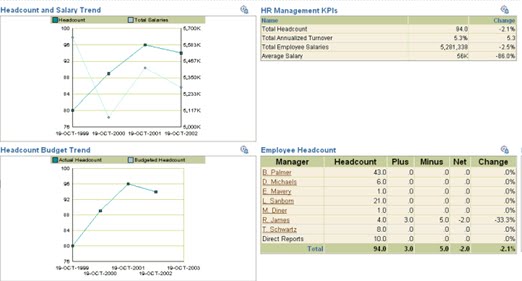
3. Intelligence and analytics: taking the former issue further, why should one have to run specific reports and simulations on what are humdrums issues? Wouldn't it be much more efficient to have configurable queries on several HR aspects (see above diagram with HR KPI's) in a push mode where you see the result at best every time you refresh your analyrics page (or dashboard), at worse at no more than a click? You can't do that when every query means  having to query the database, and I'm not even talking here of the highly technical skills needed.

4. Reporting: after payroll,  much of HR's dullest work is putting together the innumerable (and constantly increasing) list of reports required by business and demanded by government. With ITM, why bother about putting them together and storing them when they can be pieced together on the fly? Your report on mid-managerial employees in the northern region making $100,000 a year is not available or was never pre-built? No problem.  You can now have it faster than an ad hoc tool could ever have helped you, even faster than some already configured, standard reports delivered by your vendor. If this is not a revolution, I don't know what is.

The practical applications of IMT in the HR space are such that IMT is bound to deliver solid enhancements once the vendors get around how to market it. At Sapphire SAP was unsurprsingly mum on whether it would packaged with applications and/or the database and how it will be charged. But it is already clear that with this SAP has an edge over Oracle whose Larry Ellison ridiculed its nemesis and unsurprisngly so as he realizes that should IMT live up to its expectations his flagship database business could start declining, maybe even go the way of the dinosaurs. Small wonder that at the same time as Oracle is dismissing IMT it has quietly beefed up its offering  with what it calls IMT but is just a glorified cache applied to the database to speed up processing it time. Also important (but it wasn't mentioned by SAP at the conference - somebody clearly didn't do their research thoroughly, I surmise) is that from a competitive viewpoint IMT could damage Oracle who makes large use throughout its HRMS suite of so-called FastFormulas which are stored in the database. With IMT (or rather without since FastFormulas can't use it), the Oracle product (on whose code the next-generation Fusion HCM is being developed) will look decidedly dusty.

Whatever the respective competitive strengths of every vendor and their marketing tactics, and expect a deluge of hype as everybody jumps on the IMT bandwagon regardless of what they can really offer, one thing is clear: real-time HR is now for the first time about to become ...real.

Sunday, May 23, 2010

Are Social Networks The Next Big Thing in HR? Or just another tech bubble in the making?

MADRID
It seems that unless you tweet and have followers or fans or friends in  MySpace, Orkut, LinkedIn, Viadeo etc. you just don't exist. Really? Or is this just the latest fad not worth wasting much time on? To answer these questions, it's worth remembering that many technologies originated in the consumer world before being ado(a)pted in the business arena. Just think of the internet itself  or smart phones  where the initial enthusiasm by consumers were met by frosty skepticism from the business world which then went on to become avid users of the same tools. Will the same happen with social networks such as Facebook, or microblogs such as Twitter that are all the rage outside the business world -but often during business hours to the chagrin of many HR heads? Or will they just peter off  like the unlamented Second Life? (Anybody remember those corporate avatars that were supposed to revolutionize everything from performance evaluation to training to recruiting?)

Based on what I hear and see from many customers, even here in Spain (not the most forward-thinking place you might think, but remember that it's here that one of the most innovative HR products, Meta4, was born) it seems that the question should be asked in the present tense: social networks (SN's) are already part and parcel of the business world, with HR applications found and evolving on a daily basis. Just to take one example, I know many people that spend more time communicating through SN's than good old email. LinkedIn (claiming over 50 million users), of which so many of us professionals make a copious use of to share information in a push fashion, is a much more efficient way to update your network on, say, a project you are working on than through a traditional email blitz, if only because you'll never have 50 million contacts in your email address book.

One concern that I hear from CIO's and heads of HR is that social nEtworking will lead to nOtworking with employees spending much of their working time updating their personal profiles and chatting with their friends. This is exactly the same argument I heard at the turn of the millennium when the new generation of HR systems came onto the market and could be accessed by a browser, especially the self-service components. Allowing employees access to the internet in order to access these applications meant they could also surf the internet and spend their time on personal email, when not on porn sites. The horror, heads of HR used to cry, refusing any internet access. To which I countered, "well, if you're afraid that your employees may use any opportunity not to do any work, you might as well get rid of the water cooler where they could hang around and chat, and you should also board up all windows lest your employees waste time looking at the traffic outside instead of working." Needless to say that I won the argument over the reluctant companies and the same argument can be used today. I would even go further and say that that famous expression of "empowering the employee" so much touted and so little used in practice, could actually be made more meaningful. Just as with your children, trust your employee to be responsible and they might behave responsibly.

So, what are some of the benefits that SN's can bring to business, in particular the HR world?

Branding: just as the first companies that adopted websites (yes, there was a time not so long ago when some  well-known corporate entities didn't have an internet presence) benefited from an aura of tech-savvy modernity which made them popular with young graduates, the same holds true with employers who use Facebook or Twitter. It gives them a street credibility that traditional media cannot easily provide. Photos, videos, forums, all contribute to creating a feel for what it is like working for a particular company.

Recruiting: again, just as the internet thoroughly revolutionized the recruitment process with most ads migrating from print media to corporate career websites and the likes of Monster, corporate Facebook accounts help companies reach millions of "fans" with job ads as well as tap into an ever-larger pool of passive applicants (Facebook claims over half a billion visitors, equivalent to being the 3rd largest country on earth) It is estimated that by next year at least one out of 10 jobs will come from SN's and already in the US close to half of proespective employers look for detailed information about their candidates on SN's.  Every day thousands of ads are posted on LinkedIn in forums which allow fine-grain targeting almost impossible to dream of in any other media, nor even online job boards: since people visit SN's more frequently than their disparate profiles on several job boards (when they have them there), their SN profiles are updated more frequently. Also, because SN's, especially the professional ones, are richer in features, recruiters can get a good idea about a candidate without having to examine thir résumé in detail. Twitter and its real-time nature can make posting job vacancies and applying to them literally a matter of a few seconds. A recruiter at Yahoo (who has a presence on Facebook "Yahoo-Europe-Jobs" for instance) told me the other day how they posted a position on Twitter and one of their 400 followers replied and it was a perfect fit. Once the sourcing is done via these 2.0 tools the more traditional process can resume. Never has the recruiting cycle been shortened so fast to reach so many. I believe that as far as recuiting is concerned, we have reached "the end of history" to use Fukuyama's famous phrase since it is hard to envisage any other technology that would shorten the process further. Finally,  by cutting the middlemen, employers can reduce the cost of recruiting by cutting on headhunters' fees: an increasing number of  jobs are actually never advertised anywhere else but on SN's,

Collaboration and virtual teams: as the world economy becomes more integrated, the risk is all too real of global corporate behemoths turning into clusters of regional or even local work groups where information is hoarded and efforts are endlessly duplicated. SN's allow such employees to collaborate in ways that email and static document-sharing tools (such as SharePoint) could never do. When a particular product or service wins kudos in, say Latin America, but managers in Europe or Asia aren't aware of it, they tend to try several times expending valuable resources, time and energy before duplicating it with resulting profit losses. Also, and probably as important, is the ability to make faceless corporations appear more human and, among other consequence, encourage inter-group mobility. An employee in the US would be encouraged to apply for a job in, say, Brazil if they already know their future manager and have collaborated with them on some projects.

Career management: one of the major failings of HR systems is that creating a career path to be offered to an employee was always prospective: "based on your experience, skills and wishes you could move from position X to Y to Z in so many years."  As we know, the future has the unpleasant habit of never happening the way it was planned and many of those career plans built at great pains remain largely theoretical. A tool like LinkedIn or Viadeo which holds data on millions of professionals can aggregate data it holds to show the actual paths offered to certain professions. For example, in order to become a senior product manager with a software vendor, you need to be a consultant for a couple of years, then a presales person or marketing manager before reaching your goal. Since this is based on reality, it is a much more useful tool to employees and employers on whom it serves as a healthy sanity check, than any of the other prospective career paths.

Like all new technologies, SN's have their detractors who tend to over-emphasize the following issues:

- What about privacy issues and confidential data? Actually these are two separate issues as privacy deals more with the employee and confidentiality with the employer. Most SN's, especially the private ones such as Facebook, allow privacy settings that can restrict the amount of information to be shared. Of course, users have to be aware that the default settings are usually the least restrictive ones. And the more garrulous they are, the more informed corporate recruiters will be. As in many other instances of life, somebody's poison is someone else's food.  Concerning the confidentiality of corporate data, there is little doubt that the more opportunities there are to share info the more risks there are for some undesirable leaks to happen. But here again, nothing that good discipline, clear messages and responsible employees cannot fix. And of course, if you're worried that some unethical behavior will out, well, just make sure that unethical behavior doesn't happen in the first place before shooting the messenger.  The best way to avoid that the world hears about your shenanigans is simply not to have any.

- Private or public SN's? Some of the confidentiality issues can also be fixed by having an SN within the corporate firewall, just the way intranets came about. Actually the better tools you offer your employees, the less likely they are to go outside. This being said, a mix of the two is possible with private SN's used for certain functions (e.g., recruiting) while career paths and collaboration will be mainly carried out through corporate SN.

- Another IT project to embark on? No, thanks. And anyway, why should HR own this? One answer for both: most of the data for SN's is already available in corporate IT systems, mainly from HR systems (members' names, careers, roles etc.) thus reducing the need for a costly implementation.

In summary, my feeling is that there are undeniably hurdles to be overcome, but they seem to me more like growing pains than serious reservations. One challenge, though, that would have to be fixed and which would  could tilt the success-or-failure balance one way or the other is the existence of tangible benefits that SN's bring. I've seen some SN's, especially private ones (that is, within the corporate firewall) where the communities of members are no more than glorified email-based distribution lists or document-sharing tools. In that case one could just rely on the older technology and save one's time, energy and resources in the implementation of the newer system whose return on investment is so limited. So far, I'd say that the jury's still out but the outlook is promising. Who knows? SN's could be the last opportunity for HR to show a lasting relevance before it slides into irreversible oblivion replaced by other business function and outsourcing outfits.

(I prefer the term Social Networks to Social Media, as the former emphasizes the holy grail of effective collaboration, sought for so long and rarely attained, whereas the latter seems to suggest a one-way communication tool)

Friday, May 14, 2010

Looming Clash of Titans: SAP Acquires Sybase

PARIS
We, independent consultants/advisors, like to exaggerate our importance and claim a prescience mere mortals rarely display. I try not to fall in this trap (at least not too often) but I cannot avoid remembering a discussion I had with an SAP executive a couple of weeks ago. To counter Oracle's rise in the enterprise-software business, I asked her, what was SAP waiting to give the Redwood Shores-based competitor what  we French call "la réponse du berger à la bergère" and move into the database business. She shook her head saying that SAP liked to focus on its strengths and would remain happy to be the #1 business-software vendor, nothing more.

As if to prove her wrong (maybe she knew but wouldn't say, or maybe she wasn't in the loop - a distinct possibility), SAP has just announced it was buying Sybase for $5.8 billion. Officially this move is not aimed at Oracle but means to increase innnovation and extend SAP's access to mobile users. But in reality it is a defensive move against Oracle which has been treading on SAP's corporate-software toes since 2005 when it initiated its strategy of acquiring large software vendors. SAP's claims that its organic growth would be sufficient to counter Oracle's strengthening position soon sounded hollow and the Walldorf-based giant, taking a leaf from Larry Ellison's book,  decided to go on the acquisition path by buying Business Objects in 2007. That move was too timid as Oracle swallowed one big company after another and the product-maintenance confusion followed by the leadership shakeup, as Leo Apotheker left after barely one year as sole CEO, didn't help SAP's fortunes.

Things took a turn for the worse, from a competitive standpoint, when the German company's nemesis, Oracle, made a bold move by acquiring Sun, thus entering an entirely new market: hardware. Playing the ostrich was no longer a viable option and the Sybase acquisition will help rebalance the field a little bit as SAP will now compete directly against Oracle in more than just one market segment. It is clear that IT vendors' game is to branch into different segments of the IT business to become a Swiss-knife company able to provide its customers with software, hardware and services. It is clear that we are entering an increasingly ferocious stack war.

So far, Oracle still has a headstart over SAP and, if the past is any indication to go by, we can expect some shrewd moves from Larry Ellison, probably in the services space. So expect some strategic decision to be made by the SAP side next year or in 2012 at the latest. What I think would make sense would be for SAP and IBM to merge: IBM is strong in services/consulting, SAP (created by former IBM'ers, let's not forget) created the corporate-software business; both are actually close partners. Sure, now the two of them compete in the database space but that should not be an issue since (a) IBM's DB2 business is more of  a legacy one, the only one IBM retained when it decided to exit the enterprise-software business and focus on services; (b) Sybase and its mobile footprint make a more cutting-edge complement than a competitor (even if  overall Sybase is considered a bit dusty); (c) since in the database league tables Sybase ranks a distant fourth after Oracle, IBM and Microsoft, a merger of SAP and IBM should not raise serious objections from anti-trust regulators;  (d)  the two will compete more effectively against Oracle which, with its acquisition of Sun has become a serious  competitor to IBM which therefore need to make a move soon.

Yes, the more I think about it, the more an IBM-SAP linkup makes sense. If it happens, you read it here first.

Friday, April 30, 2010

Faced with PeopleSoft Fading Away, What Are Customers' Choices?

PARIS  
Not a single day goes by without an announcement, a blog post, or a customer’s complaint that drives a further nail in the coffin of PeopleSoft. The recent announcement by HP, an old customer of PeopleSoft, that instead of relying on PeopleSoft, it will build its own workforce planning system came as a bombshell. One of their VP’s expressed his frustration in no uncertain terms, "…we were always hoping that that next PeopleSoft version was going to incorporate the changes that we were talking to that firm about. They rarely did," (full story here ) . End of the line for PeopleSoft doesn’t come any clearer. As HR tech blogger-in-chief Naomi Bloom showed in an excellent piece (look for the post on Product Update :PeopelSoft 9.1 which has been temporarily retired under pressure from Oracle, but read the comments, they are illuminating) PeopleSoft product updates are just marketing gimmicks, like a bone thrown to a dog, aiming at making customers buy into the myth that the product is still being enhanced until it is buried once and for all. Did you really expect that Oracle spent billions to buy a product, universally recognized as better than its own, just to continue competing with it? Of course not, the idea was to kill all competing products (others include Siebel, Hyperion et al.) thus obliging customers to migrate to Oracle’s product, EBS, rebranded as Fusion under the pretense that it is a “new” product combining the best of all its acquired product portfolio. Only customers under the influence of intoxicating substances will fail to see that under the hood of Fusion is good ole Oracle EBS code.
Also to take into account is one of Oracle’s best-kept secrets: a good third of its PeopleSoft customer base is on IBM technology (the DB2 platform). Since the Fusion product will only run on Oracle database, that means these customers will either have to switch technologies to adopt the Fusion application (something most are loath to do, since underlying-technology choices take precedence over the business software that sits on top of it) or they will have to look at other options.

So what are the legions of increasingly frustrated PeopleSoft customers to do? Apart from being mad, which I can understand but doesn’t help much, the choices in increasing order of relevance are the following:

1. Do nothing. You may be surprised by this option (which I do not recommend) but never underestimate the power of apathy that certain customers have. “Unless and until the current product stops fulfilling our business needs why bother?” Seems to be their philosophy. I’d have nothing against this display of the power of inertia, so to speak, but playing the ostrich and waiting until the last moment is a recipe for disaster. In this case, as in many others, it pays to do a little contingency planning.

2. Use a third party vendor that provides support for Oracle's doomed products (JDE, PeopleSoft, Siebel) at a fraction of the Oracle price. Rimini Street is one of them, and Oracle is going to great lengths, not less through litigation, to prevent such services from being rendered. As a customer, don't be intimidated: you've already paid through the nose for the PeopleSoft product and are entitled to get a longer lease on its life at reasonable prices. Why would you continue to cough up extortionate prices until Oracle pulls the plug on life support?

3. Wait for the successor product, Fusion HCM, to arrive and when it does switch to it (that is if your database is Oracle, see earlier point made about IBM users). Isn’t Oracle promising that the HCM Pillar (that’s their jargon) would be as good as PeopleSoft HCM, Oracle HRMS etc.? That upgrade “help” would be available? (something one can expect when two products are made by the same vendor) Well, remember Oscar Wilde’s quip that only those who believe in promises are bound by them. Didn’t Oracle, when it bought PeopleSoft, commit they would support it till Doomsday? But recent developments have shown what that commitment actually meant: a boon for the vendor to further milk the customer without producing much in return, and much angst for the customer. As for that upgrade/migration help it is increasingly clear that it is not going to be a tool but just a vaguely described “guide.” In other words, PeopleSoft HCM customers will have to reimplement a new HCM system. In that case why not shop around? It’s not as if Oracle is the only game in town (yet). There are still plenty of choices.

4. If integration to an ERP system is important to you and you are part of the big proportion of PeopleSoft customers that run SAP for Financials, Manufacturing and other business functions, then start considering SAP HCM seriously. Sure, they are not as sexy and user friendly as PeopleSoft, but, sorry, PeopleSoft is dead, so once you get over your grieving, negotiate with SAP (who are guaranteed to bend over backwards to accommodate you) and sign with them. Now, if your ERP is…Oracle, you need to consider choice number 5.

5. Independent HCM suite: here it depends on your needs: if you’re a purely domestic company then pick Lawson (if in the US only), or Meta4 (if you’re in the Hispanic market), or Northgate in the UK. If you’re considering a SaaS model, then have a look at Workday (a promising product, even if still work in progress.) The larger question here is who will replace PeopleSoft as HR’s tool of choice and it will be the object of another blog post, so watch this space.

6. You may well have two or three separate HR projects, one for an HR system of record, one for Payroll and one for Talent Management. In that case if one of the previous (#4) vendors doesn’t cover all your needs, you’ll have to select one HR SOR, a different TM suite (SuccessFactors or Taleo spring to mind) and, if a single global payroll is not your thing, select a combination of local payrolls.

Whatever you do, learn from your experience and make sure that you pick a vendor that will not over-charge you for every update or imposed migration. And protect yourself with a contract with teeth that considers every M&A eventuality or change in product strategy. Once bitten twice cautious, I’d say. This is no time to be shy about your interests as a customer.

Friday, April 9, 2010

Is Fidelity Still in HR Services Business? Bank of America Ends Outsourcing Contract

RIO DE JANEIRO
Fidelity Investments' HR Services has just taken a big hit with the announcement that their flagship client, Bank of America (BofA), has decided to dump them after a lengthy review in which they compared the option of staying with them to switching to a new provider. The decision which moves payroll, timekeeping, recruiting and benefits to Hewitt (and only keeps retirement with Fidelity for the time being) prompts any observer of the HR technology and services business to wonder what is going on. After all, BofA, was Fidelity's largest and most significant client and the contract was trumpeted with loud fanfare back in 2004.

This is no accident as the project showed that Fidelity's move into outsourcing services was not matched by the required capabilities to ensure success. In particular, the choice of a technology platform has been erratic, at best. First, Fidelity, who had been using Oracle for a long time, decided to have their own technology on which they would offer outsourcing services and in 2003 they bought from IBM Paris-based software vendor HR Access. The next few years were used to implement the system for their own workforce worldwide. Hundreds of millions of dollars were spent on that effort for Fidelity only to pull the plug in 2007 and revert to Oracle for both internal needs and big clients like BofA which continued to cost them a fortune for the honor of using their logo as a major client.

Despite this setback, Fidelity continued with another project, called Global Platform, still based on HR Access but only for Europe, to start with. The secret hope being that what didn't work in the US would, as by magic, work in Europe and the miracle could then be replicated back in the US where the BofA project was still dripping ink the color of blood. In 2008, the awaited miracle didn't materialize and the Global Platform project was shelved at a cost of several dozen million dollars, to be replaced with outsourcing services from HR Access directly.

The problem is that HR Access whose DNA is HR software (or, rather, software services around implementation - a legacy of the IBM Global Services days) has limited knowledge and experience of the outsourcing business. The top managers called in to help (such as Bill Thomas, as Head of Outsourcing, from Ceridian, now with Equaterra; Ignacio Palomera, on the Product Mangement side, from Arinso) all came and left one after the other with little noticeable impact, at least of the positive variety. HR Access is still a software vendor, still European with France representing a lion's share of its revenue and (still higher) costs. Its recent multi-million-euro win to supply the French government with a customized payroll software for all its employees is actually a double edged sword: not only does it mean that heavy R&D investment will have to be made to develop a product that can't be sold to any other customer thus preventing any product capitalization, but it also draws HR Access even farther away from the outsourcing business since most of its resources will be focused on the traditional software business rather than the brave new world of outsourcing services.

In view of these developments it is safe to predict the following :

1. Unless there are some radical changes in the way the business is managed, and the technology strategy clarified, Fidelity's cash hemorrhage is going to continue until hey exit the HR Services/outsourcing business altogether. More cost effective vendors have appeared on the landscape and are stealing Fidelity's lunch.

2. HR Access, which is still an unprofitable business as it relies on a regular handout from Fidelity, will be sold back to either a private equity firm or, more likely, another HR vendor (such as SAP who lost that French government payroll deal, but are implementing an HR system for several million French government employees.) But any sale will have to be done at a loss since any new acquirer will face a serious cost control challenge. In today's globalized world and recovering economy it doesn't make sense to have expensive developers in Paris, France, building what is after all just a payroll and HR admin product for mainly the French market and smaller satelite markets.

3. HR Outsourcing is a tougher nut to crack than previously thought, and the market through 2015 will grow more slowly than the traditional on-premise licensed software or subscription-based (SaaS) model. The reason is that all vendors are still struggling with the dual challenges of how to achieve economies of scale by implementing the Holy Grail of best practices supported by truly multi-instance technology.

Wednesday, March 24, 2010

Obama and Sarkozy: A Tale of Two Presidencies


PARIS
Last Sunday, March 21, saw two world leaders facing a key vote that would define the two-year remainder of their presidencies. I am, of course, referring to Barack Obama and Nicolas Sarkozy. The Leader of the Free World (interesting how we stopped hearing that phrase when BO became president) was facing the break-or-make-a-presidency vote in the House of Representatives on his healthcare reform plans; while Sarko, whose party controlled only two of France's 22 regions, tried to show his abysmal approval ratings didn't rub off onto local polls.

If we are to believe the French satitical show, Les Guignols, Sarkozy has a heavy chip on his shoulder regarding Obama: the US president is taller, more handsome, an extraodinarily skilled orator, enjoys rock-star popularity all over the world and has a bigger plane - like all testosterone-high males, our leaders are obsessed with size. Well, if that is true, the results of the votes held on the same day did nothing to dent Sarkozy's inferiority complex.

Obama won the vote thus getting what may well be his lasting achievement, while Sarkozy lost Corsica (the home of another short, Gallic leader with ambitions of global grandeur) thus finding himself with ALL but one of France's regions controlled by the Socialists. Rarely had a political slap sounded so thunderous.

What does this tell us about these two rulers, their leadership style, their likely legacy and why we should bother? Since they lead major countries what they do does impact people's lives, for better or worse. In Obama's case, one can safely say the healthcare reform bill is for the better, as tens of millions of American citizens who were exposed to great hardships, made even worse in the economic downturn, got a strong helping hand. No longer will insurance companies be able to play with literally life-and-death matters with only one objective in mind: making even more money for their obscenely fat stockholders (obese is probably the right word.) So far Obama has not had a major political success: sure he's avoided a full financial meltdown but a negative is rarely a good indicator of success and, anyway, the economy is still in the doldrums with unemployment at record levels. On the foreign-policy front, his amazing popularity has yet to translate into substantial gains: the Middle East peace process is stuck (I'll come back to that later), Iran, Cuba, Venezuela are not any friendlier, Russia and China are, if anything, frustrating him at every corner. So, yes, there are still a lot of things for which, to be charitable, the jury's still out, but there's no denying that healthcare reform is a major achievement arrived at through vision, patience, dogged determination and a will to go beyond style and achieve substance.

Sadly, these qualities seem to be lacking with Sarkozy. Ever since he arrived at the Elysée Palace he has seemed overly obsessed with his image, increasing his PR team to a size previously unheard of but commensurate with the man's ego, inversely proportional to his physical size (the Napoleon syndrome.) Jetting around whenever a world crisis loomed but strangely unable to produce any concrete progress on the major issues facing 21-century France. He was elected on a wave of enthusiasm for his can-do, go-getter attitude and straight talking so different from his predecessor and nemesis, Jacques Chirac. But the French soon saw through his self-obsessed behavior: one of his first decisions was to triple his salary delivering on his increased-purchasing-power election promise - at least for...himself! And since then it's been a lot of noise made in France, Europe, the wider world, but with little to show for it back home. Voters can tell a fraud when they see one, and that was the main message they sent last Sunday.

A British statesman once said that "a week is a long time in politics." Let alone two years. Many things can happen in the run up to the 2012 presidential elections in the US and France. Obama may later this year get the equivalent of Sarko's election rout with the mid-term elections. Sarkozy may suddenly carry out reforms (none less than to his own style) that will make him not only popular again but deliver gains to his subjects, while the Socialist party may either implode or fall back to its fratricidal wars .

But, I have my doubts. I think that the pattern and trend are clear and I'll make the following predictions. And remember you read it here first: Obama will get reelected while Sarkozy will be sent packing. The latter prediction will in turn call for another one: Carla Bruni, shorn of the fun of staying in presidential homes and flying in presidential jets, will also dump him. Sad ending for a sad little man.

Wednesday, March 10, 2010

When "My Big Fat Greek Wedding" becomes a Greek tragedy


PARIS
So now it's all about wicked speculators trying to destroy a small and virtuous country. At least that's the message that Greek Prime Minister Papandreou has been hammering these last days in his mini-world tour aiming at finding a solution to his country's financial travails. Excuse me, but there's nothing illegal about speculating, otherwise said speculators would already be in jail. Speculators stand to lose their shirts in their high-risk operations and, yes, this is how it works in a capitalist system: they also stand to make big bucks. But they only do so in exceptional circumstances such as a war or a particularly badly managed economy which is the case with Greece. After all, Greece does have a high budget deficit (12% and counting) and speculators had nothing to do with it. It's irresponsible Greek governments who, also adding accounting fraud to such skills, have driven the country to such dire straits. (By the way did you know that for the most part of the past 60 years the Hellenes have been run by either a Papandreou or a Constantinis? difficult to shirk your responsibilities then.)

Of course, both Merkel and Sarkozy professed they wouldn't let Greece down but at the same time the Germans have ruled out any bailout and sensibly so: why should a Teutonic taxpayer subsidize a Greek's pension or holidays? As for Sarkozy, his gesticulations are on a par with his usual behavior: they are aimed at self-aggrandizement ("Sarko the savior of the Eurozone") but also self-interest. He knows that sooner or later France will be in a similar situation: after all no French government has presented a balanced budget in the past 30 years - quite a feat. Even Germany after the colossal deficit induced by Reunification's costs (at least they had something to show for their deficit) managed to balance the books for a while, and Spain for several years in the 2000's ran a budget surplus. Sure their economy was prospering (not the case now) but the French government NEVER presents a balanced budget whether in lean or in fat years.

When will our leaders learn this simple truth: just like responsible family heads, no one can live beyond their means for ever. The day of reckoning is coming, has already come for some.

(This picture of the author was taken in the Greek islands in happier economic times)