Further info and resources from my website

Monday, September 26, 2011

2010-2011: Two momentous years of consolidation in the HR space

PARIS
My interest and experience in M&A activities in the HR services and technology space go back to Oracle's long, hostile and headline-grabbing acquisition of PeopleSoft in 2003. I was involved in the transaction, especially with the preparation of the case before the European Commission which had tried to block the acquisition on anti-trust grounds. (For those interested, this episode was the inspiration for some chapters in my book, High-Tech Planet: Secrets of an IT Road Warrior.)

Small wonder then that since I went solo two years ago I have been asked to track the mating rituals of the companies that make up the supply side of our profession and some of my findings can be found here. Sure, we are still a quarter shy of the end of 2011 and many choice morsels have already been gobbled up and are being digested. But, after the summer lull, there could well be some interesting activity, as evidenced by last week's acquisition by ADP of Asparity Decision Solutions. After all, many software companies are awash with cash and the stockmarket drubbing we are seeing means that many target companies are particularly inexpensive. This being said I do not expect any new acquisitions through the end of the year to significantly alter my findings. Should that happen, I would post an update in January.

Data and methodology
I have tracked all the acquisitions in the HR services and software industry since January 2010 where either the acquiring company or the target were based in the United States or in Europe (the only exception was SuccessFactors' purchase of Australia's Inform.) Although I also have data on other regions of the world, I have restricted myself to these two regions since they represent the lion's share of the worldwide HCM  market and M&A activity. The number of such deals was a neat 25, until ADP's latest move last week.

The first, general, comment that one can make is the surprising lack of any hostile operation. Apart from UK-based Sage and Dutch-based Unit4 slugging it out in early 2010 for the control of Polish ERP/HR vendor Teta, all acquisitions have been consensual affairs. The nasty PeopleSoft takeover by Oracle seems to be a thing of the past.

The average number of deals has been at least one per month (reaching in April 2011 a high-water mark with no less than 4 acquisitions announced in the same month, two of them by SuccessFactors). For this year we are already reaching 11 deals for just 9 months.

HR vendors are heeding Cole Porter's famous song Let's Do It and almost everybody is getting in on the act. Some, though, seem to relish it more than others especially SuccessFactors (2010's first acquisition was also the company's first in its history) and ADP. Apart from the latter, all are talent management vendors, providing further proof if necessary that this is still the hottest HCM market segment. (Actually some of ADP's transactions were aimed squarely at the talent management space.)

Number of acquisitions by vendor, 2010-2011
Source: Ahmed Limam


As befits the size of its home market, US companies are by far the most likely to engage in takeovers: 88% of the 26 acquisitions originated from a US-based corporation. However, when one looks at the nationality of target companies, European vendors are more likely to engage in cross-border acquisitions than their American counterparts, even if those are still in Europe (the only American company acquired by a European vendor in this period was Convergys by UK-based NorthgateArinso.) Of course, in absolute terms there are more European companies bought by US vendors than non-national companies by European acquirers (ADP and SuccessFactors with 3 and 2 cross-border purchases respectively are the most global of acquirers.)

A worrying development, probably due to the uncertain economic climate in 2011, this year has so far seen only 2 cross-border acquisitions versus 7 in 2010 which is hard to understand: the dollar may be weaker than many other currencies, but then it means that any investment will pay off handsomely and faster since the revenue will be booked in the stronger target company's currency. So why are American vendors so reluctant to engage in cross-border acquisitions? I can think of several European vendors who are just waiting to be snapped up, providing the acquiring company with, if not cutting-edge technology, at least a large market share and steady revenue stream. Asia and South America also have strongly established HR vendors who, in their fast growing markets, can deliver returns US (and European) companies are no longer used to.

A closer look at the average deal size shows little impact of the financial crisis, though. On the contrary, when we remove the unusually high value of Aon's Hewitt acquisition ($4.9 bn) which would skew the results and the transactions that included HR but went beyond (such as Infor's purchase of Lawson) we find that the average deal value almost doubled up from $66 mn in 2011 to $117mn. Two caveats are in order: many vendors (such as ADP) do not disclose the financial terms of their transactions and the 2011 figure is boosted by the $290 mn value of the SuccessFactors-Plateau linkup (other disclosed deals were way below the $100 mn mark.) The last quarter's performance will be crucial in either confirming this trend or reversing it.

Deals include ERP transactions where HR was one component
but undisclosed deals are not included.
Source: Ahmed Limam 
Looking at the scope of the M&A transactions, we find that the three most  popular HR areas or processes covered are: analytics, learning and core HR. The first two reflect talent management vendors expanding their offering from their niche offering to the full gamut of TM, while the latter (Core HR) shows that some talent management vendors are moving up the value chain and want to be considered as full-fledged HCM vendors. For comparative purposes I have separated out the various components of the talent management function: otherwise the TM function represents almost half of the full scope.

Source: Ahmed Limam

Finally, I found it worthwhile to study the rationale for the M&A activities. My definition may well be controversial since there are always several reasons why a vendor decides to go down the acquisition route rather than the organic one, and I may not necessarily share the official reasons offered or I may give them a different weight.  There are usually five main reasons which of course tend to overlap (when ADP bought Byte in Italy last November  it was to increase its European footprint at the same time as increase its number of customers in a key outsourcing market.)


  1. to deepen vendor's offering: I include intelligence and social here, since these are not separate HR domains
  2. to broaden it: case of Taleo buying Learn.com to add a new HR function which it did not have
  3. to expand a vendor's country footprint (globalize)
  4. to go full HR: I am including here private equity firms or ERP vendors wanting to expand their portfolio
  5. to increase market share/customer base.


Major reasons for vendors to
acquire another HR vendor.
Source: Ahmed Limam

As the following graph shows, vendors are first and foremost interested in deepening their offering, that is adding higher-value features to their products, before broadening it. With one out of three deals involving two separate countries, it is hardly surprising that the second most important reason is to expand abroad. Although its pace is slowing down in 2011, globalization is still an unmistakable fact of the HR market and will continue in 2012. The question is whether it will be as strong as in 2010 or rather along the lines of 2011.

Another interesting question about 2012 has to do with Workday. Will the most scrutinized of HR vendors finally decide to enter the M&A fray (with the help of its freshly minted IPO) to buy its way into the recruiting or learning space or will it continue to look disdainfully on the whole exercize and carry on with its organic-growth strategy?


(Ahmed Limam will be in Las Vegas next week to attend the HR Technology Conference where he will present a session comparing  the US and Europe in terms of HR and technology.)

Friday, August 19, 2011

Brazil Rising: Thoughts on HR, technology and an emerging giant

SAO PAULO
This sprawling city of concrete and steel, the largest in all the Americas as well as the southern hemisphere, not to mention being Brazil's business center, is also home to one of the most congested roads in the world. In comparison, Los Angeles residents live in traffic heaven. The situation is such that many senior executives are whisked to work by helicopter (many skyscraper rooftops in São Paulo double up as helipads.) Attending CONARH, Latin America's largest HR event where I moderated a workshop on HR system usage, since my expenses policy did not include helicopter commuting, I decided to stay near the Transamérica Expo convention center where the conference took place thus allowing me to spend more time with Latin America's HR movers and shakers.

And what a difference it makes to be talking with Brazilian heads of HR versus their Northern Hemisphere counterparts. Whereas in the "rich" world (I wonder how much longer we'll be able to call ourselves such a thing)  the talk is depressingly about crisis, uncertainty and layoffs with European and American HR directors behaving like rabbits caught in the headlights, here you would think you are on a different planet.

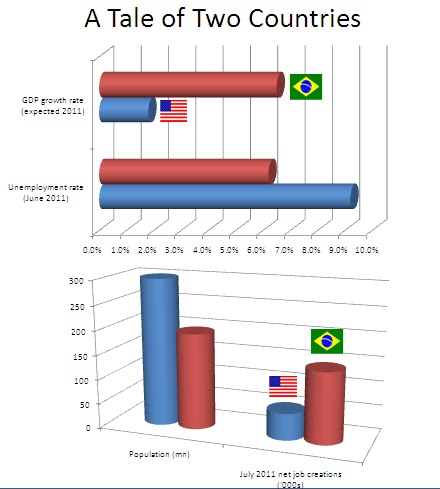
Last month Brazil created 144,000 jobs, higher than the 114,000 jobs created in the US whose population is 30%  bigger than Brazil. And, even bigger difference, those Brazilian jobs were net hires, whereas the US had job losses of 60,000.  Small wonder that whereas the unemployment rate in Europe and the US has been hovering  around 9-10%, in Brazil it is down to a historically low 6%. And when you realize that in the US only less than 30% of companies are planning on hiring, in Brazil the figure is an astonishing 80%.

 On most economic indicators the United States has been trailing Brazil
for the past few years and will be doing so in the foreseeable future

These figures were borne out by all the HR leaders I met. I do not recall a single one of them saying that they would keep their workforce at the same level this year and next, let alone downsize: every one was busy adding capacity. And that is the unofficial theme at the conference: labor shortages. Retail, manufacturing, services, banking (HSBC is laying offs tens of thousands of  employees in the "rich" world but hiring several thousand in Brazil), hotels (Rio de Janeiro is trying to squeeze thousands of new hotel rooms in the narrow strips between mountain and sea before the 2014 Soccer World Cup and 2016 Olympics), oil and gas. Every head of HR in every industry is wringing their hands that they cannot find all the people they need, and when they do they lose them to the competition. This Brazilian War for Talent inevitably creates other issues: turnover with its attendant salary rises.

Traditionally, salary rises in Brazil have been dictated by government and unions through across-the-board rises to take inflation into account. While this still exists, it has been dwarfed by market realities: with demand outpacing supply, many employees go the highest bidder with Brazilian CEOs drawing now the highest salaries in all the Americas. At the lower end of the spectrum, the strong growth of he economy as well as cash transfers by the government (Bolsa Familia program) and major infrastructure projects has meant that for several years now, every month has seen tens of thousands of Brazilian employees joining the formal workforce.

The upshot of this virtuous circle is that payroll vendors are having a boon. And when I say payroll vendors that is what the Brazilian HR market has traditionally been largely about: Payroll and HR admin, functions whose complexities local vendors have learned to manage for decades when it was a reserved market. And God knows what a complex domain Brazilian labor laws are.  In my experience, Brazilian payroll is among the most complex in the world (in the same league as Italy for instance); the list of standard reports and documents to produce or track is huge: employee contract, medical document, signing and stamping several others such as an alphabet soup of CTPS, CPF (for tax purposes), the national ID card (RG), voter's card, a social program called PIS. Some can be validated via an algorithm in the software, others cannot. In a recent World Bank report it was calculated that on average Brazilian companies spend 2,600 hours per month just to comply with regulatory requirements.

The potential for HR electronic filing is huge since many processes such as CTPS registering for new hires are still manual ones (Brazilians have an amazing love for paper; whether it is settling your hotel account or pay a restaurant bill, you will be flabbergasted by the number of forms and receipts that change hands, are signed, checked, calculated on before the process is over.) Things are changing, though, as there are currently discussions to automate many processes ("click contracts" for e-labor contracts.)  Time tracking, known in Portuguese as ponto eletrônico, was mandated by law meaning that almost 400,000 Brazilian companies will have to change this year both the hardware and software used to track when employees clock in and out (even for lunch) and create the relevant interfaces with HR systems of record.

When it comes to benefits, Brazilian companies are in a league of their own, with some benefits departments managed as full-fledged businesses. Mining giant Vale, for instance, has marketing executives in its benefits department whose role is to sell benefits and other plans to employee dependents. (In case you are curious, Vale uses PeopleSoft as its HR system of record.) Another interesting feature of the employee-employer relationship is that Brazilian companies oblige their employees to open an account in the bank of the employer's choice where their salaries are paid via direct deposit. This has the advantage of securing more decent banking fees for the employee, but it is obvious that when a company with tens of thousands of employees comes knocking on the door of, say, HSBC Brazil, they get good benefits themselves. (This cozy situation reminds me of Belgium where payroll services providers make a big part of their money by leveraging the time - and therefore interest paid- between the date when they receive funds from employers and the date when they pay salaries into employee accounts.)

As in Spain, health and safety is a big issue in Brazil with a higher rate of  workplace accidents than in the US. An HR manager for Petrobras, the Brazilian oil giant (whose IPO last year became, at $67bn,  the world's largest) told me an anecdote about the accident rate on their platforms (2 or 3 major accidents per week!) He had a hard time when visiting one of their oil rigs to talk employees out of organizing a churrasco or barbecue, knowing Brazilians' love for grilled meat. Having accurate statistics and providing training are key to bringing the accident rate down to more manageable levels. (Another issue they have in the oil and gas industry is, of course, labor shortages, especially of technical staff.)

Faced with such complexities, but also due to the fact that for a long time  Brazil operated as a closed economy and to a certain extent this continent-sized country still feels quite unique (it is the only country in the Americas to have its own language)  it is small wonder that the HR software market has traditionally been the preserve of local vendors. The major ones are:

  • Totus: Brazil's answer to SAP, it has more revenues than many US software companies (should hit US$1 billion this year) and is even expanding abroad (Mexico and Portugal);
  • LG Sistemas (the largest HR vendor with a customer list which is a roll call of the best-known Brazilian companies, many global multinationals interfacing SAP HR to LG's flagship FPW payroll); 
  • Senior (Vetorh product line) with a strong loyal customer base.

As mentioned earlier, the booming nature of the Brazilian economy is making recruiting an HR leader's daily headache. You might think that this is par for the course for emerging economies. Actually labor shortages are more acute in Brazil with 64% of employees reporting difficulty in filling vacancies versus only 40% in China and 16% in India, according to a Manpower survey. This situation is compounded by the fact that, because Brazilian employees tend to be loyal to their companies, luring them away can only be done by offering them higher salaries, which some are happy to take because companies are happy to offer them.

These developments have led the traditional payroll-cum-HR admin market to give way to an emerging talent management market segment. Salary cost escalation means that if you cannot continue to compete on salary alone, you will have to offer your employees something else to base their loyalty on. Enter career-development plans to give Brazilian employees a stake in both their company and their own professional life.  Many HR managers who have been working on competency models have embraced whole-heartedly the various aspects of talent management, launching career-management and competency programs in their companies. Brazilians, who are among the most social and communicative people on earth, have taken to social media enthusiastically (with Orkut rivaling Facebook) showing that it is just a matter of time before tens of millions of consumers of social, mobile HR appear on the map.

The issue is that HR vendors are still slow in providing the relevant tools for that. (For Portuguese readers, I wrote an article on this issue last January and it was published by a Brazilian HR portal) Brazilian vendors, although beefing up their talent management functionality, are still caught in a payroll-HR admin time warp. Strong web-based vendors  are yet to emerge. What about global vendors? you might wonder.

Global vendors SAP, Oracle, PeopleSoft, and ADP tend to be used by subsidiaries of  (mainly US) multinationals, although the burgeoning number of Brazilian multinationals is also going with these vendors (note that they still tend to favor LG or Totus for their payroll, in spite of SAP having a Brazilian payroll.) Talent vendors such as Taleo or  SuccessFactors have a token presence, usually through a local partner, and, like their ERP competitors, are happy to just work on extending the contract to local subsidiaries. At the conference I did not see a single representative from the global vendors, which makes you wonder about their business expansion plans. Considering the current economic climate in the the US and Europe, how can HR technology vendors ignore such a large, growing market as Brazil? With the Brazilian currency, the real,  relentlessly appreciating versus the dollar (when I first came to Brazil seven years ago US$1 was worth over R$3, now it has come down to R$1.5, having lost half its value) this means that every customer in Brazil can now add significantly to a global vendor's bottom line.  And starting in October,  payroll taxes on certain industries such as software, will come down 20% (a move our deficit-ridden "rich" countries can only dream of.)

Every light is blinking green, an inviting green. The land of the four S's (samba, soccer, sun and sex) has every potential to add a four S (software) to its suit. What are global vendors waiting for? For a long time Brazil was known as the country of the future. It has finally become the country of the present, and it is a global vendor's market to lose.

(Ahmed Limam keeps a second home in Rio de Janeiro from where he monitors the Latin American market and provides consulting/advisory services in the region. When the blogger is not in residence, his penthouse can be rented. Check out the Airbnb listing, also available on TripAdvisor/Flipkey and Homeaway. You can also rent it straight from the blogger))

Wednesday, July 20, 2011

A five-tier approach to a multi-country payroll project

PARIS
Although the bulk of the upcoming HR-technology projects deal with the various components of what goes by the name of talent management, by far the largest number of current HR systems still deal with good old payroll. Such a focus makes sense since you may decide to eschew compensating adequately your workforce, or recruiting them effectively, or training them in line with your company's objectives but there is no way you can avoid paying them.

With the pace of globalization showing no sign of abating most companies find themselves operating across several countries which brings to the fore the need to manage their workforce as part of a single HR system. Most multinationals have been doing just this for a good decade now: two thirds of them have a global HR system of record for all their employees from which they send the relevant data to other HR systems such as learning, time management, benefits and, primus inter pares, payroll.

Traditionally payroll has been managed via a local vendor, either outsourced or in-house, but in the last few years the proportion of large, global companies deciding to use a single, global payroll system (even if not necessarily on a single instance) has grown quite substantially. New vendors, purporting to deliver the Holy Grail of a true global payroll system, have appeared on the landscape muddying the waters of what can be done, what can only be dreamed of and what is pure fantasy.

I have spent a good portion of the past 15 years either implementing payrolls, helping end-user organizations select a new payroll system or, as part of the vendor community (especially now-defunct PeopleSoft and pre-Fusion Oracle) developing a global payroll. In my book, "High-Tech Planet", I describe the fun associated with making a business case for a global payroll.

Assuming you have decided to run your own payroll inhouse (versus outsourcing it in full or in some countries-but I will discuss this as well further below) and regardless of whether you want to do so with an on-premise system or a hosted (SaaS) one, there are basically five ways to go about it based on:

- Funding: Who will pay for it? Sure, ultimately you the customer will end up paying for it, but there are ways to go about it. The vendor can fund this out of its general licensing revenue or you the customer can pick the tab directly.

- Build: Usually he who pays for it builds it, but this is not necessarily always the case as a player (say, a subsidiary) can contract out to the development organization to do it.

- Support/maintenance: This is a key issue and again it is not always an easy decision, the builder is not always the maintainer.

-Ownership: Some of the prior issues will determine, and be determined by, who actually owns the localized payroll.

Having defined some of the key criteria and remembering what it means to have a localized payroll (if you have not done so, please read my post on the five pillars of a "glocal" HR system: http://bit.ly/eRqx5J) here are the five ways you can run your global payroll system. (And, yes, I know, my mind seems to work in fives, probably the remnant of a childhood spent using my fingers to count.)

Tier 1: The truly global payroll 

SAP is the undisputed leader covering more countries
than several vendors put together. Vendors like ADP
whose offering is made up of disparate payrolls are not
included. The figure for Oracle, PeopleSoft refers
logically to each separate product line. Although
Workday currently has the same number of country
 payrolls (two) than other vendors not mentioned here,
I am including them as I believe they will increase
 that number in the coming years
This is the ideal situation. Your payroll vendor offers a localized offering for all of the countries you operate in, meaning they have built all the different aspects required to run a payroll in, say, the US, China, Argentina and South Africa (check that they comply with my five golden rules described in the above post). They built it from their Corporate Development organization, they support and maintain it (every time a rule changes you get a patch), they pay for it themselves out of the hefty license/support/usage fee you are paying. All you have to do is "just" implement the required software and you are in business. Perfect? Trouble-free? Not really. First of all, you have to remember that every vendor will have their own definition of the law and, surprise, surprise, that definition tends to be more limited than yours. So make sure you do your due diligence on that part when comparing the offering of different vendors, you may be comparing apples and oranges (I would recommend checking if they have product managers or development engineers in the various countries you want to cover.) Second, there are few, very few vendors that cover several geographies in this Tier-1 solution in a systematic way*, meaning that you will most probably have to resort to other solutions to complete the global model you need.


Tier 2: The half-baked payroll

HR software vendors are anything if not resourceful. If the Corporate Development organization for reasons I explained at length in my book, does not want to fund a localized payroll for some countries that are key to you, chances are that your vendor's country manager of, say, Nigeria  or Thailand or Tunisia (assuming you are in contact with them), will tell you that they would fund it themselves and contract out to Development to build the required features. You can thus end up with a product developed by your vendor following their development guidelines, on their codeline, with their own people responsible for developing other parts of the standard product. For all intents and purposes, it sounds and feels like the Tier 1 solution, except that it ain't. First of all, once they've built and delivered it, Development won't touch it with a ten-foot pole. The subsidiary, sometimes under constant prodding from you, will have to finance it and if the local market does not warrant it (you were a one-off case) you may wait a long time for that statutory report on overtime pay required by the government of Brazil. And, of course, there is no guarantee that any new off-the-shelf release of the core HR system and payroll (Tier 1) delivered by the vendor will be compatible with this Tier-2 product.

Tier 3:  The partner-built payroll

This is a variant of Tier 2 whereby, since Corporate Development doesn't want to have anything to do with the local payroll (either directly or indirectly, "hey, we don't even have time to build what we committed to"), a local partner is enlisted to replace Development. The great advantage here is that the partner, usually a local payroll vendor, knows the country requirements quite well since they have been developing their own system for  a long time: they therefore have the knowledge, people and resources to develop the localized layer of rules, processes and reports that you need for countries X, Y or Z.

All they need to do is get trained on the core payroll engine, understand the global vendor's development guidelines and they can get you the country extension you wanted in a faster turnaround your global vendor could never dream of. Who will pay for this? you may ask. Well, it all depends on the relationship between the global vendor's  subsidiary and the local vendor: sometimes there is a true partnership whereby they split the licensing revenue or the local payroll vendor gets royalties. (You will not believe how much frequent-flyer mileage I accrued traveling across several time zones and meeting countless payroll vendors to fix these issues) As a customer you need to understand the intricacies of such deals to ensure proper and speedy maintenance. Also, what happens if the local vendor bows out of the agreement? Will the global vendor's subsidiary pick it up as a Tier 2 solution? Will the global vendor accept to productize it and bring this local payroll into the standard product (make it a Tier 1 solution)? What about the compatibility issue with new releases of the global system? Since the global and local products will be on separate release schedules (and sometimes technology stacks) serious issues might arise.

Tier 4: The project payroll

If neither of the previous works, usually because as a customer you represent too small a market share for the vendor to get involved even at the local level through a partnership with a local vendor or by having the product financed by the subsidiary, you can still build the local extension as part of your implementation. Your own people can do it, especially if they have experience working with the vendor, know the tools well, especially the core payroll engine. Or your system integrator (SI) could do it for you, especially if, as is likely, they have experience implementing that payroll or even building out localized versions: and like all SI's they would love to do it for you, in exchange for fat, cascading consulting fees. A third option would be to use the consulting arm of your vendor to build it for you, on a T&M basis. The advantage of the latter is that it may minimize risks associated with such a project, if only because you can assume that as part of the vendor's organization they would know the product better than your own folks or an SI. Whatever the option of this solution, you the customer as the owner and funder of this solution will still be responsible for  its support and maintenance. Tough decision to make, but well worth it if the country under consideration is a key one with many employees and user experience, analytics and integration issues demand a similar payroll be used for that country as for the other ones.

Tier 5: The third-party payroll

When all else fails, then you are left with only one solution: create an interface between (a) either your HR system of record or your global payroll (there are pros and cons to do either, I will discuss that in another post) and (b) either a local legacy payroll or, more likely, an established local payroll vendor's solutions for the countries where you do business. It could be either an ADP-like outsourced payroll or the myriad third-party payroll systems which, in spite of the global vendors' growing market share, still rule the roost all over the world and which your local team will have to install and use. If you're lucky, maybe that such an interface has already been built by your vendor. For instance, most of the ERP vendors (SAP, Oracle and PeopleSoft or "SOP") have built such an interface (goes by various names, Payroll Interface or ADP Connector) where, in a nutshell, they already map HR data (employee details, compensation, organization, contract, absence data etc.) to selected payroll systems. Just make sure you understand what is really covered and who will maintain such an interface. In some cases where the interface is too light (what I call a marketing interface rather than a true product one) you might as well build your interface yourself.  Especially when the number of local payroll vendors is huge and there is little chance of your global vendor to have built standard interfaces to all of them.


It is noteworthy to keep in mind that when "SOP" vendors start localizing their offering they do it on a module-by-module basis, meaning that they first release a localized  HR Administration system (contract types, national identifier, address format etc.) and only then (there can be a lag of several years between the two) the payroll rules (earnings, deductions, gross-to-net calculation etc.) In order to optimize a Tier-5 solution, you may want to check which of the vendors has the most localized HR Admin modules as this will help lessen the need to build such features prior to their use by a payroll interface.

One tantalizing thought is the extent to which a pure SaaS vendor (such as Workday) can meet the needs of large multinational companies since in a SaaS model the payroll sits on a vendor's data center and is accessed remotely by users. It is therefore hard to envisage how Tiers 2-4 solutions can be done with such a system. Could it be that a global payroll system will be hampered by SaaS? So far the jury is still out as there is no   vendor that has yet come up with a SaaS-based multi-country payroll. This probably explains why Workday has been quite slow at expanding its country footprint and few members, if any, of its growing customer base are using its payroll outside North America. But if a true SaaS vendor manages to enhance its configuration options to the level needed to quickly build local payrolls and/or add new payrolls quickly to its standard offering, then it will truly revolutionize the oldest of HR functions.

*A list of how various global vendors fare in terms of HR and payroll localization is available from www.AhmedLimam.com\ Vendor Localization Footprint (excerpt -Google Docs sign-on may be required.) Please note that the Tier-4 description therein is somewhat different from the five-pronged approach presented here since the Vendor Localization Footprint report does not by definition cover the Tier-5 solution presented in this post.

Monday, July 11, 2011

A wedding in the Land of White Moors

The groom (and blogger's brother) with his bride who is
dressed, hand-hennaed and bejeweled according to
centuries-old traditions 
NOUAKCHOTT
Apart from the gift of life, I shall always be grateful to my parents for having brought me up in a multicultural family. And you can't get any more wildly multicultural than my family: my mother was born in Paris into a Romanian family and at age 2  was taken to the old country when WWII broke out. My grandmother left her daughter behind with her parents to go back to France (and  my Hungarian grandfather.) Little could my grandmother suspect that the war would separate her from her daughter for 6 years and then the Communist-imposed Iron Curtain for another 12 years. Only at age 21 did my by-now Romanian-speaking mother go back to France where she met my father, an Arab from the large but little known country of Mauritania (if you don't know where it is located on the map, you'll find it in the northwestern corner of Africa, just south of Morocco - interestingly enough my father himself had a half sister, whose father was French, and she too was lost to her mother from her childhood until her mid-20's. You can call my family many things but boring isn't one of them!) I then grew up between France and Mauritania with summer breaks spent in Romania, in particular the northern region of Transylvania. Such varied cultures and languages helped me become more open to other societies and people, different ways of doing things as well as learn other languages more easily.

When my Mauritania-based brother asked me if I wanted to attend his wedding in  the country known to locals in their Arabic dialect as Trab el Bidan or Land of White Moors, I enthusiastically accepted. So it was that last Thursday, after a 15-year absence, a 6-hour Air France flight from Paris disgorged me  into the diminutive airport of Nouakchott, the largest city in the Sahara desert and Mauritania's capital. It was the day of the wedding and I had barely changed into the traditional men's garb (see picture below) when I repaired to the bride's family 's home in the northern sector of the sprawling city that is relentlessly expanding from the Atlantic Ocean into the desert in all three directions (the view from the sky with the bluish hues of the ocean and the dusty white of the desert makes quite a contrast.)

We were greeted by the bride's parents and shown into a large rectangular room decorated in the typical low mattresses and colorful woven-wool carpets where male relatives of the bride's and groom's were assembled. It was quite entertaining to play the recognition game, an uncle here, a cousin there, and a nephew, a handsome young man in his mid 20's and recently married himself. When I last saw him he was barely two years old and it was in dramatic circumstances: his mother, my older half-sister, had just committed suicide in one of the family's highest profile dramas. The women sat in a separate  room but this segregation didn't last long as one of  my aunts was too excited to stand the protocol and waved at me to join her outside where other aunts and female cousins, close and distant ones, joined me, hugging and kissing me with with full theatrics. After this breach with protocol I went back to the men, some of the elders shaking their hands while muttering in their beards something about how Moorish traditions are lost to people living in the West.

I later heard that there was another etiquette violation, this time courtesy of my father who brought his own cleric. According to tradition since the Day 1 ceremony (known in Arabic as 'aqd or contract signing) takes place at the bride's place, it is her family's cleric who should officiate. Maybe my father felt that our tribe, the Laghlal, who for centuries had vied with my future sister-in-law's tribe of Idewaali for the control of our joint town, Chinguetti, Islam's seventh Holy City, should assert itself in a show of tribal power politics.  Anyway, things went smoothly, the cleric called on the representatives of both groom and bride to get closer to him, the conditions were read out ("the husband shall not raise his hand on his wife nor take another one, otherwise the marriage will become null and void immediately"), the audience were asked if they had any reason to object to the matrimony (I felt like raising my hand saying that as my younger brother, wasn't it bad form that he would get married before I did, but then thought otherwise) and the most noble son of the even noblest family of a  greatest tribe got married to a lady who was no less grand in her titles than he was. Of course, as befits tradition, neither bride nor groom were present. A short prayer that involved our whispering verses from the Koran hands raised skywards followed and we then proceeded  to partake of the meat, dates and drinks served on a cloth set right on the carpet, while steaming hot cups of tea were circulated around. As soon as the food was dispatched, everybody got up, slipped into their shoes and left the place leaving it to the female relatives  who were going to celebrate throughout the evening.

According to Moorish tradition, the bride has to remain
unseen  for three days. The smiling girl is the blogger's
(and groom's) sister, a management consultant based
in Brittany, western France
The next evening saw the wedding reception (known in Arabic as marwah) being organized in the palatial home of a cousin, in another neighborhood (which didn't exist last time I was here), closer to the ocean but at a safe distant since Moors (as Arab Mauritanians are known) have from time immemorial turned their backs on the salty body of water, even if fishing now represents one of the country's main exports. Day 2 was slightly different from the previous religious-cum-legal day with guests definitely on the younger side and men and women mixing and, to my utter surprise, dancing freely. But it is true that Mauritanians are unique among Arabs in that women are equal to men, they run their own businesses, work and travel freely, get married and divorce at a dizzying rate (a young cousin of mine who was there had already gone through a fourth marriage and counting), something unheard of in neighboring Algeria and Morocco where divorcees and widows are damaged goods with no hope of any further social life. And I'm not speaking of retrograde Saudi Arabia where they can't even show their faces or drive their own cars.

(You will notice from the top picture and the one right above, that, unlike what is customary in the West and other Arab countries, Mauritanian brides wear black while grooms are dressed in white. This is an old Beduin tradition that has survived the ages.)


A thoughtful blogger watches
the proceedings

Once all the guests had assembled, my brother accompanied by male friends and relatives set out in a car convoy to pick up the bride at her family home. Amid a pandemonium of car horns being blown insistingly they arrived at the party where everybody was craning their necks to get a  glimpse of the bride. They didn't see much as, according to tradition, the bride is to remain covered from head to toe, face unseen, for three days until the elaborate hair braiding is undone and jewelry that is part of it removed. The newlyweds had to sit under a dais for the whole evening without drinking or eating anything nor go the bathroom, while the rest of us drank and ate and danced. The music was provided by a Moroccan Sahara band who played a catchy mix of traditional and modern tunes. I could hardly believe my eyes seeing my aunts dancing the night away, with even more energy than younger girls. Highly entertaining was the parade of marriageable girls whose mother shamelessly pushed them  my way, most of them close or distant cousins or from the same tribe: as in 1950's America, in this traditional society a girl's highest ambition is still to land a good husband, such weddings are golden opportunities for mothers to catch somebody in their spider-like web. Must say that some of the girls were stunningly beautiful.


Dancing the night away, Mauritanian-style
We thus spent the rest of the evening under a starlit sky, dancing, laughing, gossiping, flirting, eating, drinking, bursting into sudden exclamations of recognition ("oh, my God, it's you!") until jetlag got the better of me and it was time to go to sleep. I discreetly slipped out, avoiding the hundreds of hands to shake, hugs to give and foreheads to kiss if I had taken formal leave of everybody. As I pulled away in my rental car, I couldn't help but be amazed at how centuries old traditions are still being kept alive by the cell phone-toting, Chanel #5-smelling, Mercedes-driving and Rolex-carrying descendants of nomadic Arabs who a millennium ago came from distant Arabia, some of them via Spain and Sicily. In an an era of all-out globalization, this is no small feat.


(To watch the above video of the party, made from a cell phone - sorry for the quality- you may have to play with different readers such as VLC or DivX to get the sound since, for some reason, Windows Player mutes the audio track)


(For those curious to read more about Mauritania, there are unfortunately no titles I know of in English. 

In French I highly recommend Le tambour des sables (Drum of Sands), the splendid memoirs of a French colonial administrator, Gabriel Feral. General Gouraud, another colonial administrator, wrote a unique document from my family's region, Adrar: Mauritanie, Adrar: Souvenirs d'un Africain published in 1945. Famed transcontinental pilot Antoine de Saint-Exupéry's Terre des Hommes (Land of Men) is probably the most famous novel written on Mauritania (not all the action takes place there, though.) Another famous Mauritania lover, Théodore Monod who crossed the Sahara many times over a half century, the last time in his old age, wrote Méharées. Odette du Puigaudeau's  account of her travels through the Land of White Moors in the 1930's (Pieds nus à travers la Mauritanie)  is a great, authentic read. 


Traditional Moorish architecture.
(From the blogger's own copy)


The beautiful coffee table book Mauritanie: Aux confins du Maghreb is a must-read: not only does it boast splendid photography but the research and writing are first rate. 


More recent titles include Nouakchott: Au carrefour de la Mauritanie et du monde, by an academic (2009) and Bienvenue à Nouakchott (2011) by French spy/thriller writer Gérard de Villiers who has sold 150 million copies of his books, mainly in the French-speaking world.) Finally, from researcher Aline Tauzin, published in 1995, is a collection of Moorish tales in a bilingual edition (French/Mauritanian Arabic) under the title Contes arabes de Mauritanie (Arab Tales from Mauritania) which holds special appeal to me as many were told to me, as a child, by my grandmother and the aunt who lived with her. 

There are several books in Spanish due to the links between Spain and the western part of the Moorish lands, a Spanish colony under the name "Rio de Oro" and now occupied by Morocco. Fernando Pinto Cebrian, probably the Spaniard who best knows the Western Sahara, wrote Adivinanzas Saharauis and Proverbios Saharauis. There is also a compendium of lovely Moorish tales from the Sahara edited by Ramon Mayrata and published under Relatos del Sahara Español, the Spanish-language counterpart to the Aline Tauzin book.

If you are, like me,  a  movie buff, I am afraid Mauritania is unlikely to beat Hollywood as a source of great cinematic creativity, at least not in the short run. This being said, there are a couple of respected directors - literally: I only know two, Med Hondo and Abderrahmane Sissako, the latter being of mixed Moorish-African heritage. The best movie yet made in Mauritania is Sissako's delightful autobiographical comedy-drama Waiting for Happiness (2002, in French and Mauritanian Arabic). Here's a good French-language review .  

Thursday, June 16, 2011

DirDem comes to Europe - Time for technology-enabled Democracy 2.0

As luck would have it I arrived in Madrid on June 12,
the very  last day of this two-month-old grassroots
movement occupation of the Puerta del Sol square.
But as the sign says, "we are not going away,
we are moving to your conscience." 
MADRID
While in Madrid on business, I took the opportunity that I was staying downtown to visit the nearby Puerta del Sol camping ground of the Indignados  or "Outraged Citizens." These are the protesters who have taken over the Spanish capital's main square and, just like the Cairenes did in Tahrir Square earlier this year, the Madrilians are making themselves heard, rejecting a political-cum-economic system which has left the youth with a staggering unemployment rate of 45%. Most analysts forecast that it will take Spain a decade to get back to where it was prior to the crisis.

What a far cry from the three years when I lived in Madrid in the mid-1990's when the square, the heart and pulse of the city, was mainly congregated on for festive occasions such as New Year's Eve, to gulp down as many grapes as you could while the clock would chime the twelve strokes of midnight. The clock is attached to the building which houses the Madrid regional government whose president,  Esperanza Aguirre, clearly irritated at these noisy neighbors, said on TV, " If people aren't happy with the current political parties, they should constitute themselves into a new party and run for office at the next election." Sounds reasonable except that Ms. Aguirre, who belongs to the Conservative People's Party, is just not getting it

The issue issue is not whether it's party A or B which is in power, or a third party, it's the whole political system which is being challenged by citizens who realize that the old system might have had its use in the past but clearly it is now broke as it can't deliver the goods and therefore needs to be jettisoned. The same message is being broadcast every evening on Bastille Square, down the street from where I live in Paris, by fellow protesters who use the same slogan: "Real Democracy Now."  The financial meltdown and its aftermath of debt-related and construction boom-to-bust crises have brought home the realization that the political system is no longer here to serve the interests of the majority but those of a well-off minority (the bankers who creates the mess and demanded that average taxpayers bail them out) and a privileged group of self-serving politicians. (You can read a post I wrote a few months ago on what the debt crisis really means.)

A placard held by a woman protester in the Puerta del Sol encapsulates people's outrage: Crisis? Robos! (Crisis? Theft!) it loudly claims. How come that jails are full of people whose crime is "just" to have pushed or consumed drugs when those who are responsible for sending millions into unemployment, emptying the retirement nest eggs of millions more and almost destroyed the livelihood of entire countries, how come that those bankers and their regulators are still allowed to walk around free? How come that while millions are still hurting, losing their homes and seeing their living standards plummet, that banks are reaping billions in profits and awarding their executives indecently fat bonuses? How come that the political class, supposedly voted into office by citizens to represent them, perpetuates itself in power and does nothing to alleviate the majority's suffering while clinging to its privileges and that of its sponsors, mainly in the financial industry? 

How else can you explain that billions of dollars' in taxpayers' money were handed over to the banks when they made losses, but their profits are still being kept by the few? Citizens' sense of outrage with the public losses/private profits arrangement is understandable. It reminds me of the pre-revolutionary situation in France when over 95% of the wealth was in the hands of less than 5% of the population (the aristocracy and the clergy) and yet they were exempt from paying taxes, a "privilege" reserved to the poor. Small wonder that when the economic crisis became more acute people rose up and overthrew the old political system. Small wonder that two hundred years on, their descendants are going back to where it all began in July 1789 and protesting at a similar situation: privileges for the few and hardships for the many.

The reason the political system has become so dysfunctional is that it is based on representative democracy (or RepDem, for short) invented in the 18th century. While there is little doubt that it has served the West well for two centuries, it is no longer fit for the 21st century.  Much of the gridlock in the US political system can be ascribed  to the Americans' absurd adherence to the principles edicted in the Constitution by aristocratic gentlemen farmers wearing breeches and wigs. Direct Democracy (DirDem for short) was not practical when England, France, and even more so the United States, were large countries with big populations scattered all over the land. How could you summon all of your country's voters in your capital to vote on a  policy or a leader? So we had to settle for a proxy: smaller and more manageable constituencies would vote for a congressman/Member of Parliament/deputy and send him (then there was no "her") to the capital (Washington, London, Paris) to represent our interests. Except that two centuries on, as the current crisis shows all too clearly, that "representative" represents other interests and when those conflict with the voters' it is clear to all whose interests prevail.

Look at Obama, about to become a brilliant failure. He is a politician who came to power through a grass-roots movement. On Inauguration Day he announced (and signed) the closing of Guantanamo Bay camp, a blot on America's conscience, where hundreds of men have been kept in jail for a decade without any due process of law, no trial, let alone any conviction, a complete violation of the lofty principles those bewigged 18th-century gentlemen bequeathed to the nation. Also, Obama supporters expected tougher regulation and sanctions on those who, through their greed, fraud and incompetence, provoked the crisis. On the foreign-policy front, Obama promised a new dawn for the Middle East by promoting democracy and putting pressure on Israel to pull out from occupied Palestinian lands.

And what did we get? Zilch. Guantanamo is still shamefully open for its ghastly business; the Middle East peace process has resulted in neither peace nor a meaningful process, Obama caves in to the pro-Israeli lobby; Bahrain has instituted a reign of terror against its Shiite majority to America's silent acquiescence; and as for bringing the bankers to account for their (mis)deeds and reforming the system that produced the crisis from which the US is still reeling, two words summarize the situation: full impunity. In case you think I am exaggerating just read this report on the financial crisis by nobody else than the U.S. Senate or the one published by Stanford University. Both show unequivocally that the financial crisis was largely criminal and yet  none of the perpetrators has been made to pay for their crimes. Could it be that after the "military-industrial complex" of Eisenhower's days we have now entered the age of the "political-financial complex"?

Today outrage spread to the cradle of Western democracy with thousands of Greeks battling police in Athens while protesting against those who put them in that situation: the rent-seeking and maximizing elite. The Socialist Prime Minister George Papandreou's offer to form a national unity government with the Conservative opposition is not going to change much since it is exactly the same situation I alluded to earlier: Party A or Party B will not change anything. They have both been in power and turned a blind eye, when they didn't actively encourage, the behavior that led to the current mayhem. In Barcelona, Spain's second city, what Gore Vidal would call the ruling class has resorted to tactics which we associate more with the Arab dictatorships in Libya and Syria than a  Western pseudo-democracy: planting plainclothes police as violent elements in an otherwise peaceful demonstration of the Outraged Citizens, in order to sabotage and delegitimize the movement. You can watch the video on YouTube (comments in Catalan.)

So, enough of describing the disease which we are all aware of. What can be done? The RepDem political system has shown its limitations and is increasingly losing its legitimacy as people lose faith in it. Citizens are no longer willing to elect a politician and then give them carte blanche for four or five years since that will just entrench them and their moneyed sponsors. What is needed is to move to a DirDem system.

If, as I said earlier, in the 18th century it already was not feasible to gather all voters in one place, in the 21st century it is even less so. But is it?  Maybe physically, but what about virtually? Technology, which has become so pervasive through every nook and cranny of society, can help bring people together in ways unthought of before ― in many countries now you can fill your income-tax return, and pay your taxes, online. If internet is good enough for my taxes, why can't it be used to get my opinion as a citizen and my vote? Why can't I vote directly on proposed laws? a privilege hitherto reserved for an elite that has done such a dreadful job of it. Any citizen should be able to suggest an initiative or law through a Facebook-like tool where its pros and cons could be discussed by the electorate at large (your user name would be your unique national identifier such as Social Security number, with maybe some biometric identification to prevent voters from selling their votes.) Such discussion of the proposed laws through comments would enlighten and enrich the political process and at the end of this debating process (akin to a political campaign) all interested voters could cast their vote online and, if a majority supports the initiative it becomes law. No more need for parliament or congress, half of which (the upper chambers) were completely useless anyway as they just served to provide cushy jobs for the well-heeled (case of the Senates in many countries such as France and Spain; in the case of the British House of Lords it is just indefensible that almost 100 members of this body are there just because they inherited the seat from some distant ancestor.) As for the other half (for example, the Chamber of Deputies in France) they often tend to just rubber-stamp whatever decisions the executive branch has decided on.

With technology we can get rid of the political middleman who served only his interests or powerful interest groups and lobbies, rarely the average citizen. This disintermediation process which has radically changed many businesses (brick-and-mortal travel agencies and  bookstores are on their way out as people buy directly from producers such as publishers and airlines) can be applied to politics as well. With the legislative branch technologized out of existence and the people finally regaining what has been until now a nominal sovereignty, we can shift our attention to another class of politicians: those in the executive branch of government, whose function will be maintained since somebody will have to implement laws and administer policies.

Bringing executive-branch politicians to heel is even more important since elected parliaments have anyway always be supine and deferring to the unelected administration of the day. One typical example in this pseudo-democracy that France is  can be seen through the use of décrets d'application whereby a law, although voted on by the people's "representatives," cannot be enforced until the government has decreed so. As an HR person I have always been shocked that the law voted on by the elected French Parliament in 2006 on anonymous CV's is still not enforceable (and therefore not adopted by companies) because the unelected government has yet to give it its stamp of approval And you call this a democracy?

The same technology used to bypass lawmakers can be used to keep executive-branch politicians and officials in check. For one thing, not only presidents and prime ministers  (I'd call them "Chief Executive") could be elected directly online but also any citizen would be free to run for office (with, of course, some conditions such as the number of certified friends they would have on Facebook to make the process manageable.) Why should politics be reserved to professional politicians? I don't remember who said that "the business of politics should be everybody's business" but they were damn right, and a public social media allows just that. For efficiency reasons, the members of a cabinet or administration would still be chosen by the Chief Executive but confirmed by the people (the way the US Senate confirms ambassadors and other officials) after hopefully vigorous online hearings. This should help weed out incompetence, nepotism and dishonesty, because, and this would be a marked departure with RepDem practice, at any moment citizens would be able to recall any official, starting from the Chief Executive down. That carte blanche given for several years to politicians to do as they please would thus be a thing of the past.

By the same token, every policy (war, taxes, budget etc.) will start with an online discussion and end with a formal vote where citizens sign off on it ― or not! By the way, if you think this is a novel approach, a little historical perspective is in order. In Republican Rome, during Cicero's time, decisions by the Senate were then read out on the Field of Mars to gathered citizens who would then vote them up or down. If it worked for ancient Romans, why can't it work for us int he 21st century?

Debating society's ills in central Madrid.
I was impressed at how peaceful,
well-organized and disciplined
the protesters were


Finally, technology is only an enabler as I have discussed in so many of my posts, articles, presentations and speaking engagements (mainly in the business arena.) There are also other cultural symbolic measures that can be taken to keep politicians and public officials on their toes and remind them that they are supposed to serve the people, and not the other way round. To go back to ancient Rome, when a general was granted a triumph after a big victory, he would parade through Rome in full glory but there was a slave standing next to him and whispering repeatedly in his ear, "Remember you are mortal." Our politicians need a similar type of reminder: You are here to serve the people. 

I have always been flabbergasted by the total lack of accountability of politicians in our pseudo-democracies. When  you give instructions to your cleaning lady, you can pretty much expect her to carry them out as well as show some respect to you. Same thing with your employees at work. Why? For a simple reason: you are the one who have hired them, you are the one describing their duties, paying them a salary and if you are not happy with them you can always fire them. That's why you usually tend to get from them what you need. But not with politicians. You are the one hiring them, because you vote them into office; you give them their job description, by choosing their political program over their adversaries' (I almost wrote partners in crime); you pay their salaries through your taxes; and you can fire them when you vote them out of office. And yet politicians behave as if they were the boss and you the employee, or the servant.

I would therefore suggest some symbolic changes to remind politicians who the real boss is and that the word public servant should mean what it means. One way would be to have direct access to them ―say, one day a week. Every public official from the Chief Executive down to a small-town mayor, should set aside a day a week where any citizen can come and talk to them. Since obviously it would not be feasible to see all citizens, the lucky visitors could be selected on a first-come, first-served basis or, after signing up online, be selected at random. Then, during the meeting, the citizen could ask any question they want, have access to any document (why did you pick this supplier? what was this expense for?)  and film with their smartphone the whole proceedings to be posted then on YouTube for the whole electorate to view, post comments on and, if they feel like it, initiate a recall procedure.

I can already see my detractors shouting down my proposals on the grounds that they would lead to chaos, demagoguery and populism. If you ask people whether they want their taxes raised, you can be sure they would vote it down. Ask them if they want welfare spending to be raised and you can expect them to click yes enthusiastically. How could you then ever be able to balance a budget? True, DirDem could lead to some messy outcome, but then many governments have been running deficits for years (the French government has NOT presented a balanced budget for over 30 years!) DirDem can't be worse. And then, I am pretty sure that most people would rather live with a mess of their own than one imposed on them by self-serving politicians and greedy bankers.

Other critics might point out that in Europe many legislative and executive functions have moved one level up to the European Union institutions. My proposals are even more valid since most people, not less national politicians (who see the mote in somebody else's eye) have always decried "Europe's" democratic deficit. For issues that are a country's responsibilities (for instance taxes or labor relations) only national voters would participate in the Facebook-like voting system. For issues that are dealt with at European level (including the appointment of European commissioners) all European voters would participate. And as for the European Parliament it will join the national ones in the graveyard of history.

This is the longest blog post I have ever written, and I doubt I will soon be able to match its length. But then the stakes described here are higher than any other I have tackled in my one-year-old blog. My sincerest hope is that it would generate a lot of positive debate to fix what has become an untenable system. I still have confidence in my fellow humans and believe that many of my ideas make sense and, if implemented, could solve many of the current issues in our 21st-century polity.

What do you think?


Wednesday, May 25, 2011

PeopleSoft vs Workday - Old vs New

ROME (Updated March 5, 2012)
While in the Eternal City to evangelize European HR leaders on the joys of a modern HR system at a Talent and Mobility Conference, I was asked by the Head of HR of an Italian bank  running PeopleSoft and considering alternatives to present  to their board of directors the pros and cons of PeopleSoft versus Workday. Here is the takeaway I left the board members with at the end of my presentation:

  • PeopleSoft has over 3,000 customers, and the number is decreasing* − Workday  has less than a tenth of that but the number is increasing fast.

  • PeopleSoft runs the whole gamut of HCM − Workday has yet to plug some big holes in its product scope (global payroll, recruiting, learning, time.)
  • When PeopleSoft grew and went international, it took Europe by storm − Workday is taking much longer  to grow overseas.
  • To run PeopleSoft will cost you several hundred dollars per year per user − Workday will cost you a fraction of that.
  • PeopleSoft is based on a technology that is 30 years old - Workday has the most modern object-oriented technology found in enterprise software.


It looked great at the end of last millennium...


...but this is clearly what companies require in the 21st century


  • When you meet a fellow PeopleSoft user and discuss your respective projects, you are comparing apples and oranges as many are either on Releases 7.5, or 8.3 or 9.0 − Workday customers can have a more meaningful discussion as they all are on the same product release.
  • You buy PeopleSoft − you rent Workday.
  • You install PeopleSoft on your computers − you access Workday over the internet.**
  • To meet your requirements you can (and sometimes have to) customize PeopleSoft to your heart’s content - and your system integrator’s great financial satisfaction − Configuring Workday may be enough.***
  • PeopleSoft, which covers all industries, has a strong offering for, and a large customer base in, the public sector  −  Workday so far is targeting mainly private businesses****
  • You upgrade PeopleSoft every three and a half years *****  − you get a regular update from Workday several times a year.
  • PeopleSoft HCM is part of an ERP offering itself just another of several other business applications belonging to Oracle whose sprawling portfolio includes hardware and its flagship database system − Workday is first and foremost an HCM system branching out into the ERP world.
  • Both PeopleSoft and Workday are the brainchild of one of our industry’s legendary and visionary leaders, Dave Duffield − he built the former in his middle age and the latter as he nears his sunset years.

PeopleSoft is the past  Workday is the future.


*Companies that have recently discontinued PeopleSoft HR include: Johnson &Johnson, Hershey (both gone to SAP), Flextronics, T. Rowe Price, McKee Foods (all three switched to Workday). Many more have moved to local providers (LG Systems in Brazil, Meta4 or HR Access in Europe.) And an even greater number of customers are considering the move for 2012/2013, with Workday featuring in many shortlists. 


**There are many reasons why a SaaS system can cost less, but one of the most obvious ones is that you do not need to purchase any hardware NOR any database either when you start out or when you upgrade to a new release as is the case with on-premise systems such as PeopleSoft. 


***This is one of the most interesting aspects in a PeopleSoft vs Workday comparison. Many companies throughout the years have acquired the very bad habit of over-customizing their systems when configuring the system as the setup stage was in many cases enough to meet corporate requirements. It is therefore difficult for many to accept to "lose" that possibility. This being said, if  after careful analysis there are some mission-critical requirements which cannot be met neither through configuration nor with coming functionality, then I would agree that a SaaS system like Workday cannot be envisaged.


****Directly linked to the previous point. Government organizations whether in the US or in Europe were the last to move from home-made system to package software. The reason is the unique and complex requirements they have (try understanding how to move somebody from one step to another and onto a different grade while ensuring their payroll is on track.) Customization eased the pain to move to package software. Localization (especially of payroll) is also an issue: may of  SOP's (SAP, Oracle, PeopleSoft) localizations were achieved through customization, not as part of the standard offering. How will a SaaS system deal with a Saudi Arabia customer that wants to use a lunar-based calendar rather than the Western (Gregorian) one? I do not expect a Workday for the Federal Government soon to replace the PeopleSoft equivalent.
Companies in other industries are also sitting on the fence and not rushing to SaaS because of this issue. An HR executive from a major US-based computer-equipment company told me last week that although they want to move away from PeopleSoft, their experience with Taleo is not encouraging them to adopt Workday. Retail companies, because of their complex time management requirements, also fall within this category. SaaS vendors, of which Workday is the standard bearer, will have to make quick and serious progress in configurability to meet these challenges.

This being said, before jumping to the conclusion that customization is key, careful analysis and questioning of one's business processes are in order. In my (increasingly and frighteningly long) experience, it feels like many heads of HR use vanilla software the way few Californians (especially of the Angeleno variety) order their food without dismembering the menu as it is printed out ("Instead of the coleslaw, could I have a serving of mashed potatoes?") more out of habit and because it is possible rather than based on a true need.


*****The average time for a new release when PeopleSoft was an independent company was less than two years (PeopleSoft came out with 4 releases between early 2000 and end 2004). Since Oracle took it over in January 2005, that is for the past SEVEN years, there have been only 2 releases. 

Tuesday, May 3, 2011

Can Infor's acquisition of Lawson deliver on great HR technology?

PARIS

The compulsive blogger that I am is going to be quite busy with the dizzying speed of M&A activity in the HR technology space.  In a lively LinkedIn discussion (registration is required) it was reported that serial acquirer Infor, which last week bought Lawson, had great plans to consolidate its multiple offerings, maybe  à la Oracle Fusion. My first reaction was, “Yeah, right!” since Infor’s business model has never been premised on innovation or consolidation. Just consider the history of its multiple acquisitions:

1.     Anael HR: this one is my favorite as it exemplifies the amazing M&A movement in our industry. It was developed (along with a payroll product called Sysper) in the 1980’s by a French company called Presys (itself the resulting merger of two small IT companies) which in turn was bought by UK-based ERP company JBA in the late 1990’s (which also bought a small French HR-cum-payroll vendor called Logi-Soft).  Anybody remembers JBA? They were quite big in the 1990’s (I attended their users' conference at their Birmingham, UK, HQ and it was quite impressive) but then they just vanished into thin software air. Then, when the 2000 dotcom bubble burst, JBA was sold to Canadian company GEAC.  Anael was an AS/400 offering that targeted construction and staffing companies, although I recall they also had a Windows version that came from the Logi-Soft product. The functional scope was basic HR and payroll, no workflow (at least when I saw it a decade ago), English was limited to payroll and there was no multi-currency (even though it was already part of a global offering!)

2.      In 2005, private equity firm Golden Gate Capital bought GEAC and breaking it up moved its ERP products to Infor (one of its companies) which thus found itself with two HR systems : French Anael and Canadian SmartStream. SmartStream had tried to expand in Europe – I remember meeting several of GEAC executives in the late 1990’s/ early 2000’s and they swore to me they were going to take Europe by storm. Well, I guess they found a way around perjury since SmartStream never went “continental.”

3.      Infor also has Infinium, a run-of-the-mill self-service offering they sell in the US though I’m not sure what payroll/HR system it runs off of. Maybe the previous, though for the life of me I can’t see US companies running Anael HR which is still part of Infor’s active portfolio.

4.      Now, with last week’s acquisition of Lawson, Infor finds itself with three "new" HCM products: Lawson HCM, recently acquired Enwisen  and whatever is left of Movex, the Swedish AS/400-based product Lawson had bought several years ago and which was a limited payroll and HR system targeting the retail and manufacturing industries. When I was an analyst/consultant with CXP in the second half of the 1990's both Movex and Anael were demoed to me and, truth be told, I was underwhemed. It does not seem that things have improved markedly since then.

5.      In addition to these seven HR products, there may well be other HR products tucked away in the sprawling Infor offering (I think they have a time-tracking system as part of their ERP or manufacturing software.)

It is therefore quite uplifting to hear that, like St. Paul on the road to Damascus, Infor has suddenly seen the light and is planning on bringing about big changes in their offering. This is all the more surprising since, as I described it above, nothing in Infor's record suggests it has ever been interested in innovation or consolidation. Infor, in its  business model, is similar to Sage which, in some geographies, has more revenue than giants Oracle and SAP, because it has a multitude of products it sells, often through resellers, to different segments of the mid-market with little product innovation. Investing little in R&D and selling to many makes you profitable. Why would Infor want to change this model and go down an unknown road? Have they stumbled upon a unique vision? I have yet to hear it articulated. Do tigers shed their stripes and sprout feathers? With all the innovation coming only from SaaS and talent management vendors, our industry is in sore need of a next-generation HCM system. Could Infor deliver that? To quote another saint, Thomas this time, “I’ll believe it when I see it.”